

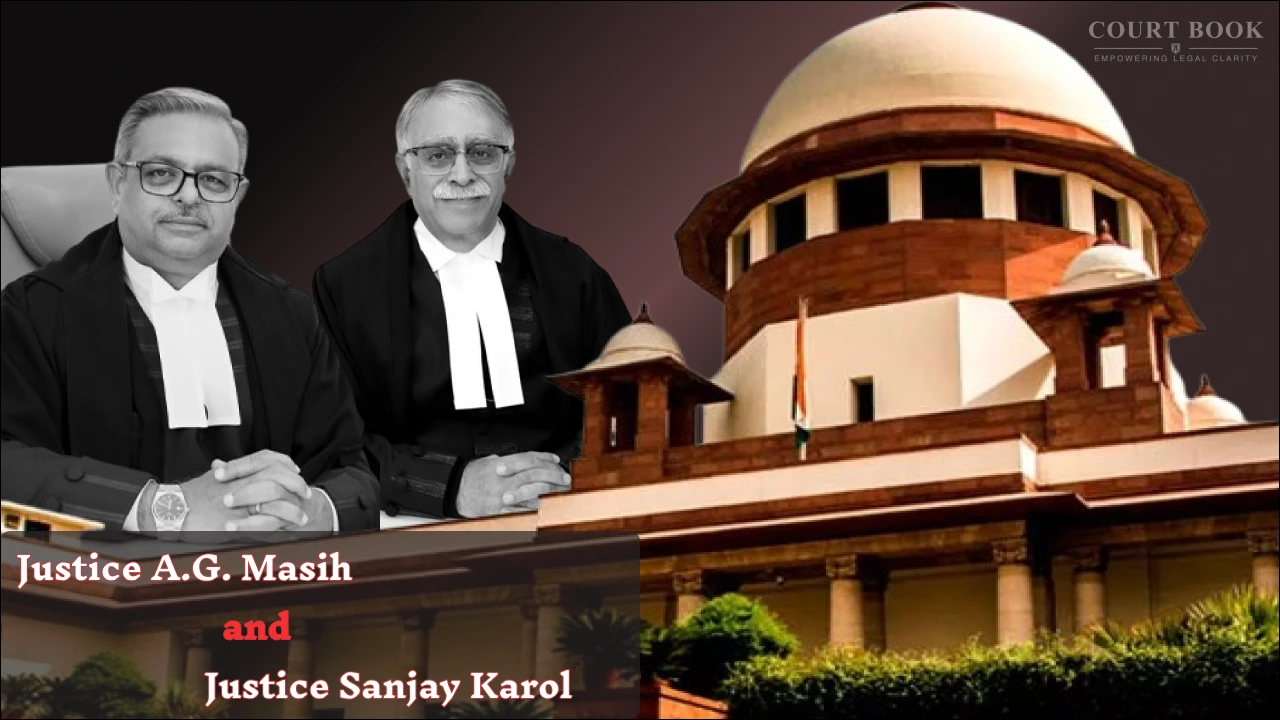
In a significant service law ruling, the Supreme Court has directed the Gujarat Government and the Gujarat Panchayat Service Selection Board to reappoint a group of terminated Gram Sevaks in Banaskantha district. While upholding concerns regarding their original recruitment, the Court held that equity demanded relief because the employees had served for several years without any fault on their part and vacancies were available.
Background of the Case
The dispute arose from recruitment to the post of Gram Sevak, Class III, conducted by the District Panchayat Service Selection Committee in Banaskantha. The appellants were selected, their documents were verified, and they joined service.
However, unsuccessful candidates challenged the selection process, arguing that the selected candidates possessed qualifications different from those prescribed in the recruitment advertisement. After prolonged litigation, the Gujarat High Court's Division Bench directed preparation of a fresh select list excluding the selected candidates. That decision was later upheld by the Supreme Court.
Fearing termination, the employees approached the High Court seeking adjustment against existing vacant posts instead of removal from service. Their plea was rejected, leading to termination and the present appeal before the Supreme Court.
The bench of Justice Sanjay Karol and Justice Augustine George Masih noted that the employees had entered service through a recruitment process conducted by the authorities and had continued to work for several years.
Rejecting the State's argument that recruitment had since been centralized under a different authority, the Court observed:
“The change in the recruiting authority is a matter of administrative reorganisation and cannot visit its consequences upon employees who were selected, duly verified, and had rendered years of service in the interregnum.”
The Court also took note of the fact that the State did not dispute the existence of vacant Gram Sevak posts in the district. According to the bench, accommodating the employees against vacant positions would not affect any third-party rights or create an additional burden on the public exchequer.
The judges further emphasized that no allegation of misconduct or fraud had ever been made against the employees.
“Their removal at this stage would cause irreparable hardship disproportionate to any public interest sought to be served,” the Court observed.
An important factor that weighed with the Court was a later amendment to the recruitment rules. The amendment expressly recognized the educational qualification possessed by the appellants as eligible for appointment to the post of Gram Sevak.
The bench observed that it would be unfair to permanently exclude employees on the basis of a qualification that the State itself now accepts as valid.
Allowing the appeal, the Supreme Court directed the State Government and the Gujarat Panchayat Service Selection Board to adjust the appellants against existing vacant Gram Sevak posts in Banaskantha district within eight weeks.
The Court clarified that:
The adjustment will be treated as a fresh appointment.
The employees will not receive benefits of their previous service.
No claim for seniority or continuity of service will be available.
They will be placed at the bottom of the existing seniority list.
The order is confined to the peculiar facts of the case and shall not operate as a precedent.
The appeal was accordingly disposed of.
Case Details
Case Title: Kishankumar Babubhai Chamar Changecha & Others v. State of Gujarat & Others
Case Number: Civil Appeal arising out of SLP (C) No. 34123 of 2025
Judges: Justice Sanjay Karol and Justice Augustine George Masih
Decision Date: May 4, 2026


