

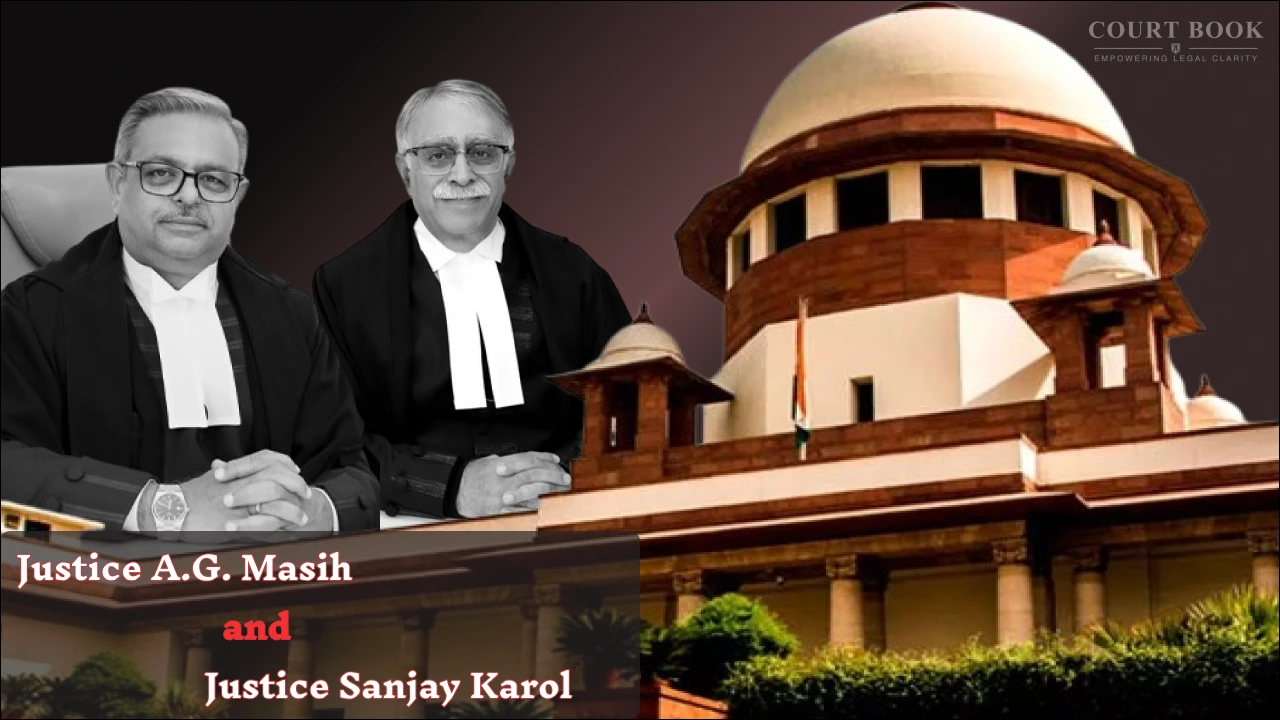
The Supreme Court set aside an FIR registered following a Bombay High Court direction, holding that statutory remedies must be exhausted before invoking constitutional powers. The Court emphasized that Article 226 cannot ordinarily be invoked when statutory remedies are available in criminal matters.
Background of the Case
The case arose from a dispute involving a Nashik-based property developed into a resort project known as “E&G Green Valley.” The complainant company alleged that certain individuals had used forged documents and impersonation to initiate a land measurement process and assert control over parts of the property.
According to the complaint, an application for property measurement was filed in April 2025 using fabricated documents. It was further alleged that during the official survey, a woman impersonated the company’s director and misled authorities.
Read also:- Allahabad High Court Slams Arbitrary Vehicle Confiscation, Orders Compensation to Owner
Parallel civil disputes between the parties regarding lease and sub-lease agreements were already pending before competent courts.
The High Court directed recording of statement and action as per law, following which an FIR came to be registered.. The complainant then approached the Bombay High Court under Article 226, seeking directions for registration of a criminal case.
On December 17, 2025, the High Court passed an interim order directing the complainant’s director to appear before the police for recording her statement and instructed that action be taken in accordance with law.
Following this, an FIR (No. 0194/2025) was registered against the appellants under multiple provisions of the Bharatiya Nyaya Sanhita, 2023.
The accused challenged this action before the Supreme Court, arguing that the FIR was a direct result of the High Court’s order and was legally unsustainable.
The Supreme Court examined whether the High Court was justified in directing action leading to FIR registration without the complainant first exhausting statutory remedies.
The bench noted that although Article 226 grants wide powers, it is discretionary and subject to self-imposed limitations.
“The extraordinary jurisdiction under Article 226 ought not to have been invoked when alternative equally efficacious remedies were available,” the Court observed.
Referring to established precedents, the Court reiterated that when a person’s grievance relates to non-registration of an FIR, the law provides a clear step-by-step mechanism.
“The remedy does not ordinarily lie in invoking writ jurisdiction in the first instance,” the bench stated,
emphasizing that approaching the Superintendent of Police or a Magistrate is the proper course.
The Court also highlighted that the complainant had not approached either the Superintendent of Police or the Magistrate before filing the writ petition.
The judgment underscored that criminal law provides a structured process:
• First, approach the police station for FIR registration
• If refused, approach the Superintendent of Police
• If still unresolved, move the Magistrate
By bypassing this mechanism and directly approaching the High Court, the complainant effectively attempted to use writ jurisdiction as a first resort.
Read also:- Andhra Pradesh High Court Dismisses Appeals Seeking Higher Land Compensation in Kadapa Case
The Court cautioned that such practices, if allowed, would undermine the statutory system.
Setting aside the High Court’s interim order, the Supreme Court quashed the FIR registered pursuant to it.
The bench held that the writ petition itself was premature and not maintainable in the absence of exhaustion of alternative remedies.
“Entertaining such a writ petition would result in bypassing the statutory scheme in its entirety,” the Court noted.
However, the Court clarified that its ruling does not express any opinion on the merits of the allegations.
Liberty was granted to the parties to pursue appropriate remedies under the law.
Case Details
Case Title: Sujal Vishwas Attavar & Anr. vs State of Maharashtra & Ors.
Case Number: Criminal Appeal arising out of SLP (Crl.) No.1088/2026 & 1133/2026
Judge: Justice Sanjay Karol and Justice Augustine George Masih
Decision Date: May 4, 2026
Download Judgment

