

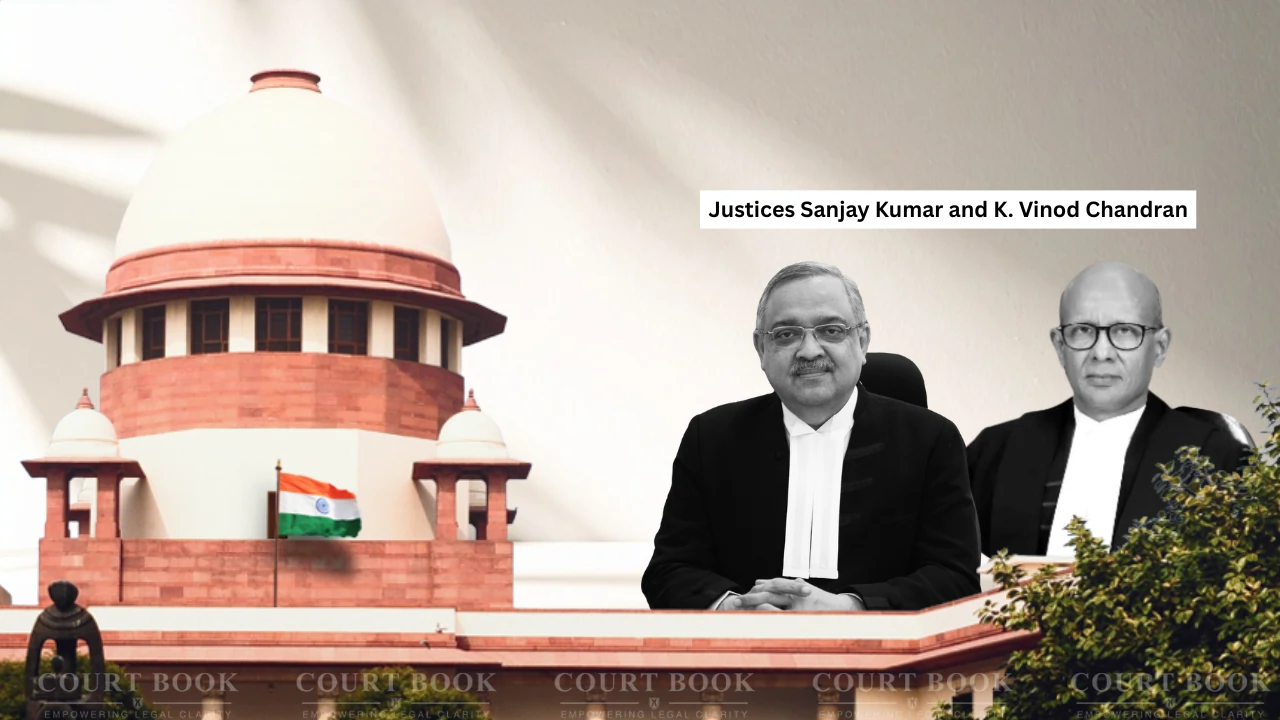
In a significant ruling on procedural safeguards, the Supreme Court set aside an FIR registered under the Uttar Pradesh Gangsters and Anti-Social Activities (Prevention) Act, 1986, holding that mandatory legal requirements were not followed while preparing the Gang Chart.
The case involved an appeal filed by Gabbar Singh alias Devendra Pratap Singh, who had challenged the refusal of the High Court to quash the FIR.
Background of the Case
The FIR (No. 0125 of 2022), registered at Kotwali Nagar Police Station in Bahraich, accused the appellant of being part of a gang involved in serious offences such as land grabbing, extortion, cheating, and criminal intimidation.
The prosecution relied heavily on a “Gang Chart” - a document required under the 1986 Act and the 2021 Rules - to justify invoking stringent provisions of the law.
Earlier, the High Court had refused to interfere, noting that multiple criminal cases were pending against the accused and finding a prima facie case.
Senior counsel for the appellant argued that the Gang Chart accompanying the FIR did not comply with the mandatory procedure prescribed under the 2021 Rules. It was pointed out that the certified copy of the Gang Chart lacked signatures and recommendations from key authorities.
On the other hand, the State contended that the original Gang Chart had been duly signed by the concerned officials at different stages and that procedural compliance had been met.
The bench examined whether the statutory procedure had been followed strictly, especially since the law has serious consequences for personal liberty.
The Court noted that:
• The Gang Chart must contain written recommendations from the Station House Officer and the Additional Superintendent of Police.
• It must be approved by the Superintendent of Police and the District Magistrate after a joint meeting.
• These requirements must be evident on the face of the document itself.
However, the certified Gang Chart placed before the Court lacked signatures and did not reflect compliance with these mandatory steps.
The bench observed,
“When a particular thing is to be done, it should be done in the manner stipulated… or not at all.”
It further emphasized that such safeguards are essential, especially when a law can stigmatize a person as a “gangster” and affect their liberty.
The Court found:
• No clear recommendation from the Additional Superintendent of Police in the certified document.
• No indication of a joint meeting between the District Magistrate and Superintendent of Police.
• Absence of signatures of key authorities in the version of the Gang Chart accompanying the FIR.
The Court rejected the State’s argument that procedural lapses could be overlooked, holding that strict compliance is mandatory in such cases.
Allowing the appeals, the Supreme Court set aside the High Court’s orders and quashed FIR No. 0125 of 2022 dated May 28, 2022.
The Court clarified that the quashing was based solely on procedural irregularities in the Gang Chart and would not affect the merits of other criminal cases pending against the appellant.
Case Title: Gabbar Singh @ Devendra Pratap Singh vs State of U.P. & Ors.
Case Number: Criminal Appeal arising out of SLP (Crl.) Nos. 17929–17930 of 2025
Judge: Justice K. Vinod Chandran & Justice Sanjay Kumar
Decision Date: March 20, 2026
Download Judgment

