

The Supreme Court has reduced the prison sentence of a Madhya Pradesh man convicted of using a forged land record in court proceedings, while keeping his conviction intact. The Court held that although offences involving forged documents are serious, sentencing must remain proportionate to the facts of each case.
Background of the Case
The matter dates back to September 2014 when the appellant appeared before a Judicial Magistrate in Rewa to furnish surety for an accused person. During scrutiny of the documents submitted, the Magistrate noticed irregularities in a Bhu Adhikar Rin Pustika (land rights and loan book) produced before the court.
The suspicious document was referred for inquiry, leading to registration of an FIR. Investigators alleged that the land record was forged and had been presented as a genuine document during judicial proceedings.
Following trial, the Fifth Additional Sessions Judge, Rewa, convicted the appellant under Sections 420, 467, 468 and 471 of the Indian Penal Code and sentenced him to five years' rigorous imprisonment on each count, with sentences running concurrently. The High Court later upheld the conviction and sentence.
Court’s Observations
When the matter reached the Supreme Court, the Court limited its consideration to the issue of sentence. The conviction itself was not under challenge.
The Bench acknowledged the seriousness of forgery-related offences, particularly when forged documents are used in court proceedings.
“The use of forged documents before a Court of law cannot be viewed lightly,”
the Bench observed.
However, the Court also stressed that punishment must be proportionate. It noted that the incident occurred more than a decade ago and that no material had been placed before the Court showing that the appellant was a habitual offender.
The Bench further noted that the disputed document was detected at the initial stage itself and did not ultimately result in irreversible financial or property-related consequences.
“The principle of proportionality remains central to the sentencing process,”
the Court said while examining whether the five-year sentence required modification.
Decision
Taking into account the long passage of time since 2014, the absence of criminal antecedents, and the period already spent in custody, the Supreme Court concluded that the interests of justice would be served by reducing the sentence.
The Court maintained the appellant’s conviction under Sections 420, 467, 468 and 471 IPC but reduced the substantive sentence to the period already undergone. The fine imposed by the trial court was left unchanged.
The Bench directed that the appellant be released forthwith, subject to payment of the fine if it had not already been deposited. The appeal was accordingly partly allowed.
Case Details:
Case Title: Israfil @ Pappu @ Naimuddin Khan v. State of Madhya Pradesh
Case Number: Criminal Appeal No. 3081 of 2026 (Arising out of SLP (Crl.) No. 19486 of 2025)
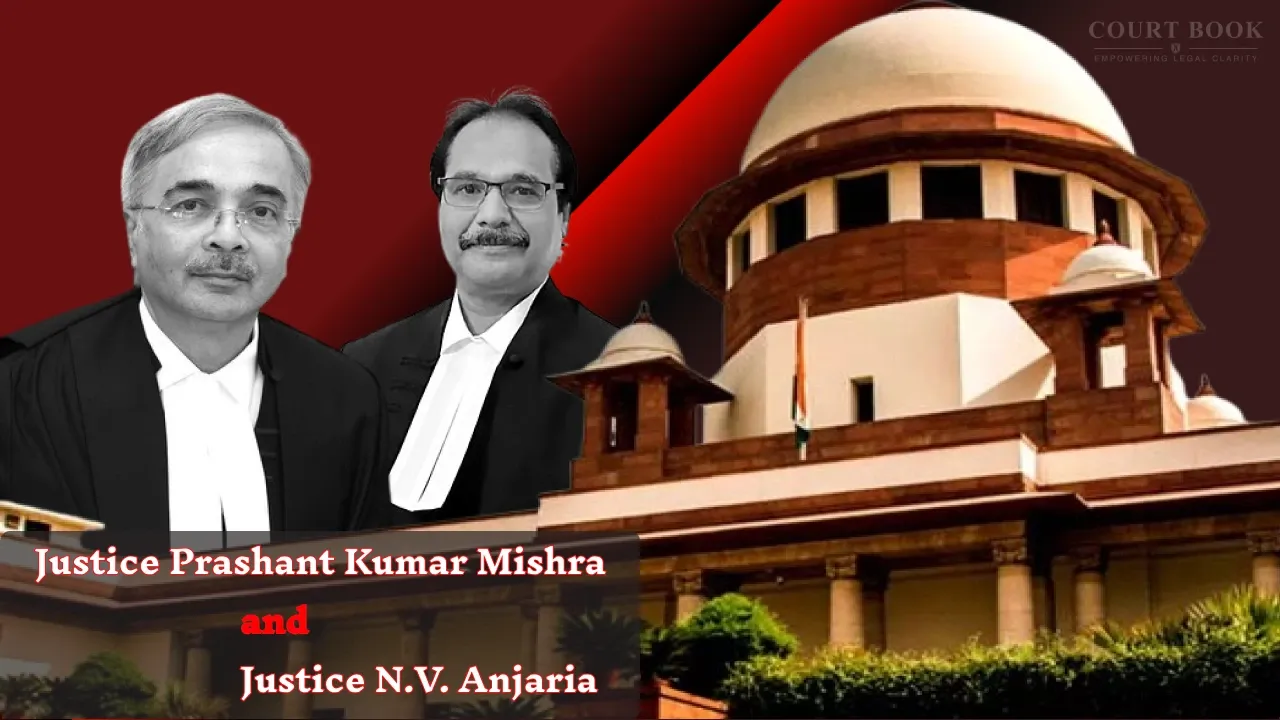
Judge: Justice Prashant Kumar Mishra and Justice N.V. Anjaria
Decision Date: June 23, 2026


