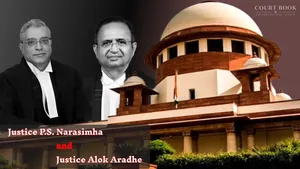
The Supreme Court has upheld the conviction of an Excise Department constable from Uttarakhand in a decades-old bribery case but reduced the sentence considering his advanced age and the circumstances of the case. The Court ruled that the findings of guilt recorded by the trial court and the High Court were legally sound and did not warrant interference.
The judgment was delivered on March 13, 2026, in the case of Raj Bahadur Singh vs State of Uttarakhand.
Background of the Case
According to the prosecution, Raj Bahadur Singh, who was serving as a constable in the Excise Department in Udham Singh Nagar district, allegedly demanded a bribe of ₹500 from a man involved in the illicit liquor trade.
The complainant, Kashmir Singh, had previously been challenged by excise officials over alleged illegal liquor activities. During a raid conducted in his village on June 16, 1990, the constable allegedly threatened him with legal action unless he paid the amount.
Feeling pressured, the complainant approached the Vigilance Department and filed a complaint on June 18, 1990. A trap was then organized by the vigilance team.
During the operation conducted at a restaurant in Khatima, the complainant handed over five ₹100 currency notes that had been treated with phenolphthalein powder. The accused allegedly accepted the money, after which officers conducted a chemical test that turned the solution pink, indicating contact with the tainted notes.
Following the trap, a case was registered under the Prevention of Corruption Act, 1988.
After investigation, a charge sheet was filed and the matter went to trial.
In March 2006, the trial court convicted the constable for offences under Section 7 and Section 13(2) of the Prevention of Corruption Act. He was sentenced to one year of rigorous imprisonment and a fine of ₹1,000, along with two years of rigorous imprisonment and a fine of ₹2,000 for the respective offences.
The accused challenged the conviction before the Uttarakhand High Court, but in April 2012 the High Court dismissed the appeal and upheld the trial court’s findings.
The constable then approached the Supreme Court.
Counsel for the appellant argued that the complainant had falsely implicated the constable due to personal hostility and in order to continue his illicit liquor business without interference.
The defence also pointed to alleged contradictions in the statements of prosecution witnesses and questioned the reliability of the independent witness involved in the trap proceedings.
It was further argued that the accused had not been given a proper opportunity to examine himself as a defence witness and that the tainted currency notes were not produced before the court.
Read also:-Calcutta High Court Enhances Compensation for Parents Who Lost Two Sons in 2015 Road Accident
The State, however, defended the conviction, submitting that the trap was carried out in accordance with law and that the testimony of the complainant and the independent witness clearly established the demand and acceptance of illegal gratification.
After examining the evidence, the Supreme Court found no reason to interfere with the findings of the lower courts.
The bench noted that the prosecution’s case relied largely on the testimony of the complainant and the shadow witness, both of whom had consistently supported the prosecution version.
“The High Court committed no error in upholding the judgment of the trial court and sustaining the conviction,” the bench observed.
The Court also rejected the argument that the independent witness was “interested,” stating that mere acquaintance with the complainant was not enough to treat the witness as biased.
It further observed that the trap proceedings and the recovery of the tainted currency notes were duly recorded, and the phenolphthalein test confirmed the acceptance of the bribe.
While affirming the conviction, the Court considered the appellant’s age and the time that had passed since the incident.
At the time of the offence in 1990, the accused was about 40 years old, but he is now approximately 75 years old. The Court also noted that he had already spent around two months and 24 days in custody during the pendency of the proceedings.
Taking these circumstances into account, the Supreme Court reduced the sentence to the minimum punishment prescribed under the law.
The Court modified the sentence to six months’ rigorous imprisonment for the offence under Section 7 of the Prevention of Corruption Act and one year’s rigorous imprisonment for the offence under Section 13(2) of the Act.
With this modification in sentence, the Court disposed of the appeal.
Case Title: Raj Bahadur Singh vs State of Uttarakhand
Case No.: Criminal Appeal No. 1105 of 2013
Decision Date: 13 March 2026
Download Judgment


-300x169.webp)
-300x169.webp)





-300x169.webp)