

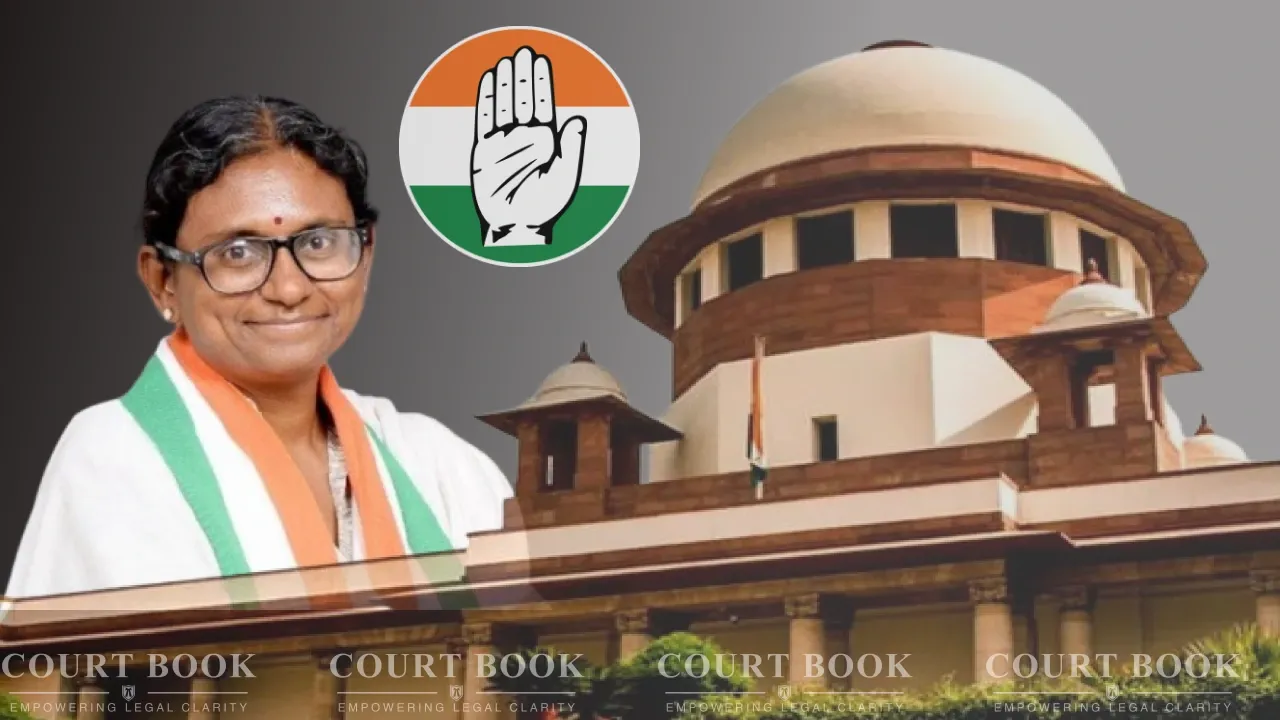
The Supreme Court on Friday (12 June) declined to entertain a petition filed by Congress leader Meenakshi Natarajan challenging the rejection of her nomination papers for the Rajya Sabha election from Madhya Pradesh. The Court held that the Constitution does not permit judicial intervention in an ongoing election process and that any challenge must be raised through an election petition after the election process is over.
A Bench of Justice Prashant Kumar Mishra and Justice A.S. Chandurkar dismissed the writ petition, holding it to be not maintainable in view of the bar contained in Article 329 of the Constitution.
Background of the Case
Meenakshi Natarajan, the Congress party’s candidate for one of the Rajya Sabha seats from Madhya Pradesh, approached the Supreme Court after the Returning Officer rejected her nomination on June 9, 2026.
The Returning Officer concluded that her Form 26 affidavit did not disclose details relating to proceedings pending before a court in Hyderabad. Based on this omission, the nomination papers were rejected.
Natarajan challenged the decision before the apex court, arguing that the rejection was legally unsustainable. According to her, the proceedings referred to in the objection had not reached a stage that required disclosure under election law. She contended that no charges had been framed against her and that the complaint remained at a preliminary stage.
Meanwhile, BJP candidates Tarun Chugh, Rajneesh Agrawal and Mahesh Kewat were declared elected unopposed after no rival nominations remained in the fray.
Arguments Before the Court
Senior Advocate Abhishek Manu Singhvi, appearing for Natarajan, argued that the Returning Officer had committed a clear legal error. He submitted that election law requires disclosure only in specific circumstances and that the proceedings relied upon by the Returning Officer did not satisfy those conditions.
He urged the Court to exercise its constitutional powers, stating that his client was merely seeking an opportunity to contest the election.
During the hearing, Singhvi remarked,
“Let her contest the election. If she loses, she loses. She is only seeking the right to participate in the democratic process.”
He also questioned the Election Commission's decision to proceed with the declaration of results while the dispute was pending before the Supreme Court.
Opposing the plea, Senior Advocate Mukul Rohatgi argued that the right to contest an election is a statutory right and not a fundamental right. Therefore, he submitted, a petition under Article 32 was not maintainable.
The respondents further contended that Article 329 creates a constitutional bar against judicial interference during an ongoing election process and that the proper remedy lies in an election petition.
Court’s Observations
The Bench emphasized that courts have consistently refrained from interfering with election processes once they are underway.
The judges observed,
“Whenever an attempt is made to invoke this Court’s or the High Court’s writ jurisdiction during the process of elections, the courts have consistently declined interference, keeping in view the mandate contained in Article 329 of the Constitution.”
The Court rejected the argument that an exception should be carved out for cases involving allegedly obvious or manifest errors in the rejection of nomination papers.
According to the Bench, creating such an exception would introduce a distinction not contemplated by the Constitution.
The judges stated that accepting such a proposition would require courts to separate election disputes into categories based on the perceived seriousness of errors, a principle not found in Article 329.
At the same time, the Court made it clear that it was not expressing any opinion on the merits of the Returning Officer’s decision. It observed that all questions regarding the legality of the nomination rejection could be raised before the appropriate forum through an election petition.
Decision
Dismissing the writ petition, the Supreme Court held that it could not exercise jurisdiction under Article 32 in light of the constitutional scheme governing election disputes.
The Bench granted liberty to Meenakshi Natarajan to pursue her challenge through an election petition under the Representation of the People Act and clarified that its observations would not prejudice any future proceedings before the competent forum.
Case Details
Case Title: Meenakshi Natarajan v. Election Commission of India
Case Number: W.P.(C) No. 766/2026 (Diary No. 36330/2026)
Judges: Justice Prashant Kumar Mishra and Justice A.S. Chandurkar
Decision Date: June 12, 2026


