

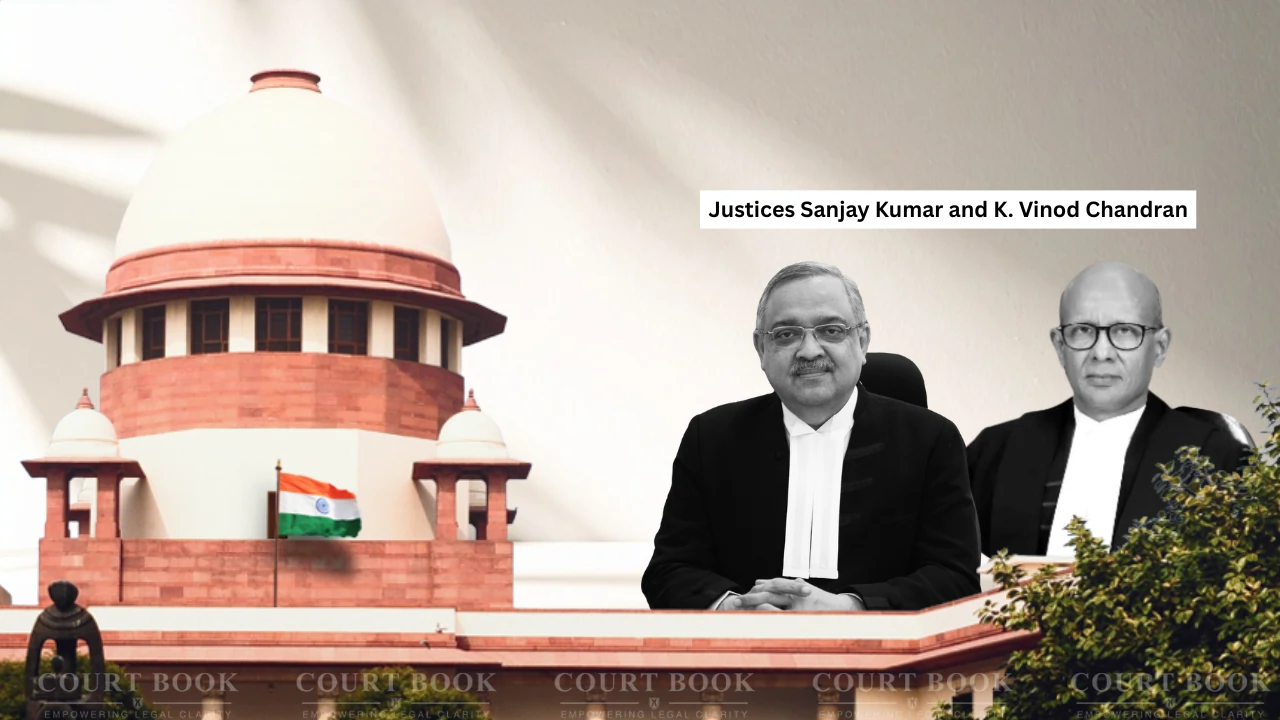
The Supreme Court has set aside a Chhattisgarh High Court order that had disqualified a construction company from a government tender process over the form of Earnest Money Deposit (EMD). The Court held that the tender conditions did not make submission of a demand draft mandatory for out-of-state bidders and observed that a fixed deposit receipt (FDR) was also an acceptable form of security.
The dispute arose from a Water Resources Department tender for the “Construction of Head Work of Lamti Feeder Minor Tank Scheme” in Chhattisgarh.
Background of the Case
The appellant, RR Constructions and Infrastructure India Pvt. Ltd., challenged the High Court ruling which had declared the company ineligible because it submitted the EMD through a fixed deposit instead of a demand draft.
Senior Advocate Amit Anand Tiwari, appearing for the company, argued before the Supreme Court that the tender document treated the demand draft option as optional and not compulsory. He also pointed out that the fixed deposit had been issued in favour of the tendering authority itself.
On the other hand, the respondents argued that the appellant had failed to disclose a later disqualification related to another stage of the tender process and contended that the appeal had become ineffective after the financial bid was opened.
Court’s Examination of Tender Conditions
The bench examined Clauses 2.13 and 2.15 of the tender document dealing with EMD requirements for out-of-state bidders. The judges noted that the clauses repeatedly used the word “may,” indicating that furnishing a demand draft was only one of the available options and not a mandatory condition.
The Court also took note of the State’s submission that authorities had earlier accepted fixed deposit receipts from out-of-state bidders in similar situations.
Referring to the tender terms, the bench observed that the appellant’s fixed deposit qualified as an “approved interest-bearing security.”
“The word ‘may’ is also employed in Clause 2.15 and hence it is only in the nature of an option and not a mandatory condition,” the Court observed.
Issue of Subsequent Disqualification
During the hearing, another issue surfaced regarding the company’s later disqualification at the stage of opening “Envelope B,” relating to pre-bid qualification certificates.
The Supreme Court clarified that it was not expressing any opinion on that later disqualification. However, it allowed the appellant to approach the tendering authority within 48 hours of the judgment being uploaded and submit its representation against that decision.
Supreme Court’s Decision
Allowing the appeal, the Supreme Court set aside the High Court judgment and restored the appellant’s qualification at the stage of opening “Envelope A” of the tender process.
The bench made it clear that its ruling was confined only to the EMD-related disqualification and did not deal with the later dispute concerning technical qualification documents.
Case Details
Case Title: RR Constructions and Infrastructure India Pvt. Ltd. v. Gayatri Ventures & Ors.
Case Number: Civil Appeal arising out of SLP (C) No. 37099 of 2025
Judges: Justice Sanjay Kumar and Justice K. Vinod Chandran
Decision Date: May 20, 2026
Download Judgment

