

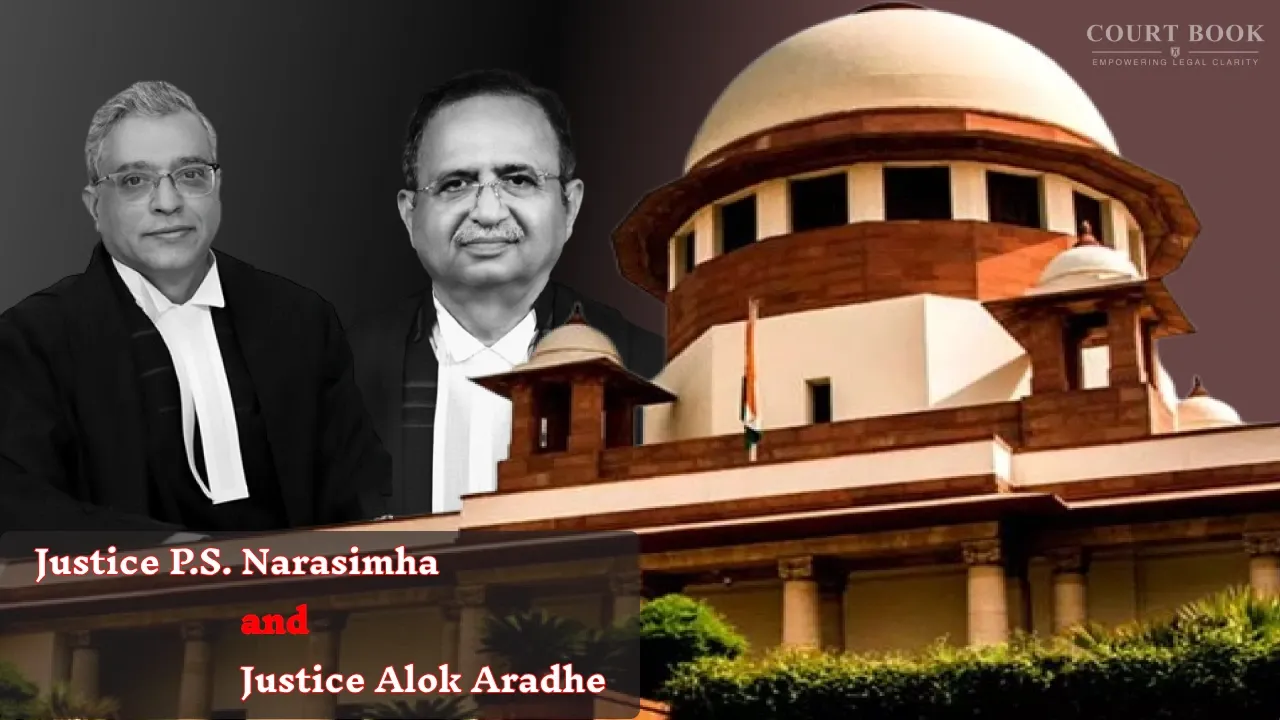
In a significant ruling on gender equality and welfare benefits, the Supreme Court has held that a married daughter cannot be excluded from consideration for allotment of a fair price shop merely because she is married. The Court allowed an appeal filed by Kulsum Nisha and directed authorities in Uttar Pradesh to allot the fair price shop to her within four weeks.
The judgment was delivered by a Bench of Justice P. S. Narasimha and Justice Alok Aradhe on June 2, 2026.
Background of the Case
Kulsum Nisha's mother was running a fair price shop in Amethi district under the Public Distribution System. After her mother's death in March 2024, Kulsum applied for allotment of the shop under the dependent quota.
However, her application was rejected by the Sub-Divisional Magistrate and later by the Deputy Commissioner. The authorities relied on a government policy that excluded married daughters from the definition of "family" for such allotments.
The Allahabad High Court's Lucknow Bench also declined relief, holding that it was bound by earlier Division Bench decisions. At the same time, the High Court acknowledged that the issue raised an important question concerning the rights of married daughters and granted a certificate for appeal to the Supreme Court.
The appellant argued that denying benefits solely because a daughter is married violates constitutional guarantees of equality and non-discrimination. It was contended that marital status has no connection with a person's dependency, financial condition, or ability to run a fair price shop.
The State of Uttar Pradesh defended the policy, arguing that married daughters generally move to their matrimonial homes and therefore form a separate category from unmarried daughters.
The Court also received assistance from Amicus Curiae Rukhmini Bobde, who submitted that dependency is a factual issue and cannot be determined solely on the basis of marital status.
Court's Observations
The Supreme Court found that the objective of the dependent quota scheme is to provide immediate financial support to the family of a deceased dealer and to ensure uninterrupted functioning of the public distribution system.
Rejecting the State's reasoning, the Bench observed:
“Marriage neither extinguishes the bond between a daughter and her parental family nor furnishes a valid basis to presume absence of dependency.”
The Court noted that many married daughters continue to live with, support, or depend upon their parents. It said dependency must be assessed on facts and cannot be presumed to disappear after marriage.
The Bench also highlighted that while a married son remains eligible, a married daughter was excluded under the policy.
In a strong observation, the Court said:
“The distinction is founded upon a gender-based stereotype that a daughter, upon marriage, becomes a member of another family and loses all ties with her natal family.”
According to the Court, such assumptions are inconsistent with the constitutional guarantees of equality and non-discrimination under Articles 14 and 15(1) of the Constitution.
Purposive Interpretation of the Rules
Instead of striking down the relevant provision, the Court adopted a purposive interpretation of the Uttar Pradesh Essential Commodities (Regulation of Sale and Distribution) Control Order, 2016.
The Bench held that the expression relating to daughters in the scheme must be read broadly to include married daughters, provided they establish dependency, satisfy local residence requirements, and fulfil all other eligibility conditions.
The Court emphasized that dependency not marital status is the governing criterion for compassionate allotment.
Decision
Applying these principles to the facts of the case, the Supreme Court noted that Kulsum Nisha continued to reside in the same village even after marriage, assisted her mother in operating the fair price shop, and had taken responsibility for her sisters, including a visually impaired sister.
The Court found that her application had been rejected solely because she was a married daughter.
Allowing the appeal, the Supreme Court set aside the orders of the Allahabad High Court, the Deputy Commissioner, and the Sub-Divisional Magistrate. It directed the competent authority to issue the allotment order in favour of Kulsum Nisha within four weeks.
The Court further held that earlier contrary decisions of the Allahabad High Court in Saida Begum and Kusumlata do not lay down the correct law.
Case Details:
Case Title: Kulsum Nisha v. State of U.P. & Ors.
Case Number: Civil Appeal No. 7667 of 2025
Judges: Justice Pamidighantam Sri Narasimha and Justice Alok Aradhe
Decision Date: June 2, 2026


