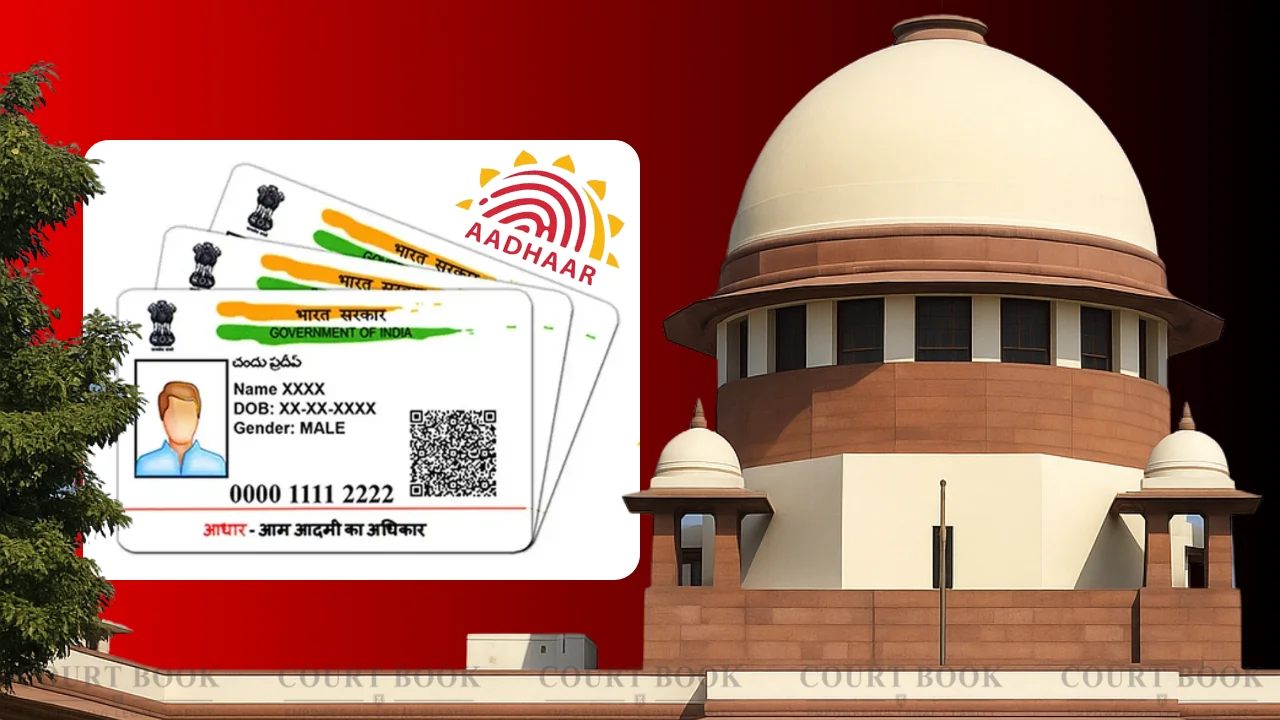
The Supreme Court on Tuesday (16 June) sought responses from the Union Government, all States and Union Territories on a petition alleging that Aadhaar cards are being used beyond their legal purpose and are being treated as proof of citizenship, domicile, residence and date of birth.
A Bench comprising Chief Justice Surya Kant and Justice V. Mohana issued notices on the plea and directed that it be tagged with similar matters already pending before the Court.
Background of the Case
The petition was filed by advocate Ashwini Kumar Upadhyay through advocate Ashwani Dubey. It seeks directions to the Centre, State Governments and the Election Commission of India to ensure that Aadhaar is used strictly as proof of identity and not as proof of citizenship, domicile, address or date of birth.
According to the plea, Section 9 of the Aadhaar Act, 2016 clearly states that Aadhaar does not serve as evidence of citizenship or domicile. The petitioner also relied on a notification issued by the Unique Identification Authority of India (UIDAI) on August 22, 2023.
The petition quoted the notification, stating that “Aadhaar is proof of identity, not of citizenship, address or date of birth.”
The petitioner argued that despite these provisions, Aadhaar continues to be accepted for several purposes, including school admissions, property transactions, birth certificates, ration cards and driving licences.
A key challenge in the petition relates to Form-6, the application form used for new voter registration.
The plea contends that Aadhaar is being accepted in the form as proof of date of birth and residence, which, according to the petitioner, is contrary to the Aadhaar Act and the Representation of the People Act, 1950.
“The Aadhaar is not only being used as a proof of age, citizenship and domicile... but also being used in Application Form for New Voter Registration (Form-6) as proof of date of birth and proof of residence,” the petition stated.
The petitioner further claimed that the existing verification mechanism is inadequate and may allow individuals without sufficient supporting documents to be included in electoral records.
Court Proceedings
During the hearing, the Bench took note of the submissions and issued notices to the Union Government as well as all States and Union Territories.
The matter has been linked with similar petitions already pending before the Supreme Court for consideration.
Apart from seeking restrictions on the use of Aadhaar, the petitioner has also asked the Court to declare the use of Aadhaar as proof of date of birth and residence in voter registration applications as contrary to statutory provisions and constitutional guarantees.
The plea additionally seeks reforms in the electoral verification framework and proposes the creation of a monitoring committee comprising a retired Supreme Court judge, cybersecurity experts and forensic specialists.
Decision
The Supreme Court issued notice to the Centre, States and Union Territories on the petition and tagged the matter with connected pending cases for further hearing.
Case Details:
Case Title: Ashwini Kumar Upadhyay v. Union of India
Case Number: W.P.(C) No. 654/2026 (Diary No. 30016/2026)
Judge: Chief Justice Surya Kant and Justice V. Mohana
Decision Date: June 16, 2026





 chief. Eknath Shinde – Shiv Sena leader-300x169.webp)
-300x169.webp)

-300x169.webp)