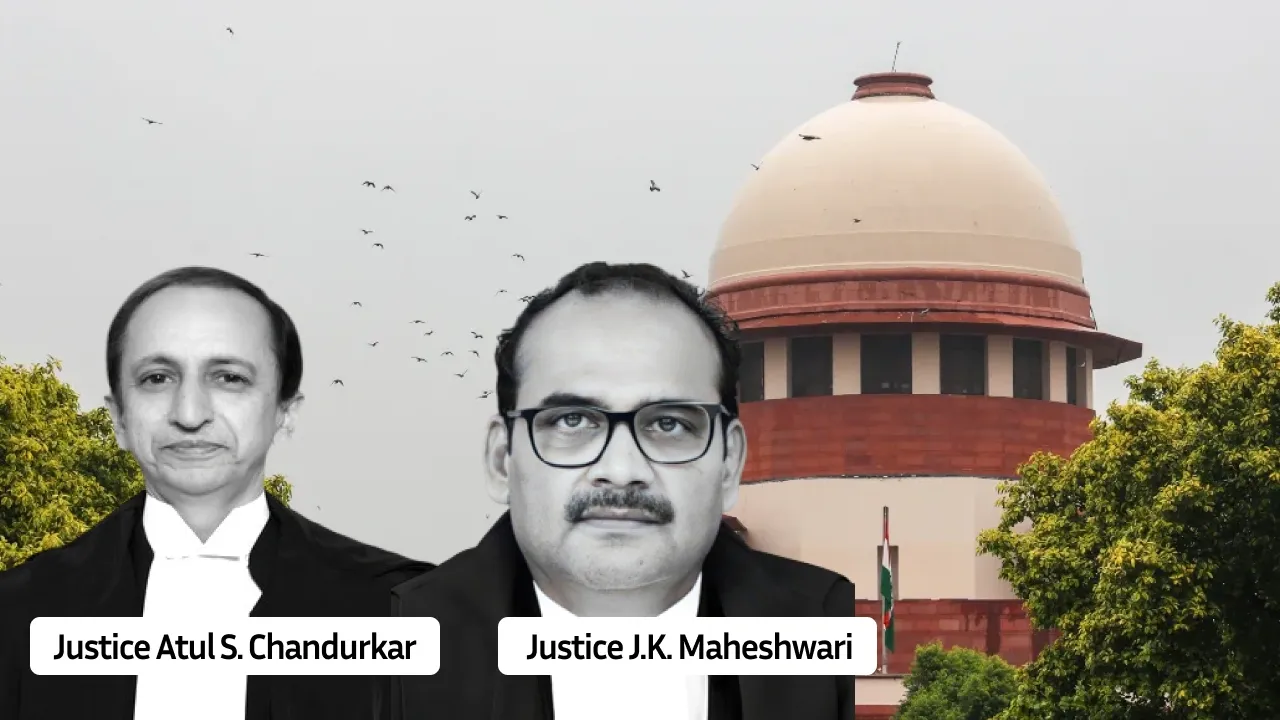
In a significant ruling on transparency and access to information, the Supreme Court on June 15 held that the Madhya Pradesh Special Police Establishment (SPE) functioning under the Lokayukt cannot claim exemption from the Right to Information (RTI) Act merely by virtue of a state government notification.
A Bench of Justice J.K. Maheshwari and Justice Atul S. Chandurkar dismissed an appeal filed by the Special Police Establishment and upheld a Madhya Pradesh High Court order directing disclosure of information sought by a public servant facing corruption-related prosecution.
Background of the Case
The dispute arose after Kamta Prasad Mishra, then serving as a Town Inspector in Katni district, sought information under the RTI Act regarding the process through which sanction for his prosecution under the Prevention of Corruption Act had been granted.
Mishra had been named in a trap case registered by the SPE in April 2017. The State Government granted prosecution sanction in May 2020. Seeking details of the decision-making process and related communications, he filed an RTI application on July 1, 2020.
His request was rejected by authorities and later by the State Information Commission, which relied on Section 8(1)(h) of the RTI Act. That provision allows withholding information if disclosure could impede an investigation or prosecution.
However, the Madhya Pradesh High Court found that the investigation had already been completed and directed the authorities to provide the information. The SPE then approached the Supreme Court.
Before the Supreme Court, the SPE relied heavily on a 2011 notification issued by the Madhya Pradesh Government under Section 24(4) of the RTI Act.
The notification stated that the RTI Act would not apply to cases being investigated by the Lokayukt's Special Police Establishment and the State Bureau of Investigation of Economic Offences.
During the hearing, the Bench questioned whether the SPE could legally be treated as an “intelligence and security organisation,” a requirement for exemption under Section 24(4).
The court noted that organisations protected under Section 24 are generally involved in intelligence gathering, national security, border protection, or similar functions.
Court’s Observations
After reviewing the statutory framework governing the Lokayukt and the SPE, the Bench found that the agency's role is limited to investigating corruption-related offences and certain offences involving public servants.
“The SPE cannot be termed to be an ‘intelligence and security’ organisation for the purposes of Section 24(4) of the Act of 2005,” the Bench observed.
The court pointed out that the Lokayukt system was established to investigate allegations of corruption and misconduct against public servants, not to perform intelligence or security functions.
Rejecting the State's argument of “institutional parity” with agencies listed in the RTI Act's Second Schedule, the Bench held that the nature and functions of those organisations were fundamentally different.
The judges further observed that subordinate legislation, such as government notifications, must remain within the limits of the parent statute. If a notification goes beyond the authority granted by law, courts are empowered to invalidate it.
Decision
The Supreme Court held that the 25 August 2011 notification, insofar as it exempted the Madhya Pradesh Special Police Establishment from the RTI Act, was inconsistent with Section 24(4) and therefore unsustainable in law.
“The Notification dated 25.08.2011 does not conform to Section 24(4) of the Act of 2005 and is, thus, excessive in nature,” the Bench said.
Accordingly, the court struck down the notification to the extent it excluded the SPE from the RTI Act and affirmed the Madhya Pradesh High Court's direction requiring disclosure of the information sought by Mishra.
The Bench clarified that it had not examined the validity of the notification concerning the State Bureau of Investigation of Economic Offences, and the notification would continue to operate for that agency.
With these findings, the Supreme Court dismissed the criminal appeal and disposed of all pending applications.
Case Details:
Case Title: Special Police Establishment v. Kamta Prasad Mishra & Others
Case Number: Criminal Appeal No. 3743 of 2024
Bench: Justice J.K. Maheshwari and Justice Atul S. Chandurkar
Decision Date: June 15, 2026




-300x169.webp)
-300x169.webp)

-300x169.webp)