

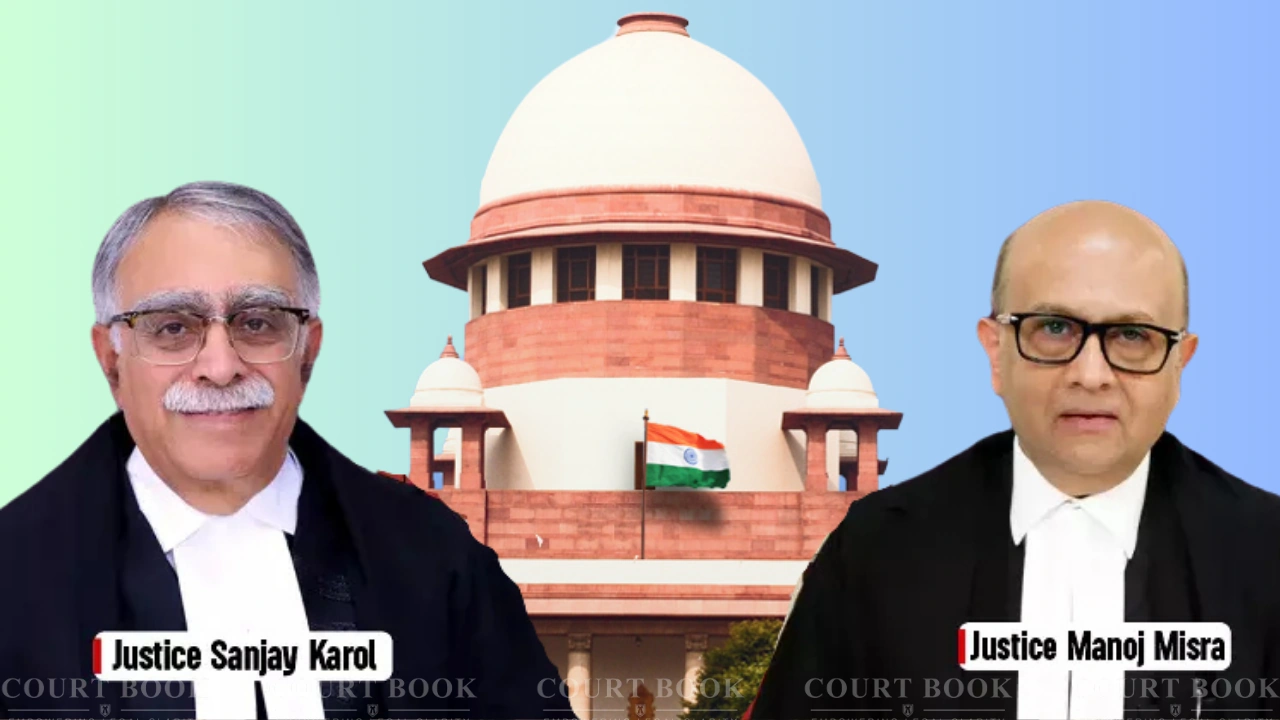
In a significant ruling on disciplinary proceedings, the Supreme Court has set aside the dismissal of an employee of the U.P. Cooperative Federation, holding that failure to conduct a proper oral inquiry violates principles of natural justice.
Background of the Case
The case arose from disciplinary action taken against Jai Prakash Saini, an employee posted as an in-charge at a paddy procurement centre. He was accused of financial irregularities, including alleged short delivery of paddy and misappropriation of funds.
Following an internal inquiry, the Federation dismissed him from service and ordered recovery of over ₹9.5 lakh. His challenge before the Allahabad High Court (Lucknow Bench) was unsuccessful, prompting him to approach the Supreme Court.
Counsel for the appellant argued that the entire inquiry process was flawed. It was submitted that:
• No oral hearing was properly conducted
• No witnesses were examined to prove the charges
• The employee was denied a fair opportunity to defend himself
On the other hand, the Federation contended that sufficient material existed on record and that the employee’s replies were evasive, which, according to them, amounted to admission of charges.
The bench carefully examined the record and rejected the Federation’s justification.
“The departmental charge-sheet is not a plaint… an evasive reply cannot be treated as an admission of guilt,” the Court observed.
The Court emphasized that when charges are denied, it becomes mandatory for the employer to prove them through evidence. This includes examining witnesses and allowing cross-examination.
It further noted that even in cases relying on documents, those documents must be proved through witnesses unless expressly admitted.
Crucially, the Court recorded that the Federation itself admitted that no witness had been examined during the inquiry.
Referring to established legal principles, the Court reiterated that a valid disciplinary inquiry must include:
• Clear communication of charges
• Examination of witnesses
• Opportunity to cross-examine
• Right to present defence evidence
“In the present case… the department had not produced any witness… even though the charges were denied,” the bench noted, concluding that the inquiry stood vitiated.
Allowing the appeal, the Supreme Court set aside:
• The High Court’s judgment
• The dismissal order
• The recovery direction
The Court granted liberty to the Federation to conduct a fresh (de novo) inquiry within six months, if it chooses.
It also clarified that:
• If no fresh inquiry is initiated, the employee will be entitled to reinstatement with continuity of service and arrears (subject to adjustments).
• If a fresh inquiry is conducted, the employee must be reinstated and may be placed under suspension as per rules during the process.
No order as to costs was passed.
Case Details
Case Title: Jai Prakash Saini vs Managing Director, U.P. Cooperative Federation Ltd. & Ors.
Case Number: Civil Appeal arising out of SLP (C) No. 2900/2020
Judge: Justice Manoj Misra (with Justice Sanjay Karol)
Decision Date: April 1, 2026
Download Judgment

