

The Supreme Court of India has quashed criminal proceedings against a woman accused in a land dispute case from Haryana, observing that the matter was essentially civil in nature and did not disclose any criminal intent on her part.
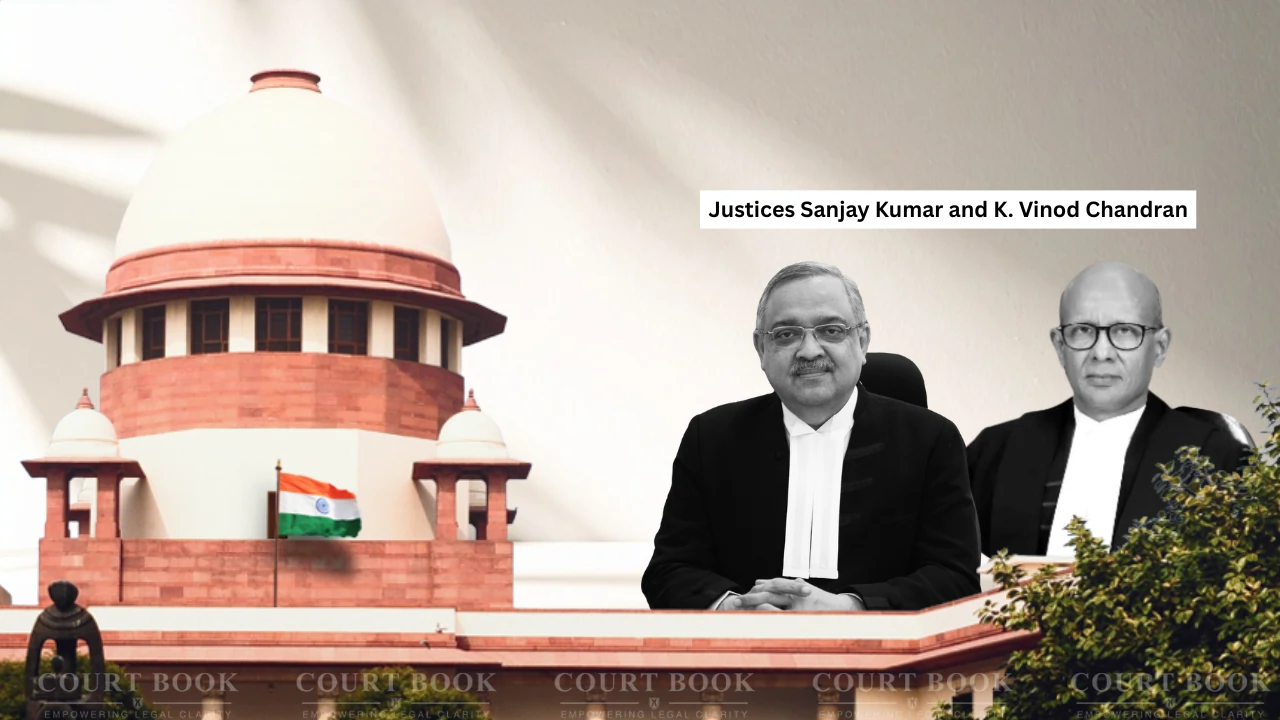
A bench of Justice Sanjay Kumar and Justice K. Vinod Chandran passed the order while allowing an appeal filed by Sunisha Anand.
Background of the Case
The case arose from FIR No. 588 dated June 2, 2018, registered at Faridabad Central Police Station. The allegations related to execution of General Power of Attorneys (GPAs) and subsequent sale transactions involving disputed land.
According to the prosecution, forged GPAs were allegedly used in land transfers despite knowledge that part of the land had already been transferred to the State of Uttar Pradesh. The Punjab and Haryana High Court had earlier refused to interfere, saying the allegations disclosed criminal elements.
Before the Supreme Court, senior advocate Siddharth Luthra argued that although Sunisha Anand’s name appeared in the original FIR, she was not initially made an accused. He contended that she was later added through a supplementary FIR without any fresh evidence emerging during investigation.
The Haryana government opposed the plea and submitted that her role became clear during investigation, justifying her inclusion as an accused.
Court’s Observations
The Supreme Court closely examined the allegations and found that the dispute largely revolved around property rights and title claims.
The bench noted that the appellant had inherited rights in the property after the death of her father, Onkar Singh. The Court also observed that the allegations mainly concerned execution of GPAs and sale deeds by family members claiming ownership over the land.
Importantly, the judges questioned how the GPAs could be described as fake when the prosecution itself alleged that they had been executed by the mother and daughter concerned.
“The GPA can be termed as fake or fraudulent” only if there was material showing criminal fabrication, the bench indicated while finding no such evidence on record.
The Court further observed that even if the sellers had transferred more land than what they legally owned, that by itself would not automatically attract criminal liability in the facts of the case.
The judges also took note of the pending civil suit between the parties and said the complainant appeared to be using criminal proceedings in a property dispute already before a civil court.
“Criminal law cannot be used to further the cause in a purely civil dispute,” the bench observed.
Decision
Allowing the appeal, the Supreme Court quashed FIR No. 588 of 2018 against Sunisha Anand, holding that the allegations in the FIR did not disclose criminality against her.
The Court clarified that the FIR would stand quashed only insofar as the appellant was concerned. Pending applications, if any, were also disposed of.
Case Details
Case Title: Sunisha Anand v. State of Haryana & Anr.
Case Number: Criminal Appeal No. 2457 of 2026
Judges: Justice Sanjay Kumar and Justice K. Vinod Chandran
Decision Date: May 11, 2026
Download Order

