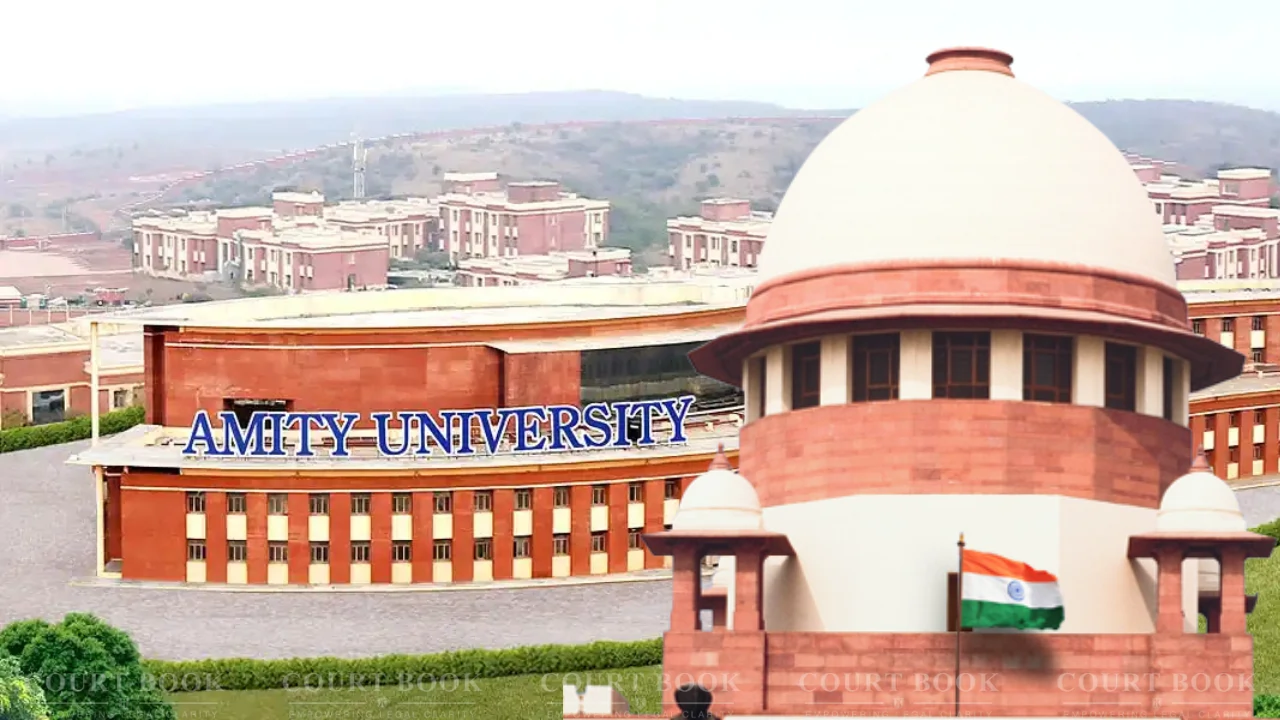
The Supreme Court on Thursday (08-01-2026) expressed clear displeasure over the Union government’s failure to follow its earlier direction on filing affidavits in a writ petition involving Amity University, Noida.
Hearing W.P. (Civil) No. 531/2025, a Special Bench of Justice Ahsanuddin Amanullah and Justice N.V. Anjaria noted that an affidavit which was required to be personally affirmed by the Cabinet Secretary was instead filed by a senior official from the Ministry of Education.
Background of the Case
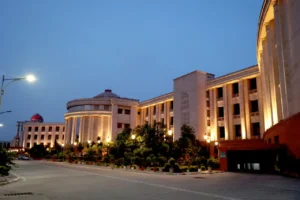
The petition has been filed by Ayesha Jain against Amity University, Noida and others. The matter has also brought in multiple government authorities, including the Union of India, the University Grants Commission (UGC), and all States and Union Territories, as respondents.
Earlier, on 20 November 2025, the Supreme Court had issued a strict compliance order. It directed that:
• The Cabinet Secretary (for the Government of India),
• The Chief Secretaries (for all States/UTs), and
• The UGC Chairman
must personally obtain information and file affidavits themselves, without delegating the task to anyone else.
Read also:-Bombay High Court Sets Aside ₹20,000 Maintenance Order, Flags Gaps in Wife’s Income Disclosure
What Happened in Court on January 8
When the matter was taken up on 8 January 2026, Solicitor General Tushar Mehta informed the court that he was appearing for both the Union of India (R-4) and the UGC (R-3).
However, the Bench immediately flagged a major issue:
the Union’s affidavit had not been filed by the Cabinet Secretary, despite the court’s earlier clear direction.Court’s Observations
The Bench made it plain that it was not impressed with the explanation offered.
It reminded everyone of the wording of its earlier order, stressing that there should be “no delegation” and that the responsibility of every disclosure would rest with the person signing the affidavit.
In a strong remark, the court noted its surprise at the situation, saying it was “quite surprised” that the Cabinet Secretary appeared to be under a misconception despite the categorical order.
Read also:- Jharkhand High Court Upholds Divorce, Grants ₹35,000 Monthly Maintenance to Wife and Daughter
The Solicitor General submitted that the affidavit filed by the Secretary, Department of Higher Education, had included a request for exemption from the Cabinet Secretary’s personal filing.
But the Bench was quick to underline that such a request could not be made casually through another officer. As the court put it, if there was any “technical” difficulty, the Cabinet Secretary should have approached the court properly-either through his own affidavit or by filing a suitable application.
Union Government’s Stand
Answering the court’s query on why the proper application was not moved in time, the Solicitor General fairly admitted it may have happened due to “inadvertence” or “misconception.”
The Bench recorded the Solicitor General’s statement that a specific affidavit/application would now be filed by the Cabinet Secretary seeking exemption and/or permission to delegate filings to the concerned Secretary.
Read also:- General Allegations Can’t Prove Cruelty Where In-Laws Never Lived With Complainant: Patna High
Compliance Status of States and UTs
The Supreme Court also reviewed whether States and Union Territories had complied with the November 2025 directions.
It noted three categories:
(i) States/UTs that complied and filed affidavits:
Assam, Arunachal Pradesh, Haryana, Karnataka, Jharkhand, Manipur, Meghalaya, Punjab, Nagaland, Uttar Pradesh, Tripura, Sikkim.(ii) States/UTs where lawyers appeared but affidavits were not filed:
Andhra Pradesh, Bihar, Chhattisgarh, Himachal Pradesh, Kerala, Madhya Pradesh, Odisha, Rajasthan, Goa, Mizoram, Tamil Nadu, Telangana, UT Puducherry, UT Jammu & Kashmir, West Bengal.(iii) States/UTs with no appearance and no affidavits:
Gujarat, Maharashtra, Uttarakhand, UT Andaman & Nicobar, UT Dadra & Nagar Haveli and Daman & Diu, NCT Delhi, UT Ladakh, UT Lakshadweep, UT Chandigarh.Read also:- Supreme Court Revives Landowners’ Compensation Challenges After Punjab & Haryana HC Ruling
Court Issues Notices and Warns of Action
For the States and UTs in Category (ii), the court directed that notice be issued to the concerned Chief Secretaries, asking why action should not be taken for failing to file affidavits and not even seeking exemption or more time.
For Category (iii), the Bench took an even tougher line and issued notice asking why contempt proceedings should not be initiated against the Chief Secretaries for violating the earlier order and not ensuring representation in court.
After the order was dictated in open court, counsel for the State of Madhya Pradesh requested permission to file its affidavit the same day. The Bench accepted the request.
The court then extended similar relief to other Category (ii) States/UTs, stating that if compliant affidavits were filed that day, their Chief Secretaries would not need to respond to the notice mentioned in Paragraph 10 of the order.
The court also recorded that Arunachal Pradesh had filed an affidavit, but it was not affirmed by the Chief Secretary. The Bench directed the Chief Secretary to explain why a personally affirmed affidavit was not filed despite the specific order.
Read also:- Misuse of Lawyer’s Identity: Delhi High Court Protects Senior Advocate Vikas Pahwa
Court’s Decision
The Supreme Court:
• Permitted the Cabinet Secretary to file an appropriate affidavit/application,
• Allowed the Union government to file fresh/further affidavits personally affirmed by the concerned Secretaries within two weeks,
• Issued notices to defaulting Chief Secretaries, including potential contempt notices for those with no appearance and no affidavit, and
• Directed the matter to be listed again on 28 January 2026 at 3 PM, as part-heard.
Case Title: Ayesha Jain vs Amity University, Noida & Ors.
Case No.: W.P. (Civil) No. 531/2025
Decision Date: 08-01-2026
Download Order


 chief. Eknath Shinde – Shiv Sena leader-300x169.webp)
-300x169.webp)