

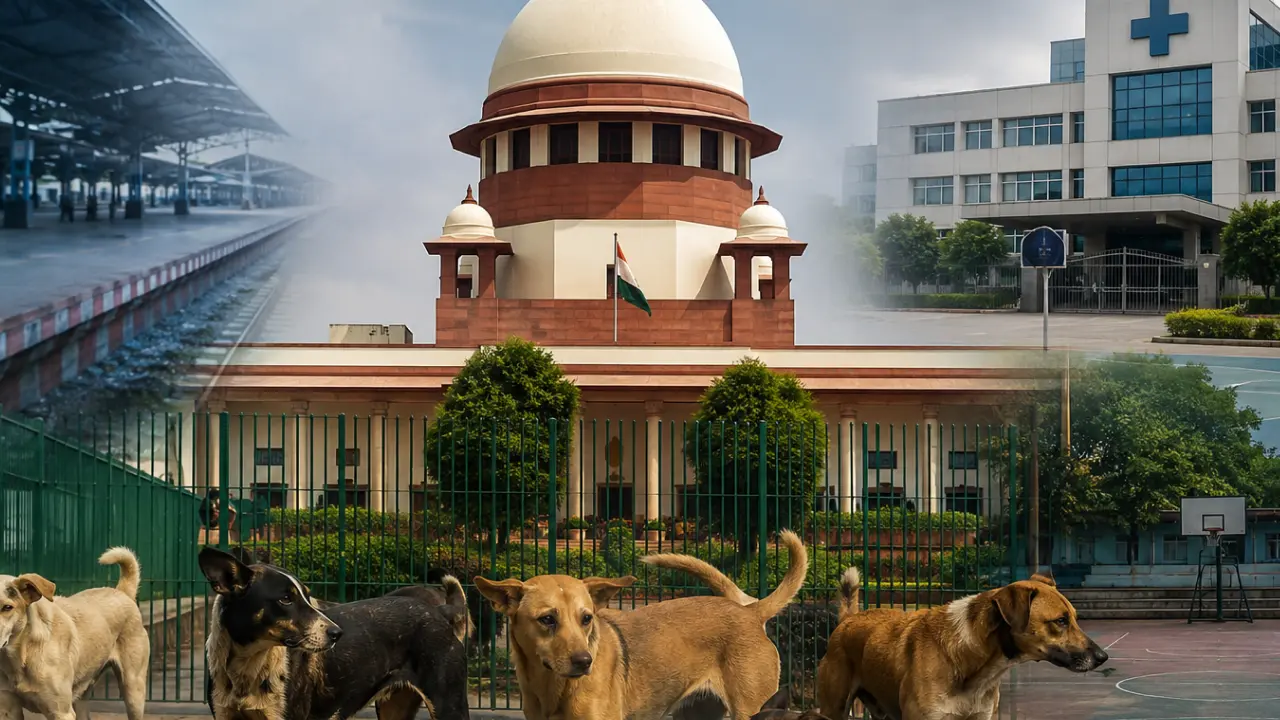
The Supreme Court of India, in a landmark judgment delivered on May 19, 2026, upheld sweeping pan-India directions for clearing stray dogs from institutional premises, ordered at least one Animal Birth Control Centre per district, and permitted euthanasia of rabid or dangerously aggressive dogs under strict conditions.
Background
The case began as a suo motu writ petition taken up by the Supreme Court on the basis of alarming media reports under the headline "City Hounded by Strays, Kids Pay Price." Over successive hearings in 2025, the Court issued a series of escalating directions - on August 11, August 22, and finally November 7, 2025 - that formed the bedrock of this landmark ruling.
The November 7, 2025 order had directed municipal authorities across India to immediately remove all stray dogs from the premises of educational institutions, hospitals, sports complexes, bus stands, and railway stations, and shift them to designated shelters after sterilisation and vaccination. Critically, it barred re-release of such dogs back to the same institutional locations.
A large number of interlocutory applications followed - from animal welfare groups, associations, and individuals - challenging these directions as being in conflict with the Animal Birth Control (ABC) Rules, 2023, which mandate re-release of sterilised dogs to the same locality. At the same time, other applicants supported the directions and sought their expansion to parks, gated housing societies, and other public areas.
The three-judge bench of Justice Vikram Nath, Justice Sandeep Mehta, and Justice N.V. Anjaria addressed all these applications through the present comprehensive judgment (2026 INSC 506).
What the Supreme Court Said and Ordered
On the ABC Rules vs. Court Directions Conflict
The Court decisively rejected the argument that its November 2025 directions violated Rule 11(19) of the ABC Rules, 2023 - the provision requiring sterilised dogs to be released back to the same locality.
The Court held that institutional spaces such as schools, hospitals, sports stadiums, bus depots, and railway stations cannot be treated as "streets" or "localities" within the meaning of the Prevention of Cruelty to Animals Act, 1960. Reading Rule 11(19) alongside Section 2(i) of the PCA Act - which defines "street" as roads, lanes, passages, and publicly accessible open spaces - the Court concluded that the Court held that the expression ‘same place or locality’ under Rule 11(19) could not be extended to restricted-access institutional premises.
The Court held that such an interpretation would disregard the statutory context and undermine public safety in sensitive institutional spaces.
On Article 21 and Human Life vs. Animal Welfare
The Court delivered a clear constitutional declaration: when the safety and lives of human beings are weighed against the welfare interests of animals, the balance must "necessarily and unequivocally tilt in favour of the preservation and protection of human life."
The Court recorded submissions that India’s stray dog population had risen from approximately 2.5 crore in the early 2000s to nearly 8 crore today, making India the country with the highest number of dog-bite incidents and rabies-related fatalities globally. Karnataka alone reported over 2 lakh dog-bite cases and 25 rabies deaths in just the first four months of 2026.
The Court observed that if this situation is allowed to continue unchecked, civic life could regress to a state where "the Darwinian theory of survival of the fittest effectively governs public spaces," which would be wholly incompatible with a constitutional democracy.
Upholding the AWBI Standard Operating Procedures
he Court examined challenges to the Standard Operating Procedures (SOPs) issued by the Animal Welfare Board of India (AWBI) on November 27, 2025. Applicants had argued the SOPs went beyond the Court's directions by extending coverage to religious places, parks, airports, and tourist sites.
The Court disagreed, holding that the November 2025 directions were never meant to be an exhaustive list. What mattered was the functional character of a space - whether it attracts substantial public congregation and vulnerable populations - rather than its precise nomenclature. The SOPs were upheld in their entirety.
Fresh Directions Issued by the Court
The Supreme Court issued a new set of binding directions applicable to all States, Union Territories, and the NHAI:
• One ABC Centre per district: Every district must have at least one fully functional Animal Birth Control Centre with trained veterinary staff, surgical facilities, and logistics support. The Court directed States to create additional institutional mechanisms commensurate with local requirements.
• Anti-rabies vaccines: All government hospitals must maintain a mandatory and uninterrupted stock of anti-rabies vaccines and immunoglobulin.
• Euthanasia permitted: In areas where dog-bite incidents have become frequent and stray dog populations have grown to alarming levels, authorities may - after assessment by qualified veterinary experts - resort to euthanasia of rabid, incurably ill, or demonstrably dangerous dogs, strictly in accordance with the PCA Act and ABC Rules.
• Protection for implementing officers: Officers and officials who carry out stray dog removal and other compliance actions in good faith shall not ordinarily face FIRs or criminal complaints. Any such proceedings will require a prima facie showing of malice, gross abuse, or action entirely outside the Court's directions.
• NHAI's responsibility: The National Highways Authority of India was firmly told it cannot pass the buck entirely to State Governments for clearing stray cattle from National Highways. NHAI must deploy specialised transport vehicles, create holding and shelter infrastructure, and enter arrangements with animal welfare organisations and gaushalas for handling stray animals on highways.
Monitoring Transferred to High Courts
In a significant structural direction, the Supreme Court transferred day-to-day monitoring of compliance to all High Courts across the country. Each High Court is directed to register a suo motu writ petition titled "In Re: Compliance with the directions issued by the Supreme Court in Suo Motu Writ Petition (Civil) No(s). 5 of 2025" as a continuing mandamus before a Division Bench.
All States and Union Territories must file updated compliance affidavits before their respective High Courts by August 7, 2026. The High Courts must compile and send a consolidated compliance report to the Supreme Court every four months, with the first report due before November 17, 2026 - the next date of hearing before the Supreme Court.
Officials who continue to fail in compliance may face contempt proceedings before the jurisdictional High Court.
This ruling draws a firm constitutional line: public safety under Article 21 overrides the statutory presumption of re-release under the ABC framework, at least within institutional and high-footfall public spaces. By decentralising monitoring to High Courts while retaining supervisory jurisdiction, the Supreme Court has built in a layered accountability mechanism covering every state and union territory simultaneously.
The direction on euthanasia of dangerous dogs, while carefully circumscribed, signals judicial openness toward measures beyond the traditional Capture-Sterilise-Vaccinate-Release model in exceptional circumstances..
Case Title: In Re: “City Hounded by Strays, Kids Pay Price” with connected matters
Download Judgment

