

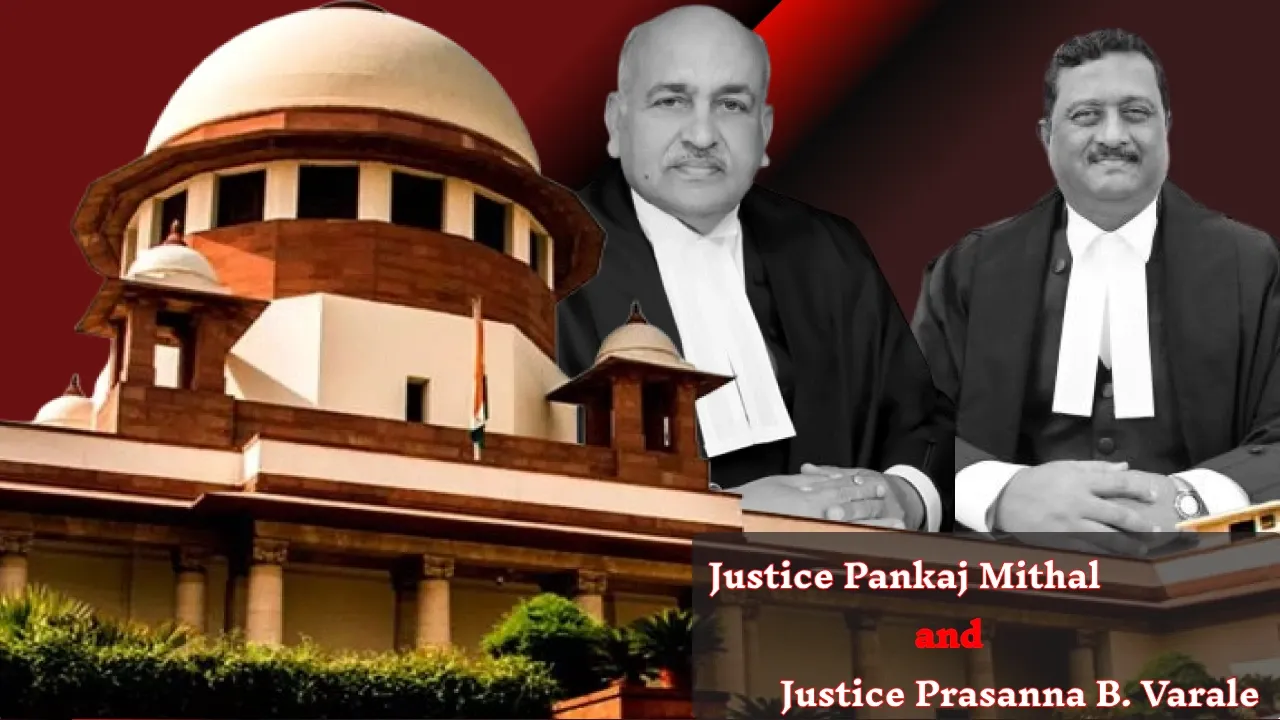
The Supreme Court has upheld the conviction of a man accused in the 2002 murder of four members of a family in Madhya Pradesh’s Satna district, holding that the recovery of material evidence at his instance formed an important link in the chain of circumstances.
A Bench of Justice Pankaj Mithal and Justice Prasanna B. Varale dismissed the criminal appeal filed by Upendra Khare, who had challenged the Madhya Pradesh High Court judgment affirming his conviction in the case.
Background of the Case
According to the prosecution, police received information on July 20, 2002, that Rajesh Shukla and his family members could not be contacted. When relatives reached the house, they allegedly found Rajesh Shukla, his wife Madhu Shukla, son Prabhanshu Shukla and sister Vinita Shukla dead with injuries.
During investigation, police claimed jewellery was missing from the house and alleged that multiple accused had entered the residence armed with weapons. The prosecution alleged that the victims were first administered Calmpose injections and were later attacked with sharp weapons.
The trial court convicted Upendra Khare under Section 302 IPC and sentenced him to life imprisonment. The High Court later upheld the conviction.
Appearing for the appellant, counsel argued that the prosecution case rested entirely on circumstantial evidence and that the chain of circumstances was incomplete. It was submitted that no motive was attributed directly to the appellant and that no weapon or stolen property had been recovered from him.
The defence also questioned the recovery proceedings, arguing that the independent witnesses to the seizure had turned hostile and that the alleged recoveries were made nearly two months after the incident. It was further argued that the investigation itself was faulty.
On the other hand, the State contended that the prosecution had successfully established the case through circumstantial evidence and that recovery evidence could still be relied upon even if panch witnesses turned hostile.
The Supreme Court noted that the prosecution case was based on circumstantial evidence but observed that the recovery of certain articles at the instance of the appellant constituted an important circumstance against him.
The Bench referred to medical evidence and postmortem findings which showed that the deaths were caused due to excessive blood loss from injuries inflicted on vital parts of the body. The Court also noted that traces of Calmpose injection were found during examination and the viscera report indicated the presence of Diazepam.
Rejecting the appellant’s argument regarding hostile seizure witnesses, the Bench observed that recovery evidence does not automatically become unreliable merely because panch witnesses fail to support the prosecution.
“The evidence of the investigating officer can be relied upon to prove the recovery even when the panch witnesses turned hostile,” the Court noted while referring to earlier Supreme Court precedents.
The Court, however, also remarked that the investigation “was not up to the mark” and said the investigating agency ought to have acted with greater sensitivity considering that four persons had lost their lives. Still, it held that deficiencies in investigation alone could not be a reason to discard material evidence placed by the prosecution.
Dismissing the appeal, the Supreme Court held that the trial court as well as the High Court had properly appreciated the evidence on record.
“We see no reason to show any interference in both the judgments,” the Bench stated while affirming the conviction and sentence awarded to the appellant.
Case Details
Case Title: Upendra Khare v. State of Madhya Pradesh
Case Number: Criminal Appeal No. 1937 of 2013
Court: Supreme Court of India
Judges: Justice Pankaj Mithal and Justice Prasanna B. Varale
Decision Date: May 25, 2026


