

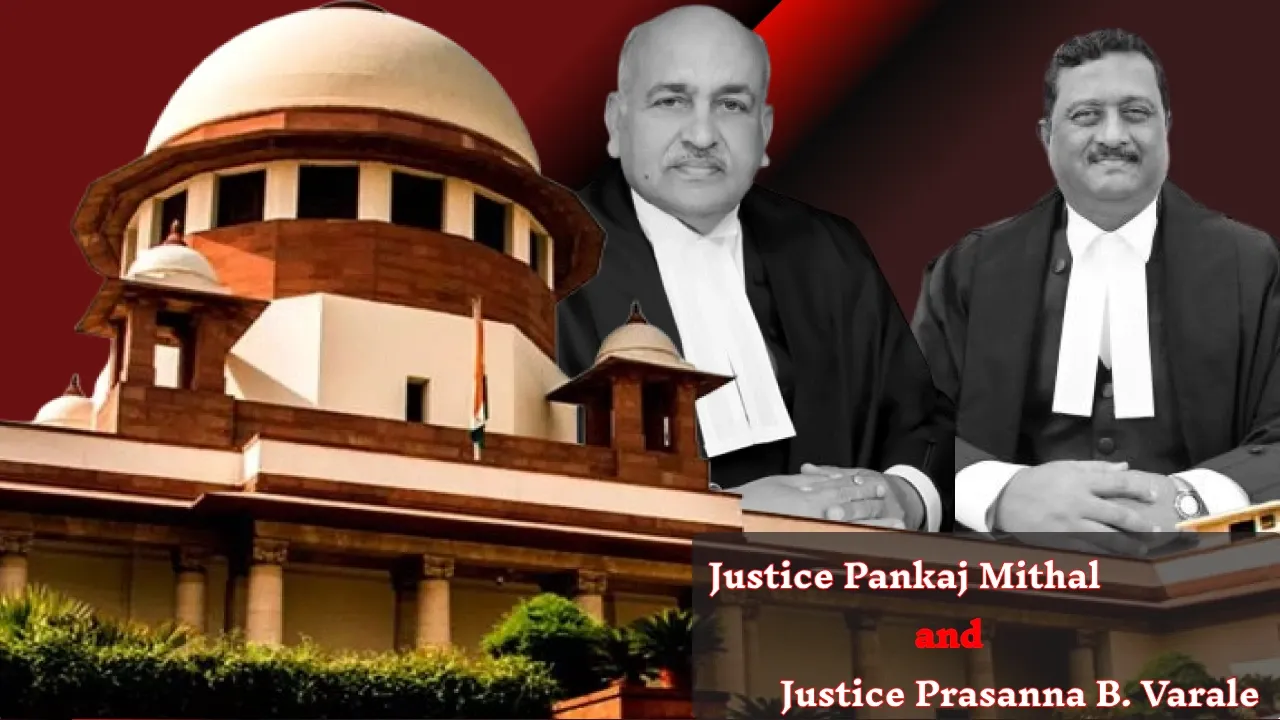
The Supreme Court has upheld the acquittal of four men accused in the 2007 kidnapping and murder of a Rajasthan taxi driver, observing that suspicion alone cannot replace legal proof in a criminal trial based entirely on circumstantial evidence.
A bench of Justices Pankaj Mithal and Prasanna B. Varale dismissed appeals filed by the complainant and the State of Rajasthan against a Rajasthan High Court judgment that had acquitted all four accused persons.
Background Of The Case
The case arose from a complaint lodged on April 28, 2007 by Pawan Kumar Sharma after his brother Ashok Kumar Sharma, who operated a Bolero jeep as a taxi, went missing. According to the complaint, two young men had hired the vehicle on April 26, 2007 and the driver never returned home.
During investigation, police arrested several accused persons and later recovered the driver’s body from a dry well. The trial court convicted four accused under provisions relating to kidnapping, murder, dacoity and destruction of evidence, sentencing them to life imprisonment.
However, the Rajasthan High Court later overturned the conviction, holding that the prosecution had failed to complete the chain of circumstances required for conviction in a case resting on circumstantial evidence.
Before the Supreme Court, the State and the complainant argued that the recoveries made from the accused persons, along with “last seen” evidence, were enough to establish guilt beyond reasonable doubt.
The bench, however, agreed with the High Court’s assessment that serious gaps remained in the prosecution story.
The Court found the alleged recovery of the dead body at the instance of one accused doubtful because police records already mentioned murder charges before the body was officially recovered. The Court also noted inconsistencies in witness testimony regarding when and how the body was found.
The judgment further pointed out that an independent witness allegedly present during the recovery process was never examined before the trial court.
“The prosecution failed to establish beyond reasonable doubt that the recovery of dead body was made pursuant to the disclosure statement,” the bench observed.
The Supreme Court reiterated the settled legal principle that suspicion, no matter how strong, cannot become the basis for conviction.
“It is consistently held by this Court that the suspicion however strong it may be, cannot take place of the legal evidence so as to convict an accused person,” the bench said.
The Court also refused to rely heavily on the “last seen together” theory against one of the accused. Referring to earlier judgments, the bench said such evidence is considered weak unless supported by strong corroborative material.
On the recovery of articles like a tape recorder, wristwatch and towel allegedly linked to the deceased, the Court noted that no proper identification parade of the recovered items was conducted, weakening the prosecution case further.
After examining the entire record, the Supreme Court concluded that the Rajasthan High Court had taken a “plausible view” while acquitting the accused persons and there was no reason for interference under Article 136 of the Constitution.
The bench finally dismissed all appeals and upheld the acquittal of the four accused.
Case Details:
Case Title: Pawan Kumar Sharma v. Manoj Kumar & Ors.
Case Number: Criminal Appeal Nos. 1353-1355 of 2017 along with Criminal Appeal Nos. 1356-1358 of 2017Judges: Justice Pankaj Mithal and Justice Prasanna B. Varale
Decision Date: May 25, 2026


