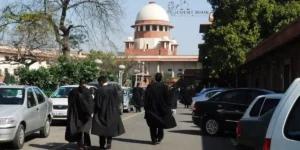
The Supreme Court on Thursday set aside a Punjab & Haryana High Court ruling that had stripped a former Punjab State Electricity Board (PSEB) employee of seniority benefits she had been fighting for since the early 1990s. The bench, hearing the matter in a packed courtroom, appeared visibly unsettled by the High Court’s approach, especially its silence on earlier judgments involving identical facts.
Background
The dispute goes back to 1976 when Smt. Krishna was appointed as a Lower Division Clerk in PSEB on an ad hoc basis. Her service continued without interruption until she was finally regularised in 1982. She claimed seniority from her initial date of joining, arguing that several employees with the same service pattern had already received that benefit.
Read also: Assam High Court Flags Gaps in Police Recruitment Policy for Transgender Applicants, Seeks Clarity
Both the Trial Court and the First Appellate Court agreed with her, holding that uninterrupted ad hoc service-if against a regular vacancy-must count towards seniority. But the High Court reversed these findings in 2024, calling the suit “barred by limitation,” even though it had ruled otherwise in earlier cases like Sant Ram and Surinder Kumar.
Her legal heirs pursued the matter after her passing in 2020, eventually bringing the fight to the Supreme Court.
Court’s Observations
During the hearing, the bench repeatedly questioned why the High Court deviated from its own line of decisions. Justice Sanjay Karol remarked at one point, “When precedents on identical facts were already placed before the High Court, how could they simply go unaddressed?”
Read also: Supreme Court Flags Serious Concerns Over Police Conduct in Madhya Pradesh Case, Seeks Affidavits
The judges highlighted that in Sant Ram and related matters, the High Court had specifically held that such service disputes involve a “recurring cause of action,” meaning the limitation argument cannot be used to deny the claim - only to restrict arrears.
The bench observed, “The respondents themselves implemented those judgments. That alone should have prompted a more careful review below.”
The Court also clarified that the government’s reliance on Tarsem Singh was misplaced since that case involved a 16-year unexplained delay and dealt mainly with the payment of arrears, not the denial of seniority itself.
Read also: Gujarat High Court Rejects State’s Appeal, Says Temple-Visit Quarrel Cannot Be Treated as Cruelty
Decision
Finding “clear error” in the High Court’s approach, the Supreme Court restored the original decree granting seniority benefits from 10 December 1976 and directed that the appellants must now receive the same treatment already extended to others under the 2017 Sant Ram order. With that, the appeals were allowed, and the matter finally reached closure nearly fifty years after the initial appointment.
Case Title: Faqir Chand & Others vs. Punjab State Electricity Board & Another
Case No.: SLP(C) No. 23863–23864 of 2025 / Civil Appeal (converted)
Case Type: Civil Appeal (Service Seniority Dispute)
Decision Date: 20 November 2025