

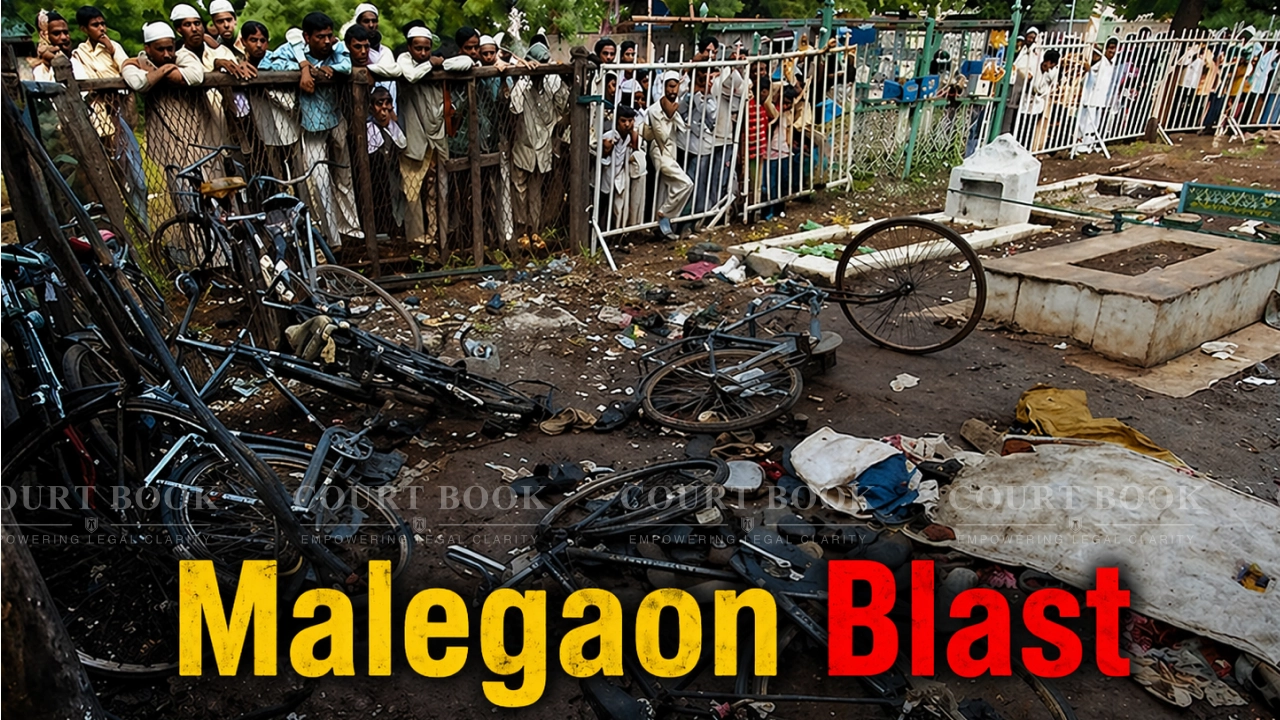
In a significant development in the long-running 2006 Malegaon blast case, the Bombay High Court has discharged four accused, holding that the evidence presented by the National Investigation Agency (NIA) was insufficient to proceed to trial. The Court set aside the order framing charges passed by the Special Court in 2025.
Background of the Case
The case relates to the September 8, 2006 serial blasts in Malegaon, Maharashtra, which resulted in 31 deaths and over 300 injuries. The investigation saw multiple agencies state police, Anti-Terrorism Squad (ATS), Central Bureau of Investigation (CBI), and later the NIA presenting differing versions over the years.
The appellants, including Rajendra Chaudhary, Dhan Singh, Manohar Narwaria, and Lokesh Sharma, were chargesheeted by the NIA in a supplementary chargesheet filed in 2013. They were accused of participating in a larger conspiracy to carry out the blasts.
The Special Court had framed charges against them in September 2025 under various provisions, including murder, criminal conspiracy, and offences under anti-terror laws. This order was challenged before the High Court under Section 21 of the NIA Act.
The Division Bench, led by Chief Justice Shree Chandrashekhar, closely examined whether the materials collected by the NIA justified proceeding to trial.
The Court noted that much of the NIA’s case relied on disclosure statements made by the accused while in custody, retracted confessions, and test identification parade (TIP) evidence conducted years after the incident.
“The disclosure statements… cannot be relied upon to frame charges,” the bench observed, emphasizing that confessions made to police are generally inadmissible unless recorded before a magistrate.
The Court also found that the test identification parade conducted nearly six years after the incident had “no probative value,” particularly in the absence of prior descriptions or prompt identification.
Further, it pointed out that the NIA’s case was largely circumstantial and built on hearsay evidence and inconsistent witness statements.
A key factor in the Court’s decision was the existence of “two irreconcilable versions” of the case one by the ATS/CBI and another by the NIA.
The earlier investigation had implicated a different set of accused with supporting forensic evidence, including RDX traces and voice samples. However, the NIA’s supplementary chargesheet introduced a new theory, primarily based on retracted statements.
“The diagonally opposite stories… cannot be reconciled by any stretch of imagination,” the Court remarked.
It also questioned why the NIA did not gather fresh independent evidence and instead relied heavily on earlier retracted statements and disclosure-based recoveries.
The Court reiterated settled legal principles governing the stage of framing charges. While a detailed evaluation of evidence is not required at this stage, the judge must ensure there is at least a “grave suspicion” supported by admissible material.
Importantly, the bench stressed that courts cannot act as a “mere post office” for the prosecution and must apply judicial mind to assess whether the evidence justifies trial.
It also noted that retracted confessions, delayed identification, and hearsay evidence cannot form the sole basis for framing serious charges, especially in cases involving severe penalties.
After evaluating the material, the Court concluded that there was no sufficient ground to proceed against the appellants.
“We hold that there is no sufficient material on record to proceed against the appellants,” the bench stated.
The High Court set aside the Special Court’s order dated September 30, 2025, which had framed charges against the four accused.
As a result, all four appellants were discharged from the case. The Court also released them from the obligations of their bail bonds.
Case Details
Case Title: Rajendra Chaudhary & Ors. vs Union of India & Ors.
Case Number: Criminal Appeal No.107 of 2026 & Criminal Appeal (Stamp) No.2772 of 2026
Judge: Chief Justice Shree Chandrashekhar & Justice Shyam C. Chandak
Decision Date: 22 April 2026
Download Judgment

