

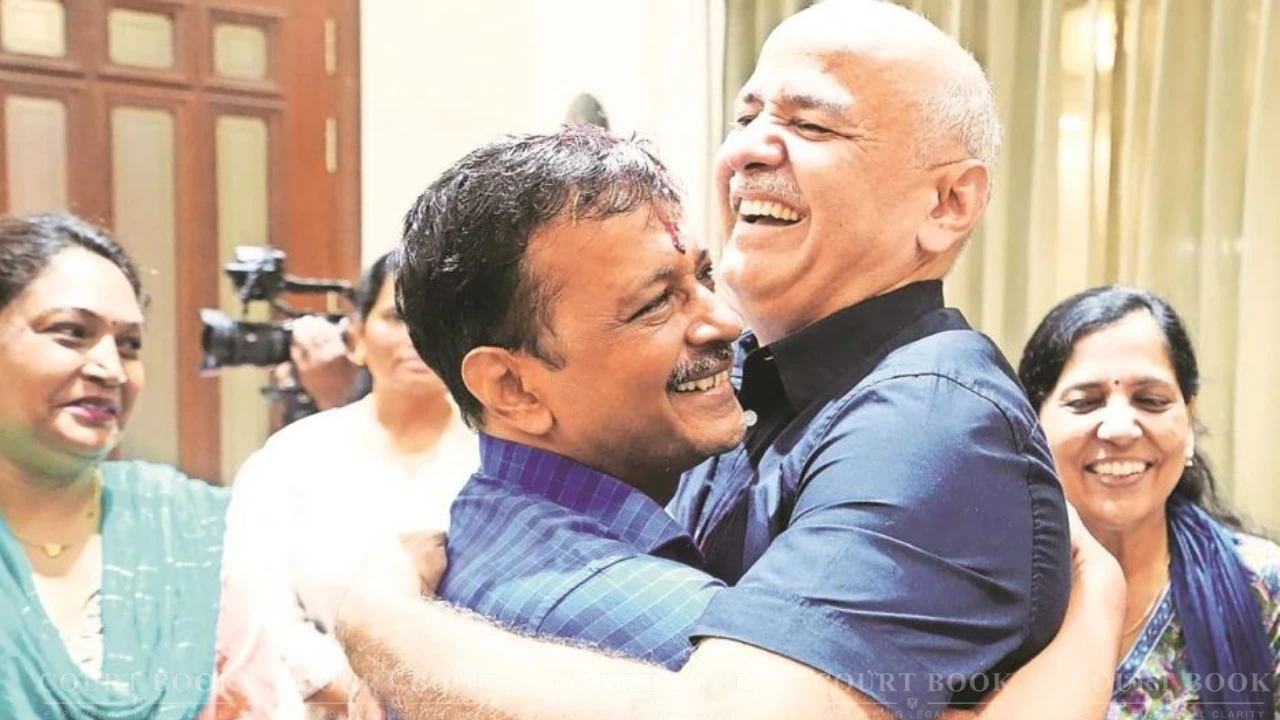
After months of arguments stretching across packed courtrooms and thick case files, the Special CBI Court at Rouse Avenue on Thursday delivered its much-awaited order on charge in the Delhi Excise Policy case.
The court, presided over by Jitendra Singh, examined whether there was enough material to proceed to trial against political leaders, officials and private businessmen named in the CBI’s chargesheets.
The case arises from FIR No. RC0032022A0053 registered by the Central Bureau of Investigation (CBI) in connection with the Delhi Excise Policy 2021–22.
Read also:-Calcutta High Court Enhances Accident Compensation to ₹6 Lakh for Court Employee
Background of the Case
According to the CBI, the excise policy was allegedly tweaked to benefit a group of liquor businessmen referred to as the “South Group.”
The agency claimed that key changes - including raising the wholesale margin from 5% to 12% and altering eligibility conditions - were made to confer undue advantage on select entities. It also alleged that illegal gratification running into ₹90–100 crore was paid as “upfront money,” part of which was allegedly routed through hawala channels and used for election-related expenditure.
Among those named in the chargesheets were senior political leaders including Arvind Kejriwal, Manish Sisodia, and Kavitha Kalvakuntla, along with several bureaucrats and businesspersons.
The prosecution filed one main chargesheet and four supplementary chargesheets in the matter.
Read also:-Calcutta High Court Orders Cancellation of OBC Certificate of Gram Panchayat Pradhan
Court’s Approach at the Stage of Charge
Before addressing individual roles, the court laid down the legal principles governing the stage of framing charges.
“The court is not to act as a post office of the prosecution,” the judge observed, adding that while detailed evidence appreciation is not required at this stage, there must be “grave suspicion” based on material on record.
Relying on Supreme Court precedents, the court reiterated that mere suspicion is not enough - the material must disclose the essential ingredients of the alleged offences if taken at face value.
The judge emphasized that in cases involving public policy, criminal prosecution cannot be used to revisit administrative decisions unless there is prima facie evidence of dishonest intent or quid pro quo.
“The wisdom or success of a policy is not for criminal adjudication,” the order noted in substance, clarifying that profit earned by private players under a policy does not automatically establish corruption.
Read also:-Karnataka High Court Reinstates KSRTC Guard, Says No Termination Without Proper Inquiry and Fair
Allegations of Bribe and Conspiracy
The CBI alleged that “upfront payments” were demanded and that policy clauses were tailored in return for illegal gratification. It also cited statements of approvers, digital records, hotel logs, and financial trails.
The court examined whether the material disclosed:
• A prima facie demand or payment linked to an official act
• A discernible quid pro quo
• A clear nexus between alleged gratification and policy changes
• Evidence of agreement amounting to criminal conspiracy
The order stressed that in conspiracy cases, the agreement itself is the core element. “Economic gain or uneven commercial outcomes cannot, by themselves, constitute conspiracy,” the court observed.
Policy Decisions and Criminal Liability
A substantial part of the prosecution’s case rested on file notings, draft cabinet notes, and internal deliberations.
The court made it clear that administrative deviations or policy changes, by themselves, do not amount to criminal misconduct.
It held that criminal liability may arise only if there is material indicating:
• Deliberate bypassing of mandatory safeguards
• Dishonest intent
• Collusive design to confer undue benefit
Absent such material, policy-making remains within the domain of governance, not criminal law.
Read also:-Calcutta High Court Partly Allows Discharge Plea in 498A Case, Drops Attempt to Homicide Charge
The Decision
After analysing the prosecution material, witness statements, banking records, and documentary evidence placed on record, the court held that a prima facie case existed against certain accused persons for offences under Section 120-B of the IPC and relevant provisions of the Prevention of Corruption Act.
Accordingly, the court ordered framing of charges against the accused persons named in the respective chargesheets for offences as detailed in the order.
The matter will now proceed to trial.
Case Title: CBI v. Kuldeep Singh & Others
Case No.: CBI Case No. 56/2022
Decision Date: 27 February 2026
Download order

