

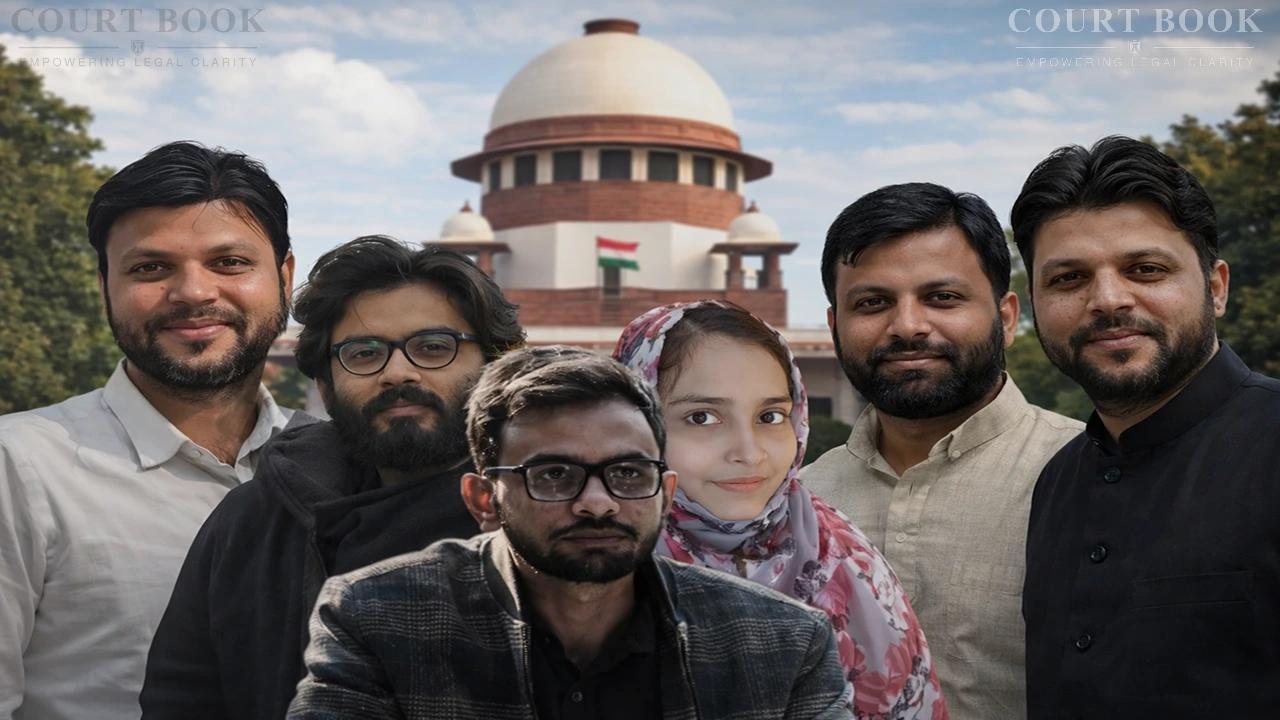
New Delhi: The Supreme Court on Monday, in a judgment deliver by Justice Aravind Kumar and Justice NV Anjaria declined to grant bail to several accused, including activist Gulfisha Fatima, in the high-profile Delhi riots conspiracy case, holding that prolonged incarceration alone cannot override the statutory bar under the Unlawful Activities (Prevention) Act (UAPA). The ruling came in a batch of appeals challenging a Delhi High Court order that had upheld the rejection of bail.
The appeals arose from FIR No. 59 of 2020, registered by Delhi Police’s Crime Branch following the communal violence in northeast Delhi in February 2020. The riots left 54 people dead, including a police official, and caused widespread damage to public and private property.
Initially registered under provisions of the Indian Penal Code, the case later saw the invocation of serious charges, including offences under Chapters IV and VI of the UAPA. The prosecution alleged a larger conspiracy behind the violence, claiming that protests against the Citizenship Amendment Act (CAA) were deliberately escalated into riots through coordinated planning and mobilisation.
Seven accused approached the Supreme Court, including Sharjeel Imam, Umar Khalid, Shifa Ur Rehman, Mohd. Saleem Khan, Meeran Haider, Shadab Ahmed, and Gulfisha Fatima, arguing that their continued detention violated their right to personal liberty.


A central argument before the court was the length of custody. Most appellants have been in jail since 2020, with the trial yet to commence formally. Senior counsel for the accused urged the court to consider prolonged incarceration as a standalone ground for bail, citing Article 21 of the Constitution.
However, the bench made it cleUAPA की धारा 15ar that delay cannot be examined in isolation.
“The constitutional concern arising from prolonged custody does not automatically eclipse the statutory embargo under Section 43D(5) of the UAPA,” the court observed, noting that the right to liberty must be balanced against the legislative intent behind anti-terror laws.
The judges also pointed out that the record did not support claims that the delay was solely due to prosecutorial inaction. According to the court, multiple adjournments, procedural objections, and the complexity of the case contributed to the slow progress.
Court’s View on Bail Under UAPA
Explaining the scope of Section 43D(5) of the UAPA, the court reiterated that bail can be denied if there are “reasonable grounds for believing that the accusation is prima facie true.” At this stage, courts are not required to weigh evidence or test defences, but only to see whether the prosecution’s case, taken at face value, meets the statutory threshold.
“The bail stage under UAPA is not a mini-trial,” the bench remarked, cautioning against detailed evaluation of evidence before the trial begins.
An important aspect of the judgment was the court’s emphasis on individual roles. The bench rejected the idea that all accused could be treated alike merely because they were named in the same FIR.
According to the prosecution narrative, Sharjeel Imam and Umar Khalid were alleged to have played a more central role in conceptualising and coordinating protests, while others, including Gulfisha Fatima, were described as local-level facilitators involved in mobilisation and logistics.
The court said such distinctions matter at the bail stage.
“Pre-trial detention cannot become indiscriminate. The role attributed to each accused must guide the court’s discretion,” it observed.
Addressing arguments that the allegations amounted only to public disorder, the court examined the definition of a “terrorist act” under Section 15 of the UAPA. It held that terrorism under the law is not limited to conventional violence alone.
Acts that disrupt essential services, destabilise civic life, or threaten the unity and security of the nation can also fall within the statutory definition, the court said, depending on intent, design, and impact.
Decision
After examining the material on record and the statutory framework, the Supreme Court upheld the Delhi High Court’s decision refusing bail to the appellants. It concluded that, at this stage, the accusations could not be said to fall outside the scope of the UAPA, nor had prolonged incarceration reached a point where continued detention became unconstitutional.
At the same time, the court directed that the trial be given priority and conducted expeditiously, leaving it open for the accused to renew their plea if there is unexplained stagnation in proceedings.
Case Title:- Gulfisha Fatima vs State (Govt. of NCT of Delhi) & Connected Appeals
Download Judgment


