

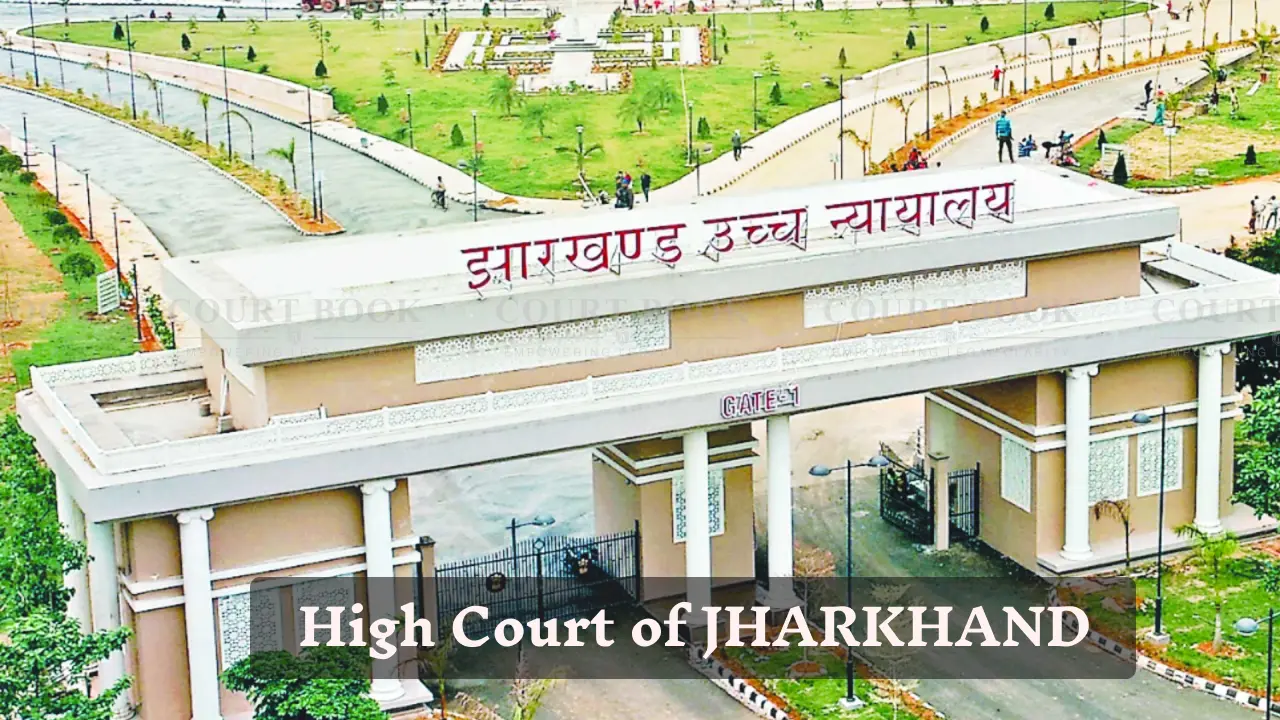
Sitting in Court the Jharkhand High Court, Justice Deepak Roshan made it clear that labour justice cannot be defeated by paperwork lapses. In a detailed judgment delivered on February 3, 2026, the Court set aside two labour awards that had rejected the claims of long-serving casual workers from the Drinking Water and Sanitation Department, Deoghar. The matters were remanded for fresh consideration, restoring hope for workers who allege they were orally terminated after seeking regularisation.
Background of the Case
The petitions arose from two connected writ cases-W.P.(L) No. 2852 of 2019 and W.P.(L) No. 3783 of 2019-filed by Pradeep Kumar Roy and six others, along with Dinesh Poddar.
Read also:-Humiliation Is Not Justice: Allahabad High Court Strikes Down Placard Punishment for Student
All petitioners claimed to have worked for years, some dating back to the 1980s, as casual workmen in roles such as hand pump mechanic, khalasi, pump operator, and jhadukash under the state’s Drinking Water and Sanitation Department. According to them, they completed more than 240 days of work annually.
Their grievance was simple but serious. After they submitted representations seeking regularisation of service, they were allegedly removed through oral instructions. They were told they could return only if they accepted contract-based work.
Steps Taken by the Workers
Following their removal, the workers raised an industrial dispute. Letters detailing their termination were sent to departmental officers, with copies marked to the Assistant Labour Commissioner, Deoghar. When no conciliation proceedings were initiated, the workers approached the Labour Court directly under Section 2(A)(2) of the Industrial Disputes Act, 1947.
Two industrial dispute cases were registered in Deoghar-ID Case No. 01 of 2017 and ID Case No. 01 of 2018.
Labour Court’s Decision
Despite the department not filing any written reply and not cross-examining witnesses, the Labour Court dismissed both cases in March 2019.
The main reason: the Court held that the workers failed to prove they had formally approached the Conciliation Officer. It also doubted the employment itself due to the absence of appointment letters.
High Court’s Observations
Justice Roshan was visibly critical of this approach.
“The Labour Court adopted a hyper-technical interpretation,” the bench observed, noting that copies of dispute letters were already on record and sent to the labour authorities.
The Court explained that under Section 2(A)(2), a workman can directly approach the Labour Court if 45 days pass after raising a dispute. The law does not insist on rigid formats. Substantive compliance is enough.
Relying on Supreme Court rulings, the High Court stressed that labour laws are welfare statutes. “Procedural prescriptions are handmaids, not mistresses, of justice,” the Court noted while referring to established precedent.
The judge also rejected the Labour Court’s insistence on appointment letters. Employer–employee relationships, the Court said, can be proved through oral evidence and surrounding circumstances.
Errors Found in the Labour Awards
The High Court pointed out multiple flaws:
• The Labour Court ignored letters already on record showing that disputes were raised.
• It wrongly concluded that no conciliation was sought.
• It examined merits of employment after holding it lacked jurisdiction.
• It dismissed uncontested evidence without justification.
Calling the findings “patently perverse,” the Court said the awards could not stand.
Read also:-Calcutta High Court Revives Dowry Death Case, Orders In-Laws to Face Trial in Andaman Mother
Final Decision
Allowing both writ petitions, the High Court set aside the Labour Court’s awards dated March 2, 2019. The matters were remanded to the Labour Court, Deoghar, for fresh adjudication on merits.
The department has been permitted to seek leave to file written statements and lead evidence, strictly in accordance with law. The Labour Court has been directed to decide the cases expeditiously.
With this, the petitions were disposed of, bringing the proceedings back to the starting line-but this time, on fairer ground.
Case Title: Pradeep Kumar Roy & Ors. vs State of Jharkhand; Dinesh Poddar vs State of Jharkhand
Case No.: W.P.(L) No. 2852 of 2019 & W.P.(L) No. 3783 of 2019
Decision Date: 03 February 2026


