

The Calcutta High Court has refused to interfere with an order granting family pension to a divorced daughter, holding that welfare rules must be read with their true purpose - financial support to dependent family members. Dismissing a writ petition filed by the Union of India, the court upheld the decision of the Central Administrative Tribunal in favour of Mita Saha Karmakar.
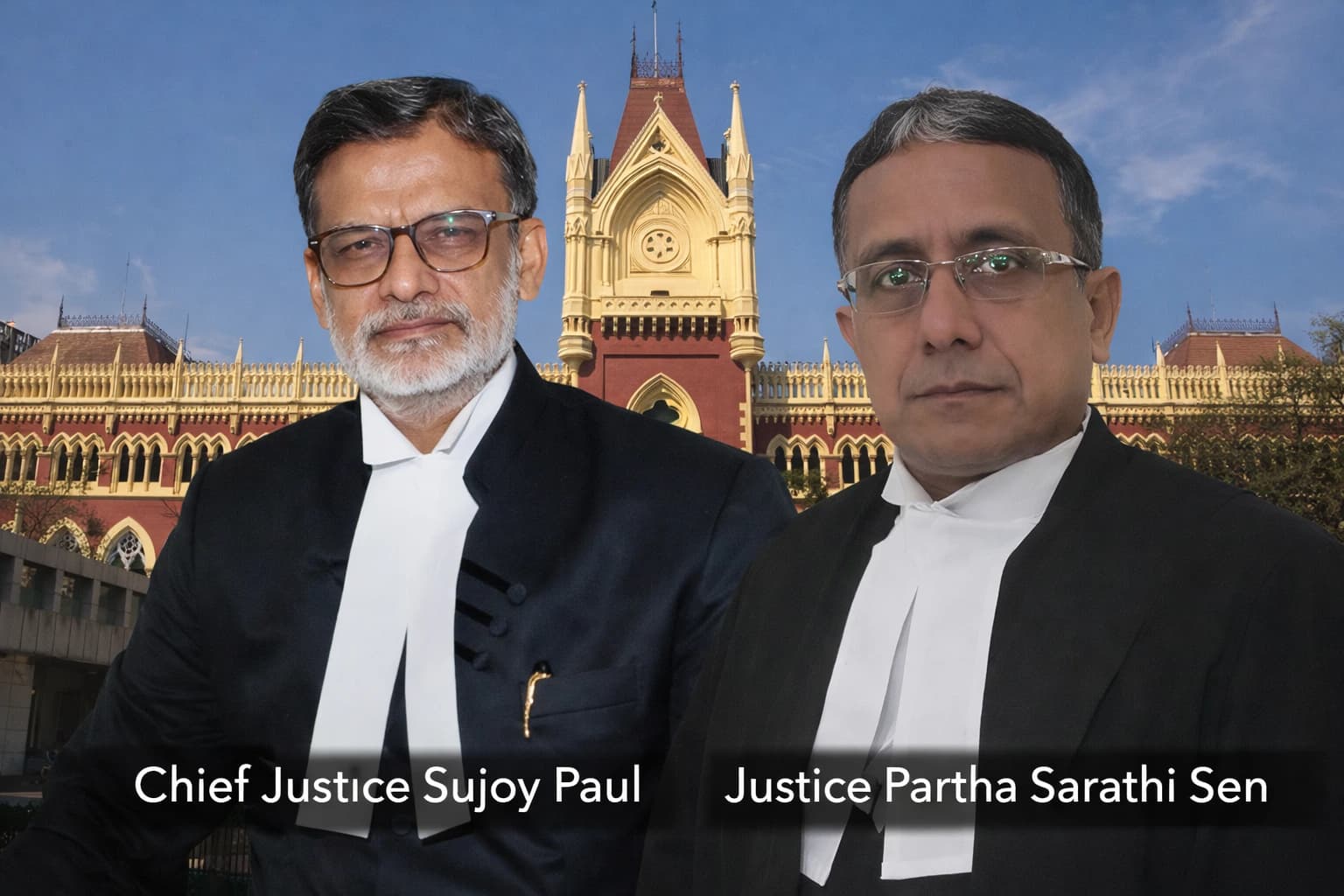
The judgment was delivered by a Division Bench led by Acting Chief Justice Sujoy Paul and Justice Partha Sarathi Sen.
Background of the Case
The dispute arose from a claim for family pension following the death of a retired employee of South Eastern Railway. The employee had retired in 1983, lost his wife in 2011, and passed away in April 2013.
His daughter, Mita Saha Karmakar, sought family pension as a dependent. Authorities rejected her claim in June 2022, reasoning that she filed for divorce only in 2014 - after the death of both parents - and therefore could not be treated as a dependent under pension rules.


Read also:- Supreme Court Clears UP Government in Ayurvedic Nurse Appointment Row, Says Training Doesn’t Guarantee Job
Challenging this rejection, she approached the Central Administrative Tribunal (CAT), Kolkata Bench. In October 2024, CAT set aside the rejection order and directed the authorities to grant her family pension. The Union of India then moved the High Court against the CAT ruling.
Arguments Before the Court
Appearing for the Centre, senior counsel argued that the tribunal misapplied the Department of Personnel & Training Office Memorandum dated 19 July 2017. The government relied heavily on a recent High Court ruling in Jayanti Chatterjee, claiming the facts were identical and that dependency had not been proved.
On the other hand, counsel for the woman pointed out that she had been deserted by her husband as early as 1995–96 and had been living at her paternal home since then. A divorce suit filed by her husband in the 1990s had remained pending and was stayed due to non-payment of maintenance.
“The records clearly show she had no independent income and was dependent on her father during his lifetime,” the respondent’s counsel submitted.
Read also:- Kerala HC nudges State on anti-superstition law, suggests special police cell to tackle black magic cases
Court’s Observations
After examining the case records, the bench disagreed with the Centre’s narrow interpretation of the 2017 Office Memorandum.
The court noted that the memorandum allows family pension to a divorced daughter where divorce proceedings were initiated during the lifetime of the pensioner, even if the final decree came later. Importantly, it does not require that the divorce must be concluded before the parent’s death.
“The object of granting family pension is to give pecuniary support to a dependent family member of the deceased,” the bench observed.
The judges also relied on findings from the matrimonial court, which had recorded the husband’s admission that he deserted his wife in December 1995 - well before her father’s death.
Why the Centre’s Reliance on Earlier Case Failed
Distinguishing the case from Jayanti Chatterjee, the High Court pointed out that in that matter, the claimant had failed to prove both dependency and initiation of divorce proceedings during the pensioner’s lifetime.
“In the present case, sufficient material has been produced to establish dependency and desertion during the lifetime of the pensioner,” the court noted, making it clear that the two cases were not comparable.
Final Decision
Upholding the CAT’s order, the High Court concluded that there was no illegality or perversity in granting family pension to the respondent.
“We find no fault on the part of the Tribunal in interpreting the Office Memorandum in its true and beneficial perspective,” the bench said, adding that writ courts should not substitute their views merely because another interpretation is possible.
The writ petition filed by the Union of India was dismissed, with no order as to costs.
Case Title: Union of India & Others vs Mita Saha Karmakar
Case Number: WP.CT 36 of 2025
Download Order


