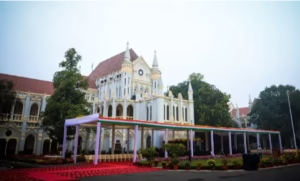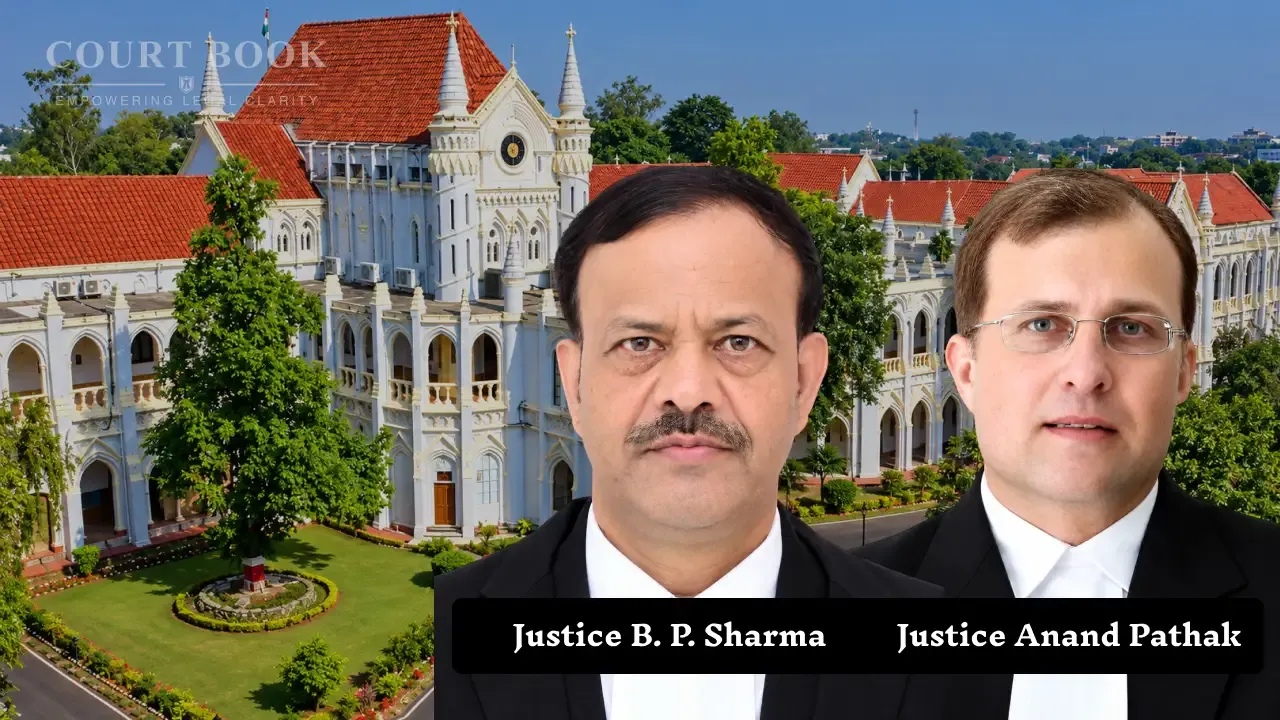
The Madhya Pradesh High Court at Jabalpur has dismissed a writ petition seeking appointment of a new Governor of Madhya Pradesh, holding that the incumbent can continue in office until a successor enters upon office.
A Division Bench of Justice Anand Pathak and Justice B. P. Sharma held that the proviso to Article 156(3) of the Constitution permits a Governor to continue in office until a successor enters upon office.
The petition was filed by Dr. M.A. Khan, a retired Professor of Jawaharlal Nehru Krishi Vishwa Vidyalaya (JNKVV), Jabalpur, as a Public Interest Litigation (PIL). The petitioner sought a direction for the appointment of the Governor of Madhya Pradesh, relying on Articles 153, 154, 155, 156 and 160 of the Constitution. He argued that the incumbent Governor had remained in office for more than five years and that his term had expired on July 7, 2026.
The submissions were opposed by Suneel Jain, Additional S.G., appearing with S.M. Guru, Deputy S.G., assisted by advocate Kurian J. Verghese for the Union of India. Abhijeet Awasthi, Deputy A.G., appeared for respondent No. 3/State. The respondents submitted that a Governor continues to hold office until the successor enters upon office and therefore argued that the petition was not maintainable and was premature.
The Bench also noted that the petitioner had not disclosed the bona fides, meaning the genuine public-interest credentials, required under the Madhya Pradesh High Court Rules, 2008 for a public interest litigation.
The Court referred to the rules requiring disclosure of the petitioner’s public standing, professional status, public-spirited background, the cause of action and any personal interest involved.
The central issue before the Court was the effect of the proviso to Article 156(3).
The provision states that although a Governor ordinarily holds office for five years, the Governor continues in office even after the expiry of that term until the successor enters office.
The Bench relied on the Supreme Court’s decision in Krishna Ballabh Sahay v. Commission of Inquiry, where the Supreme Court had considered whether a Governor could legally continue after completion of five years.
The High Court noted the Supreme Court’s reasoning that the constitutional scheme prevents a vacuum in the office of Governor and permits the incumbent to continue until the successor assumes office.
The Bench observed that the proviso to Article 156(3) ensures that there is no constitutional vacuum in the office of Governor.
“This is a proviso, which ensures that there shall never be a Constitutional vacuum and the Governor shall continue to hold office until his successor entered upon his office.”
The Court further held that since Article 156(3) itself explains the Governor’s term in this manner, the petitioner’s argument could not succeed.
“When the Proviso of Article 156(3) of the Constitution of India, itself explains the term of office in a particular manner, then arguments raised by petitioner pale into oblivion and deserve to be rejected.”
The Madhya Pradesh High Court accordingly dismissed the writ petition as misconceived.
Case Title: Dr. M.A Khan v. Secretary to the President of India and Others
Case Number: Writ Petition No. 32977 of 2026
Judges: Justice Anand Pathak and Justice B. P. Sharma
Decision Date: September 15, 2026