

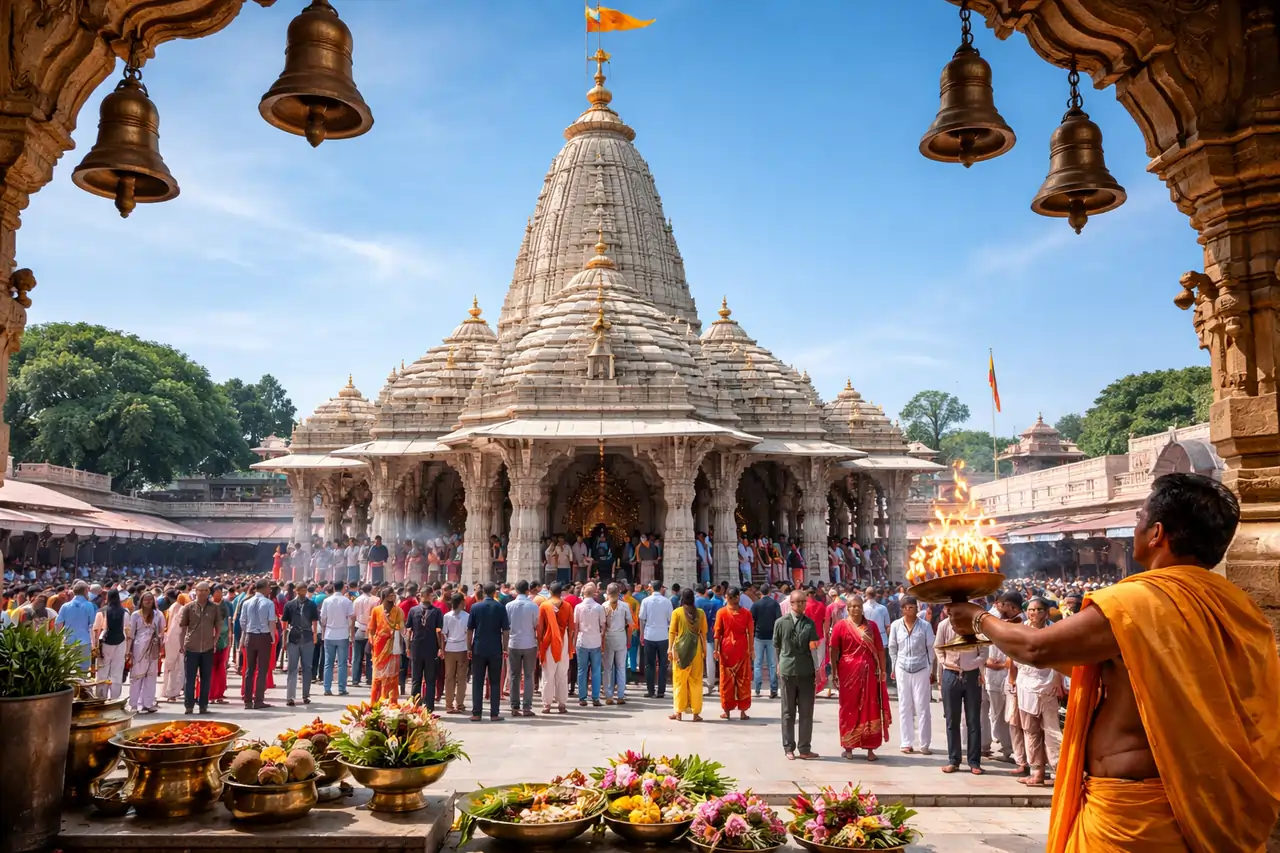
Ending a dispute that stretches back to the princely era, the High Court of Gujarat has upheld the registration of the Ambaji Temple as a public religious trust. The court dismissed both the appeal filed by the heirs of the former Maharana of Danta and the cross-objections raised by the temple trust, closing a long chapter of litigation over ownership and ritual rights.
हिंदी में पढ़ें
The judgment was delivered by Justice Hemant M. Prachchhak on December 24, 2025.
Background of the Case
The case arose from a challenge by the legal heirs of Maharana Prithvirajsinh Parmar, former ruler of Danta State. The heirs claimed that the historic Arasuri Ambaji Temple was their private property and that the Maharana had exclusive hereditary rights over its management and offerings.
The dispute gained legal shape after the Administrator of Shree Ambaji Mata Devasthan Trust applied in 1961 for registration of the temple as a public trust under the Bombay Public Trusts Act. The registration was granted in 1962 but was consistently challenged by the erstwhile royal family for decades through appeals, revisions, civil suits, and writ petitions.
The High Court examined two main questions:
• Whether the Ambaji Temple was a private religious institution of the Danta rulers or a public temple.
• Whether the heirs of the Maharana retained enforceable hereditary privileges after independence and merger of the princely state.
Court’s Observations
The bench traced the temple’s history through pre-independence records, revenue documents, merger agreements, and prior court findings. It noted that historical evidence repeatedly described the Maharana as a custodian or manager, not the owner, of the temple.
“The material on record consistently shows that the ruler of Danta acted as a sevapat and administrator of the shrine, not as its proprietor,” the court observed.
The court also rejected the argument that a royal farman issued before independence could override statutory law governing public trusts after the Constitution came into force. It held that once the Bombay Public Trusts Act applied, the nature of the institution had to be determined under that law.
The judges placed significant weight on the uninterrupted access enjoyed by the public for centuries. Pilgrims from across regions visited the shrine freely, made offerings, and participated in festivals like Navratri.
“The continuous public worship, offerings, and pilgrim access establish the public character of the temple,” the bench noted.
While rejecting ownership claims, the court upheld limited ritual privileges previously granted to the Maharana’s lineage. These include:
• Performing puja on the eighth day of Navratri
• Conducting havan
• Waving the chamar before the deity
However, these rights were held to be ritual privileges, not ownership or control over temple administration.
Decision
The Gujarat High Court dismissed:
• First Appeal No. 2293 of 2009 filed by the Maharana’s heirs
• Cross Objection No. 177 of 2011 filed by the trust
The court affirmed the validity of the temple’s registration as a public religious trust and upheld earlier findings of the charity authorities and district court.
With this ruling, the legal status of Ambaji Temple as a public institution stands finally settled.
Case Title: Maharana Mahipendrasinhji Parmar Heirs vs Administrator, Shree Ambaji Mata Devasthan Trust
Case No.: First Appeal No. 2293 of 2009
Case Type: Public Trust Registration Dispute
Decision Date: 24 December 2025
Download Judgment

