

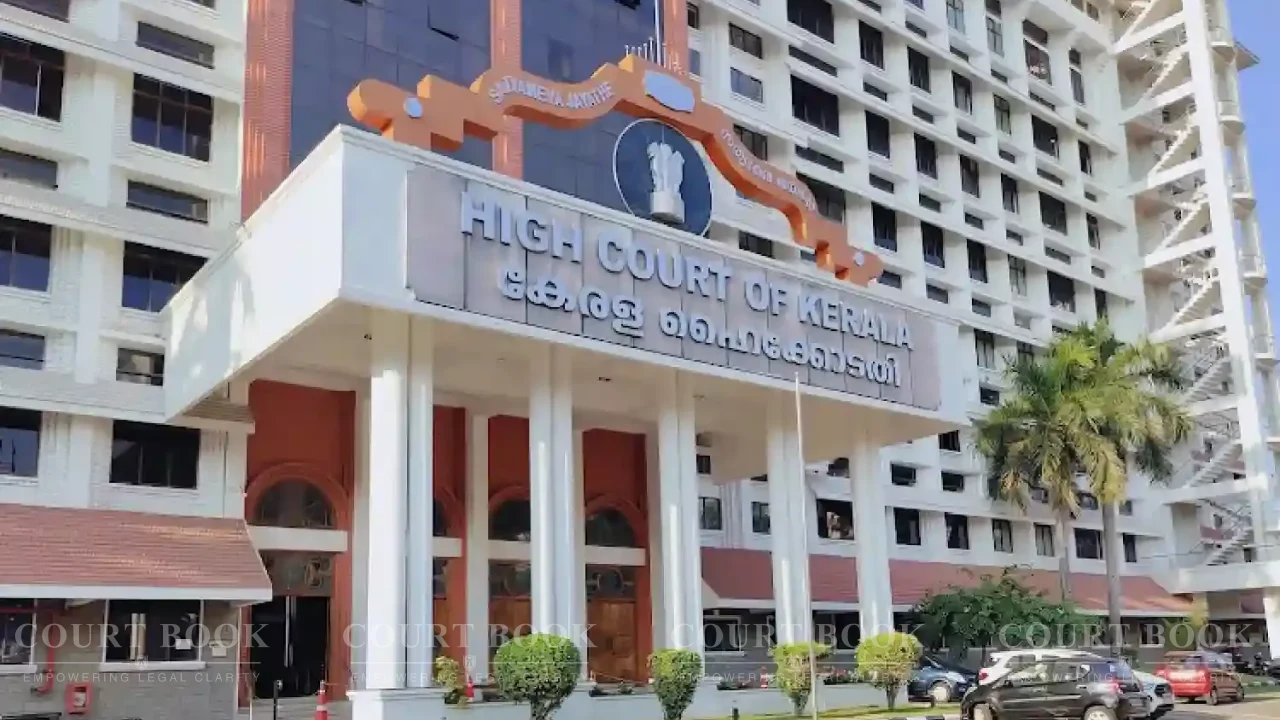
In a significant ruling on motor accident compensation cases, the Kerala High Court has clarified that a driver’s guilty plea in a criminal case cannot automatically fix negligence in a claim before the Motor Accidents Claims Tribunal.
Justice Mohammed Nias C.P., delivering judgment in OP (MAC) No.18 of 2024, set aside orders of the Tribunal that had refused to allow the vehicle owner to produce additional evidence in an accident compensation dispute.
Read also:-Madras High Court Judge Recuses in CBI Case After ₹50 Lakh Bribery Allegation Letter Sent to Centre
“The Tribunal is bound to independently assess negligence,” the court observed, adding that criminal proceedings and claim cases operate in different legal fields.
Background of the Case
The dispute traces back to a road accident on February 9, 2013, at Chembukkavu Junction, Thrissur.
A Toyota Corolla owned by Menon P.S. allegedly collided with a High Court Innova vehicle used for judges’ official travel. The Registrar General of the High Court later filed a claim petition before the Motor Accidents Claims Tribunal, Thrissur, seeking compensation for damages to the official vehicle.
According to the claimant, the Toyota Corolla emerged from a side road at high speed and crashed into the front portion of the Innova.
However, the vehicle owner disputed this version. He claimed that the High Court vehicle was driven rashly and collided with the rear portion of his car.
Read also:-Supreme Court Rules Spectrum Is National Asset, Says Insolvency Code Cannot Wipe Out Govt Telecom Dues
Criminal proceedings were initiated against the Toyota’s driver. The driver pleaded guilty and was fined by the criminal court in 2013.
Years later, during the pending compensation claim, the vehicle owner sought to summon a scientific expert and produce forensic paint comparison reports. The Tribunal rejected these applications solely because the driver had already pleaded guilty in the criminal case.
The Legal Issue
The core question before the High Court was simple but important:
Can the Tribunal deny a party the right to produce evidence just because the driver pleaded guilty in a criminal case?
The petitioner argued that a criminal conviction, especially one based on a plea of guilt, cannot automatically establish negligence in a compensation claim. He contended that he was not an accused in the criminal case and must be given a fair opportunity to contest negligence independently.
The Registrar General opposed this, arguing that the conviction was a relevant fact and the Tribunal had followed proper procedure.
Court’s Observations
Justice Mohammed Nias C.P. noted that proceedings under Section 166 of the Motor Vehicles Act are civil in nature. This means negligence must be decided on the basis of “preponderance of probabilities” - in simple terms, which version appears more likely based on evidence.
The court relied on Supreme Court rulings that clearly state criminal findings do not bind the Claims Tribunal.
“The opinion expressed in the final report or the result of the criminal case does not bind the Claims Tribunal,” the judgment recorded.
The bench further emphasised that a plea of guilt affects only the accused in criminal law. In contrast, a compensation claim may impose civil liability on the vehicle owner and insurer.
“A judgment based on a plea of guilt, by itself, cannot form the basis for a finding of negligence in a claim petition,” the court said.
The judge found that the Tribunal had rejected the owner’s applications solely because of the guilty plea, without examining whether the proposed evidence was relevant or necessary.
Such an approach, the High Court held, was legally unsustainable.
Read also:-Supreme Court Orders Regularisation of Income Tax Casual Workers, Slams Discrimination in 2006 Poli
Decision
Setting aside the Tribunal’s orders dated September 7, 2023, the High Court restored the vehicle owner’s right to seek permission to produce additional evidence.
The court directed the Tribunal to reconsider the applications in accordance with law and to independently determine negligence based on the evidence placed before it.
“The petitioner cannot be non-suited in the claim proceedings without being afforded a fair opportunity,” the bench observed.
The Original Petition was allowed.
Case Title: Menon P.S. v. Registrar General, High Court of Kerala & Others
Case No.: OP (MAC) No. 18 of 2024
Decision Date: February 11, 2026
Download Judgment

