

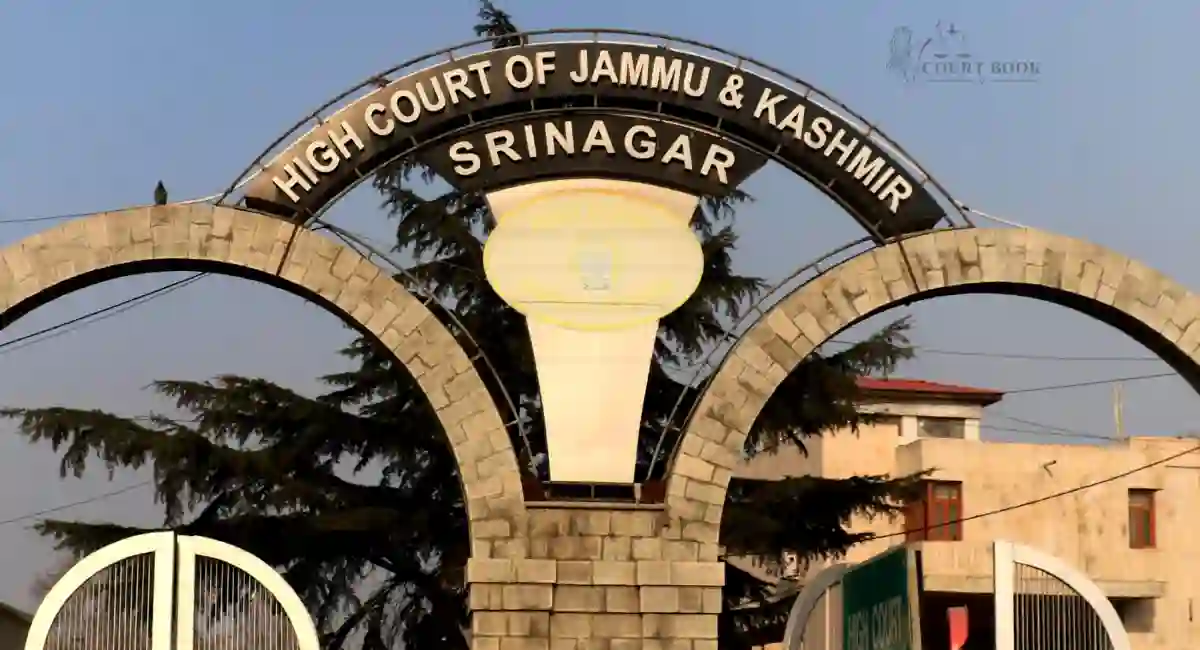
In a detailed judgment that could reshape how private school fees are regulated in Jammu and Kashmir, the High Court on Tuesday upheld the legal framework governing fee regulation while firmly cautioning authorities against excessive interference.
A Division Bench of the High Court of Jammu & Kashmir and Ladakh made it clear that while the government has the power to curb profiteering, private unaided schools cannot be treated like commercial businesses under constant state control.
Background of the Case
The case was filed by a group of private unaided schools, including New Convent High School, Delhi Public School Budgam, and others. The schools challenged multiple government orders and statutory amendments introduced after the reorganisation of Jammu and Kashmir into a Union Territory.
At the heart of the dispute were amendments to the J&K School Education Act, 2002, which created the Fee Fixation and Regulation Committee (FFRC). The schools argued that the committee was given sweeping powers to fix and control fees, including transport charges, without proper assessment.
They contended that this violated Supreme Court rulings which protect the autonomy of private unaided educational institutions.
What the Schools Argued
Senior counsel for the schools told the court that private institutions survive on self-financing and must be allowed to decide their fee structure, subject only to checks against profiteering.
“The committee has sometimes approved fees and at other times imposed them unilaterally,” the petitioners submitted, arguing that such actions were arbitrary and ignored ground realities like fuel prices, staff salaries, and infrastructure costs.
They also objected to the provision allowing a serving government officer to head the FFRC, stating that fee-related decisions are quasi-judicial in nature and require independence from the executive.
Court’s Observations
The Bench acknowledged the reality that private schools now play a central role in education, particularly in Jammu and Kashmir where public schooling has struggled to meet expectations.
“The private education system is no longer merely supplementing public education; it is on the verge of supplanting it,” the court observed.
At the same time, the judges drew a clear line between reasonable surplus and profiteering.
“Profiteering does not mean earning a surplus,” the Bench noted. “It means making excessive or unfair profits by exploiting students and parents.”
The court stressed that education cannot be run as a pure business, but it also cannot be forced into a no-profit, no-loss model.
Read also:-CLAT 2026 Answer Key Controversy Lands in Allahabad HC, Merit List to Be Revised
On the Fee Fixation Committee (FFRC)
Upholding the validity of the statutory framework, the court ruled that the creation of the FFRC under Sections 20A to 20J of the Act is constitutional.
However, it issued strong guidance on how the committee should function.
The Bench cautioned that with over 5,000 private schools in the region, it is neither practical nor lawful for the FFRC to conduct deep scrutiny of every school’s fee structure.
“The committee should ordinarily accept the fee proposed by a school unless its conscience is shocked by the magnitude of the fee,” the court said.
Special scrutiny, the judges added, should be reserved for large urban schools or cases where specific complaints of profiteering are received.
Transport Fee Issue
On transport fees, the court made an important observation, stating that such charges should ideally remain outside routine fee regulation.
“If transport fees are to be regulated, it must be done with expert input from departments like Transport and Petroleum,” the Bench observed, pointing out that fuel prices and operational costs cannot be ignored.
Read also:-No Application Needed for Citizenship by Birth, Says Delhi High Court While Ordering Passport Issue
Final Decision
In conclusion, the High Court upheld the amendments to the J&K School Education Act and the Fee Fixation Rules, 2022, refusing to strike them down.
At the same time, it laid down clear limits on state interference, emphasizing that private unaided schools must retain operational autonomy, subject only to checks against commercialisation and undue profiteering.
The writ petition was accordingly disposed of.
Case Title: New Convent High School & Ors. vs Union of India & Ors.
Case No.: WP(C) No. 1070/2022
Decision Date: 28 January 2026
Download Judgment

