

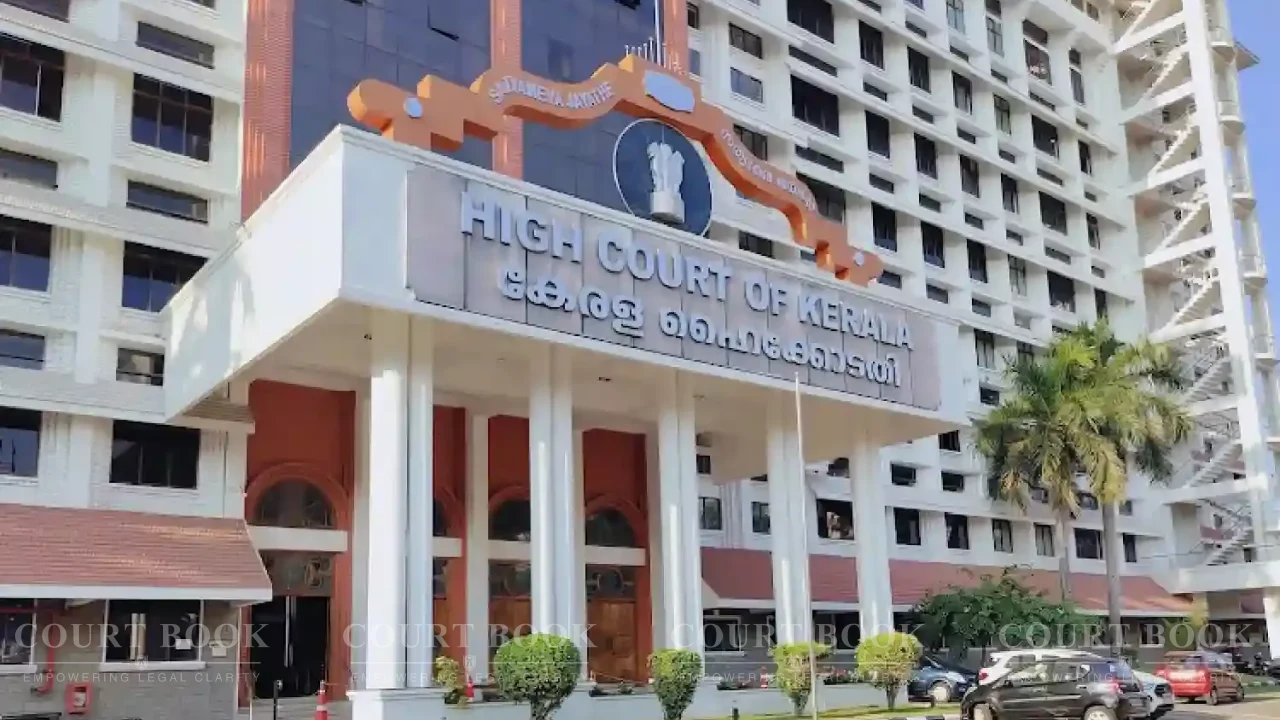
The Kerala High Court on Thursday partly allowed a writ petition filed by a 26-year-old man from Ernakulam, modifying an externment order that had barred him from entering the district for six months. The court held that while the police were justified in initiating action under the Kerala Anti-Social Activities (Prevention) Act, the duration of the ban required reconsideration.
Background of the Case
The case involved Ibrahim, a resident of Ashamannoor in Ernakulam district, who was served an externment order under Section 15(1)(a) of the Kerala Anti-Social Activities (Prevention) Act, 2007. The order, issued on November 24, 2025, prohibited him from entering the limits of Ernakulam Rural police jurisdiction for six months.
The police had classified Ibrahim as a “known rowdy” based on his alleged involvement in three criminal cases. The most recent case, registered in August 2025 at Kuruppampady Police Station, related to serious offences under the Bharatiya Nyaya Sanhita. He was arrested in September and later released on bail.
Challenging the order, Ibrahim approached the High Court, arguing that the decision was taken mechanically and after an unreasonable delay, breaking the link between the alleged conduct and the preventive action.
Court’s Observation
A Division Bench comprising Justice A.K. Jayasankaran Nambiar and Justice Jobin Sebastian closely examined the timeline of events and the nature of the allegations.
The court noted that although there was a gap of several months between the alleged offence and the externment order, part of that period was spent by the petitioner in custody. During that time, there could be no apprehension of further criminal activity.
“The delay, in the facts of this case, cannot be termed inordinate,” the bench observed, adding that some time is naturally required for verification of records and compliance with procedural safeguards.
However, the court made a clear distinction between preventive detention and externment.
“The consequences of an externment order are comparatively less severe than a detention order, though it still restricts personal liberty,” the bench noted, while stressing that authorities must apply their mind carefully before fixing the duration of such restrictions.
Why the Court Intervened
The judges found that out of the three cases relied upon by the police, one dated back to 2021 and the others were from 2025. They also noted that the nature of offences was not grave enough to justify the maximum restraint imposed.
Referring to earlier Supreme Court rulings, the court emphasised that an externment order must clearly justify the period for which restrictions are imposed.
“The authority must record its subjective satisfaction while fixing the duration. A blanket order without reasoning cannot be sustained,” the bench observed.
The court also took into account the personal and family circumstances of the petitioner while assessing the proportionality of the punishment.
Final Decision
Partly allowing the writ petition, the High Court modified the externment order.
Read also:-Rajasthan High Court Upholds Bank Officer's Dismissal, Says Courts Can't Reassess Disciplinary
Instead of six months, the court restricted the externment period to three months from the date of receipt of the order.
“The impugned order is modified to the extent that the petitioner shall be interdicted from entering the limits of Ernakulam Rural only for a period of three months,” the court held.
With this modification, the writ petition was disposed of.
Case Title: Ibrahim v. State of Kerala
Case No.: WP(Crl) No. 19 of 2026
Decision Date: 16 January 2026


