

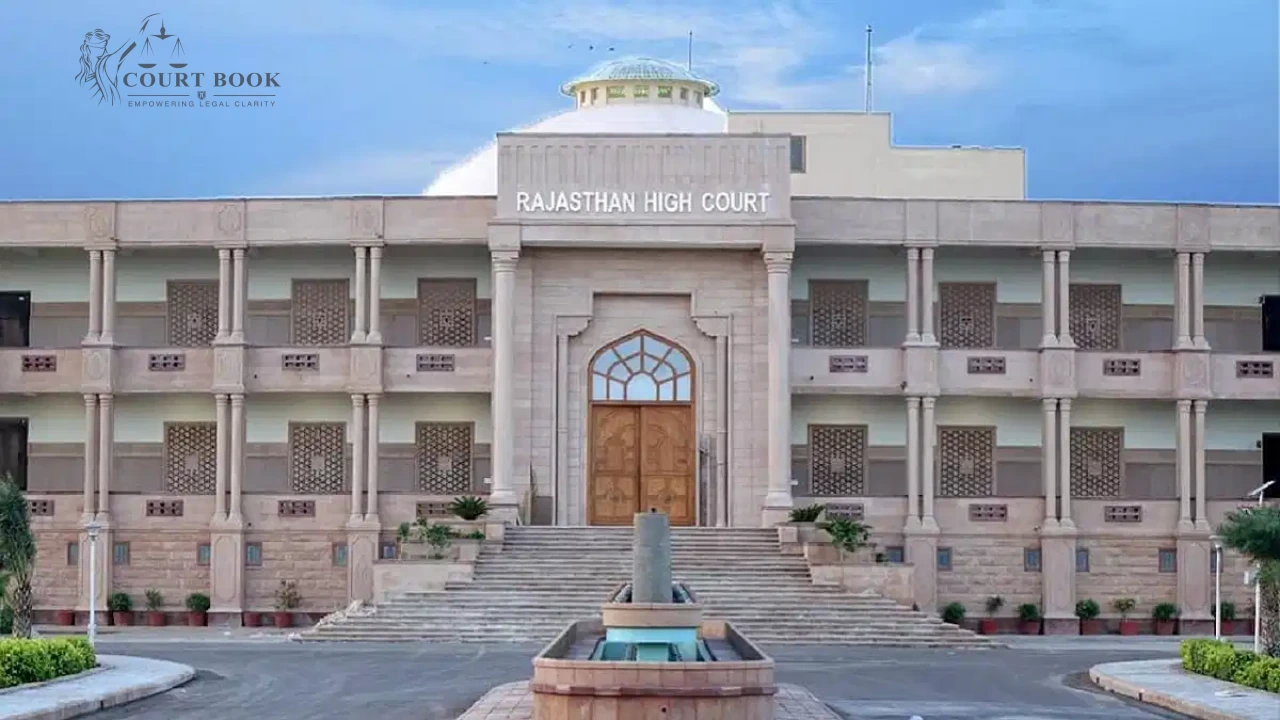
In a significant service law ruling, the Rajasthan High Court has refused to interfere with the dismissal of a Central Bank of India officer, holding that courts cannot act as appellate authorities in departmental matters. The court upheld the penalty imposed nearly two decades ago, observing that the disciplinary process was fair, lawful, and backed by sufficient evidence.
Background of the Case
The case involved A.K. Tandon, a former officer of the Central Bank of India, who had challenged his dismissal from service imposed in February 2002. The punishment followed a departmental enquiry conducted under the Central Bank of India Officer Employees’ (Discipline & Appeal) Regulations, 1976.
Tandon had approached the Rajasthan High Court under Articles 226 and 227 of the Constitution, questioning both the dismissal order and the appellate authority’s decision which upheld it. He argued that the punishment was excessive, arbitrary, and imposed without proper consideration of his medical condition.
According to the petitioner, repeated adjournments were denied despite medical certificates, and the enquiry was conducted ex-parte, violating principles of natural justice.
Arguments Before the Court
The petitioner’s counsel contended that:
• The punishment of dismissal was disproportionate to the alleged misconduct.
• The enquiry officer ignored medical records and genuine health issues.
• Adequate opportunity to defend was denied.
• The appellate authority failed to apply independent reasoning.
On the other hand, the bank strongly opposed the plea, stating that:
• The enquiry followed due process and granted multiple opportunities.
• Medical certificates were found unreliable and inconsistent.
• The employee avoided appearing before the Medical Board despite repeated directions.
• The misconduct involved serious charges, including financial irregularities and indiscipline.
Court’s Observations
Justice Anand Sharma, after examining the entire record, noted that judicial review in disciplinary matters is limited in scope. The Court reiterated that it cannot reassess evidence or substitute its own conclusions for those of the disciplinary authority.
“The High Court cannot act as an appellate forum in departmental proceedings. Its role is confined to examining the fairness of the process, not the correctness of the decision,” the bench observed.
The Court gave detailed attention to the enquiry report, which documented how the petitioner repeatedly avoided appearing before the Medical Board, submitted doubtful medical certificates, and failed to cooperate with the proceedings.
The judge also relied on several Supreme Court rulings, including Union of India v. P. Gunasekaran and Union of India v. Sunil Kumar, which clearly state that punishment can be interfered with only when it is shockingly disproportionate or legally perverse.
Findings on Medical Grounds
The High Court rejected the argument that the enquiry violated natural justice due to denial of adjournments. It noted that:
• Multiple adjournments had already been granted.
• Medical certificates were inconsistent and in some cases altered.
• The petitioner failed to appear before a duly constituted Medical Board.
• There was no proof that he was medically unfit to attend proceedings.
“The enquiry officer recorded detailed reasons for disbelieving the medical documents. There is nothing arbitrary in that assessment,” the Court said.
Final Decision
Concluding the matter, the High Court held that:
• The enquiry was conducted fairly and in accordance with law.
• The findings were supported by evidence.
• The punishment of dismissal was not disproportionate.
• No violation of natural justice or procedural irregularity was made out.
Accordingly, the writ petition was dismissed, and the penalty imposed on the officer was upheld.
“There is no ground for interference under Articles 226 and 227 of the Constitution,” the Court ruled.
Case Title: A.K. Tandon vs Central Bank of India
Case Number: S.B. Civil Writ Petition No. 9608/2002
Decision Date: 16 January 2026


