The Gauhati High Court has set aside a settlement recorded by a National Lok Adalat after finding that it was passed without the presence or consent of the concerned party. The court ruled that a compromise cannot be treated as valid if the party itself was absent and only the lawyer appeared without written authority.
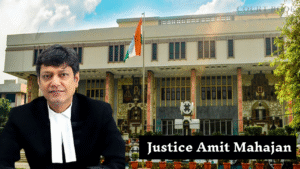
The order was passed by Justice Sanjay Kumar Medhi while hearing a writ petition filed by Mahindra and Mahindra Financial Services Ltd., challenging a settlement recorded by the Assam State Consumer Disputes Redressal Commission.
Background of the Case
The dispute arose from a consumer complaint filed in Goalpara district. The District Consumer Forum had earlier passed an ex parte order directing Mahindra and Mahindra Financial Services Ltd. to pay certain amounts to the complainant, Hakim Uddin.
Aggrieved by the order, the company filed an appeal before the Assam State Consumer Disputes Redressal Commission. The appeal was later taken up in a National Lok Adalat held on 14 September 2024, where a settlement was recorded.
However, the finance company challenged this settlement before the Gauhati High Court, arguing that:
• No authorised company representative was present at the Lok Adalat
• The advocate appearing had no written authority to settle the matter
• The settlement was recorded without the company’s consent
Based on these grounds, the company approached the High Court under Article 226 of the Constitution.
Court’s Observations
The High Court examined whether a Lok Adalat can record a settlement when one of the parties is absent and only the lawyer is present.
Referring to Section 21 of the Legal Services Authorities Act, the court noted that Lok Adalat awards are final and binding. However, the court clarified that such finality applies only when a genuine settlement is reached between the parties themselves.
“The objective of the Act is to bring disputes to a final settlement, which necessarily requires the presence and free consent of the parties,” the bench observed.
Justice Medhi also referred to Supreme Court rulings, including State of Punjab vs Jalour Singh and Bharvagi Constructions vs Kothakapu Muthyam Reddy, which held that Lok Adalat awards can be challenged in writ jurisdiction if basic legal requirements are not met.
No Proof of Authorisation
A key issue before the court was whether the company’s lawyer had written authorisation to settle the matter.
The High Court examined the records of the Consumer Commission and found no document showing that the advocate had authority to enter into a compromise on behalf of the company.
“The records do not show any authority letter empowering the counsel to sign or settle the dispute,” the court noted.
The judge further observed that when a company is involved, only an authorised officer can legally consent to a settlement. Mere appearance of counsel, without written permission, is not enough.
Decision of the Court
Setting aside the Lok Adalat order dated 14 September 2024, the High Court held that:
• A valid settlement requires the presence and consent of the parties
• A lawyer cannot bind a party without written authority
• The Lok Adalat settlement in this case was not legally sustainable
Accordingly, the court quashed the Lok Adalat order and directed the Assam State Consumer Disputes Redressal Commission to hear the appeal afresh on merits.
“The appeal shall be decided expeditiously in accordance with law,” the court directed.
The writ petition was disposed of, and the case records were ordered to be returned to the Commission immediately.
Case Title: Mahindra and Mahindra Financial Services Ltd vs Hakim Uddin
Case No.: WP(C)/4029/2025
Decision Date: 08 January 2026
Download Judgment