

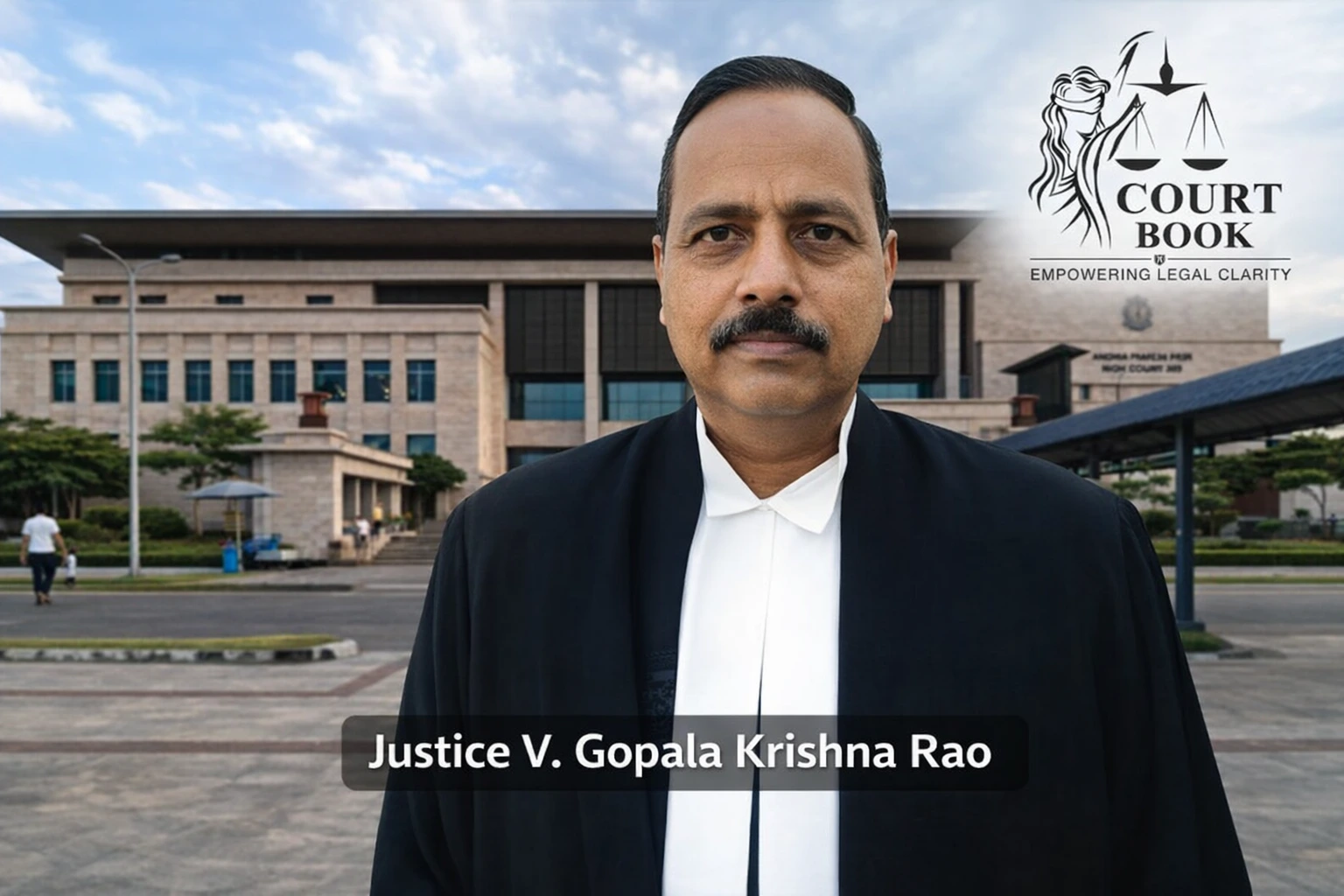
The Andhra Pradesh High Court has declined to revive a second appeal in a family property dispute after finding no valid explanation for a delay of more than five years. The court held that limitation laws cannot be stretched to cover prolonged inaction, even when property rights are involved.
The order was passed by Justice V. Gopala Krishna Rao on January 5, 2026, while dismissing an application seeking condonation of delay in filing the appeal
Background of the Case
The dispute traces its roots to a partition suit filed in 2002 by the legal heirs of Subbanarasimhulu, seeking division of joint family properties at Rajampet in Kadapa district. The trial court dismissed the suit in 2011, holding that the plaintiffs failed to clearly establish the nature and identity of the properties.
An appeal followed. In 2013, the first appellate court partly allowed the appeal, ruling that one item of the property was liable for partition. Aggrieved by this partial relief, M. Muralikrishna approached the High Court but only after a delay of 1,221 days.
To overcome this hurdle, he filed an interlocutory application asking the court to excuse the delay and hear the second appeal on merits.
Arguments Before the Court
The appellant argued that he had been residing in Dubai since 2003 and claimed he came to know about the appellate court’s 2013 judgment much later. He also cited ill health as a reason for not approaching the court in time.
Read also:- Supreme Court Clears Arbitration in Motilal Oswal Lease Dispute, Rejects Small Causes Court Objection
The respondents strongly opposed the plea. They pointed out that the appellant had actively pursued earlier litigation through lawyers in India, even while living abroad. According to them, the delay was excessive, unexplained, and showed a clear lack of diligence.
Court’s Observations
After examining the record, the High Court found several gaps in the appellant’s explanation. The bench noted that there was no clear statement about when the appellant returned to India or why he could not stay informed about the case outcome despite having engaged counsel earlier.
The court also observed that even after obtaining certified copies of the appellate judgment in 2017, the appellant waited nearly another year to file the second appeal.
Rejecting the health-related excuse, the judge pointed out that no medical documents were produced.
“There is no whisper in the affidavit about the nature of illness or any period of hospitalization,” the court observed.
Read also:- Fake Bank Guarantee Case: Karnataka High Court Blocks Railways from Blacklisting Contractor
Law on Limitation Reiterated
Citing Supreme Court precedents, the High Court underlined that limitation laws are based on public policy and aim to bring finality to litigation.
The bench observed,
“The discretion to condone delay must be exercised judiciously. Courts have no power to ignore statutory limitation on equitable grounds.”
It further emphasized that long and unexplained delays, coupled with negligence or inaction, cannot be condoned merely to reopen disputes.
Final Decision
Concluding that the appellant failed to show “sufficient cause” for the 1,221-day delay, the High Court dismissed the application for condonation of delay. As a direct consequence, the second appeal itself was rejected, bringing the prolonged litigation to an end.
Case Title: M. Muralikrishna vs Masapalli Venkatarathnamma & Others
Case Number: Second Appeal No. 1488 of 2018
Date of Order: 5 January 2026


