

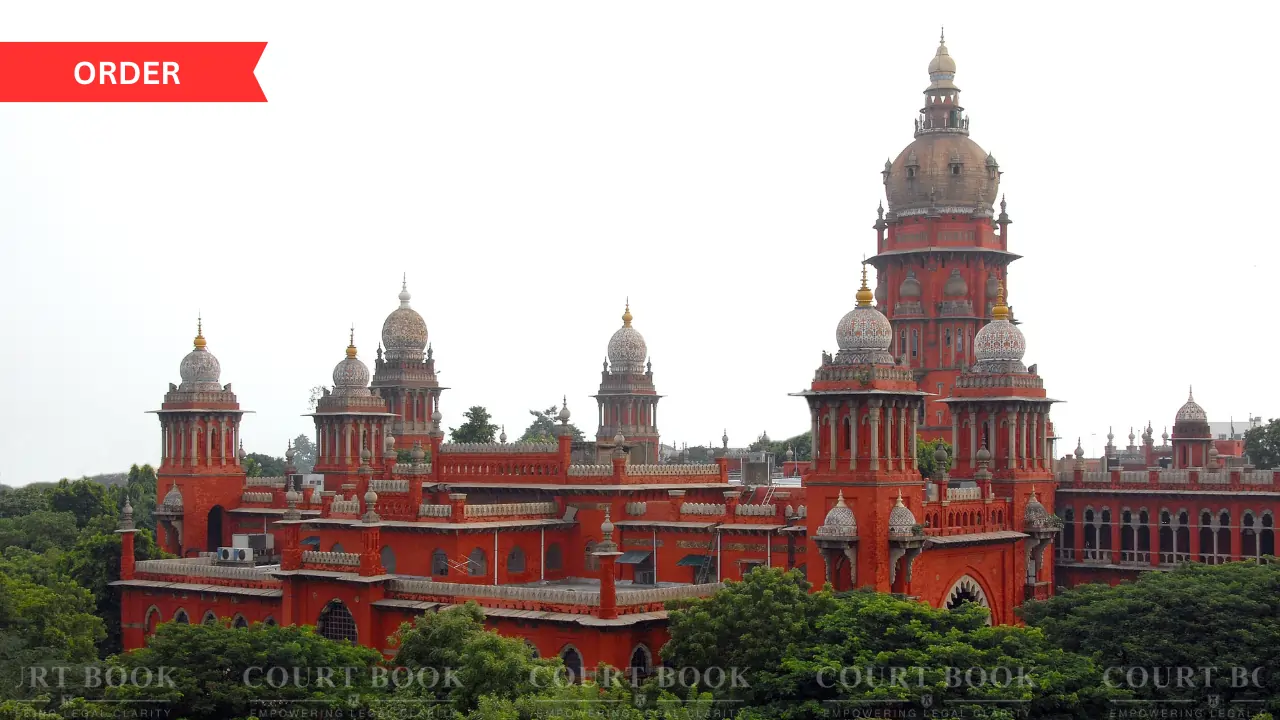
In a significant ruling, the Madras High Court clarified the limits of criminal liability for advocates, holding that a lawyer cannot be prosecuted for defamation based on statements made on a client’s instructions. The Court partly allowed petitions seeking to quash proceedings in a pending criminal case.
Background of the Case
The matter arose from two petitions seeking to quash proceedings in C.C. No. 376 of 2021 pending before the Judicial Magistrate No. I, Tiruvallur.
The dispute has its roots in a civil case filed before the Family Court, Chennai, where one party sought to declare a marriage null and void, alleging it was forced. According to the complainant, this civil action triggered retaliatory steps by the accused.
Read also:- Supreme Court Allows Hotel Owner to Join Building Rules Case, Sets Aside Punjab & Haryana HC Order
It was alleged that the first accused, along with others, lodged a complaint under the POCSO Act through a minor, accusing the complainant of misconduct. However, that complaint was later dismissed by the Mahila Court after inquiry.
The complainant further alleged that defamatory statements were circulated to media outlets and newspapers, damaging his reputation.
Justice G. K. Ilanthiraiyan closely examined the role of each accused, particularly focusing on the third accused, who was an advocate representing the others.
Read also:- No Pension Without 20 Years’ Service: Supreme Court Dismisses SBI Employee’s Claim
The Court noted that apart from a general allegation of “assisting and abetting,” there were no specific accusations against the lawyer.
“The lawyer acts on instructions given by the client and does not independently verify the truth of those facts,” the Court observed.
It added that holding advocates criminally liable in such situations would go against settled legal principles.
“Any responsibility arising from such instructions would rest with the client and not the lawyer,” the bench clarified.
The Court termed the complaint against the advocate as an “abuse of process of law.”
Based on these findings, the High Court quashed the criminal proceedings against the third accused (the advocate), allowing the petition filed in this regard.
However, the Court took a different view regarding the first accused. It found that there were specific allegations of defamation under Sections 500 and 109 of the Indian Penal Code, which required examination during trial.
Accordingly, the petition seeking to quash proceedings against the first accused was dismissed.
The Court also directed the trial court to complete the proceedings within three months from the date of receiving the order.
case details
Case Title: J.N. Naresh Kumar vs Jayakaran Vasudevan & Ors.
Case Numbers: Crl.O.P. No. 8047 of 2022 & Crl.O.P. No. 20189 of 2023
Judge: G. K. Ilanthiraiyan
Court: Madras High Court
Decision Date: 02 March 2026
Download Judgment

