

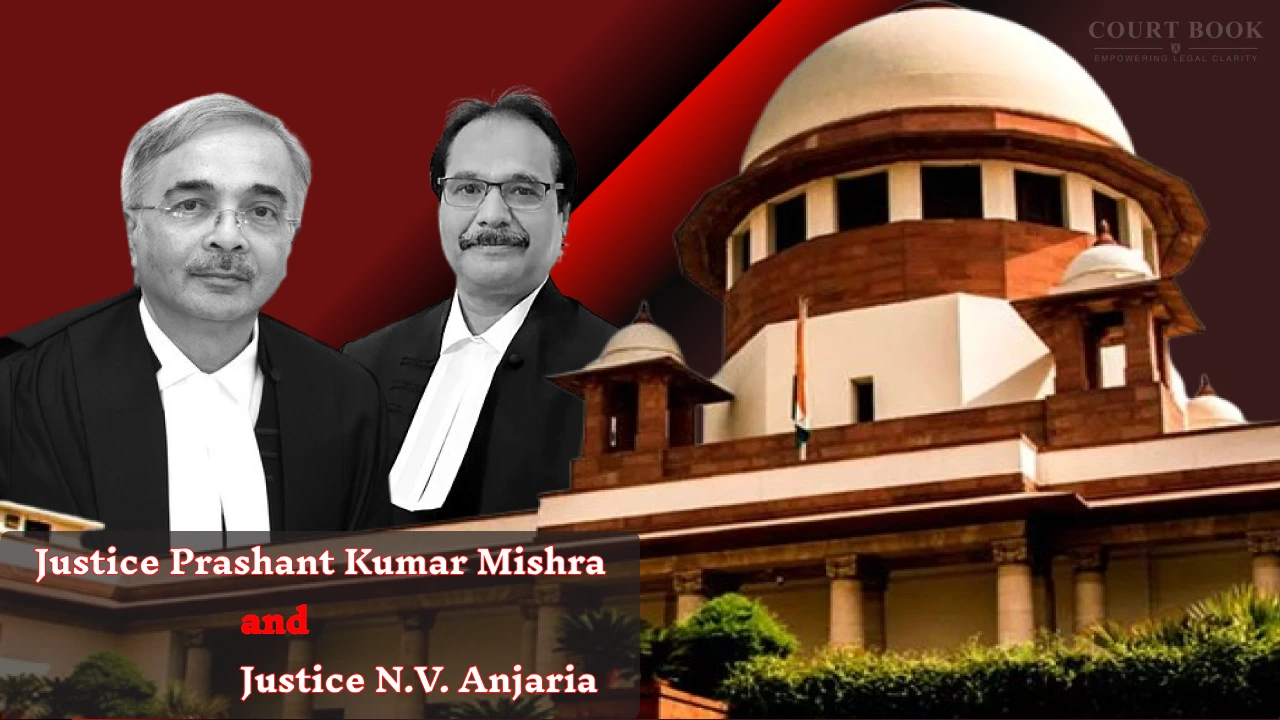
In a significant ruling, the Supreme Court has dismissed a long-pending claim for pension by a former State Bank of India employee, holding that eligibility conditions under pension rules must be strictly fulfilled. The Court examined both the length of service and the nature of exit from employment before arriving at its decision.
Background of the Case
The case arose from a dispute between K.G. Seshadri, a former clerk with the State Bank of India, and the bank’s trustees. The appellant had joined service in 1978 and was confirmed in 1979. However, after leaving for abroad and remaining absent for a prolonged period, his services were treated as voluntarily abandoned in 1998.
Years later, he sought pension benefits, claiming he had completed over 20 years of service and was entitled under the SBI Employees’ Pension Fund Rules, 1955. The bank rejected his request, prompting a series of legal proceedings before the Labour Court and the Madras High Court, both of which ruled against him.
The Supreme Court noted that earlier courts had dismissed the case on technical grounds, particularly the limited scope of proceedings under Section 33C(2) of the Industrial Disputes Act. However, the bench chose to examine the matter on merits.
“The issue before us is whether the appellant satisfies the eligibility conditions for pension,” the bench observed.
The appellant argued that he had completed more than 20 years of service and relied on Rule 22(i)(c), which allows pension after 20 years of service irrespective of age, provided the employee voluntarily retires.
The Court carefully examined how pensionable service is calculated under the rules. It clarified that service is counted from the date of confirmation, not initial appointment.
Read aslo:- Bombay High Court Orders Removal of Shivaji Statue from Port Land, Slams State Inaction
After recalculating, the bench found that the appellant had completed only 19 years, 9 months, and 25 days of qualifying service.
“The first condition of completing twenty years of pensionable service is not fulfilled,” the Court held.
A key issue was whether the appellant’s exit could be treated as voluntary retirement.
The Court rejected this argument, noting that the appellant had remained absent without authorization for a long period and failed to respond satisfactorily to notices issued by the bank.
“This is not a case of voluntary retirement, but of voluntary abandonment of service,” the bench stated.
It further clarified that Rule 22(i)(c) applies only when an employee formally seeks retirement, which was not the case here.
The Court also examined Rule 22(i)(a), which requires both 20 years of service and attainment of 50 years of age.
The appellant failed on both counts. He had neither completed 20 years of service nor reached the required age at the time of cessation.
Concluding that the appellant did not meet the eligibility criteria under any applicable provision, the Supreme Court dismissed the appeal.
“The appellant cannot be said to be eligible for pension under the Pension Fund Rules,” the bench held, bringing the matter to a close.
Case Details
Case Title: K.G. Seshadri vs The Trustees of State Bank of India & Another
Case Number: Civil Appeal No. 4279 of 2026
(Arising out of SLP (Civil) No. 12462 of 2022)Court: Supreme Court of India
Bench / Judges: Justice Prashant Kumar Mishra and Justice N.V. Anjaria
Decision Date: April 8, 2026
Download Judgment

