

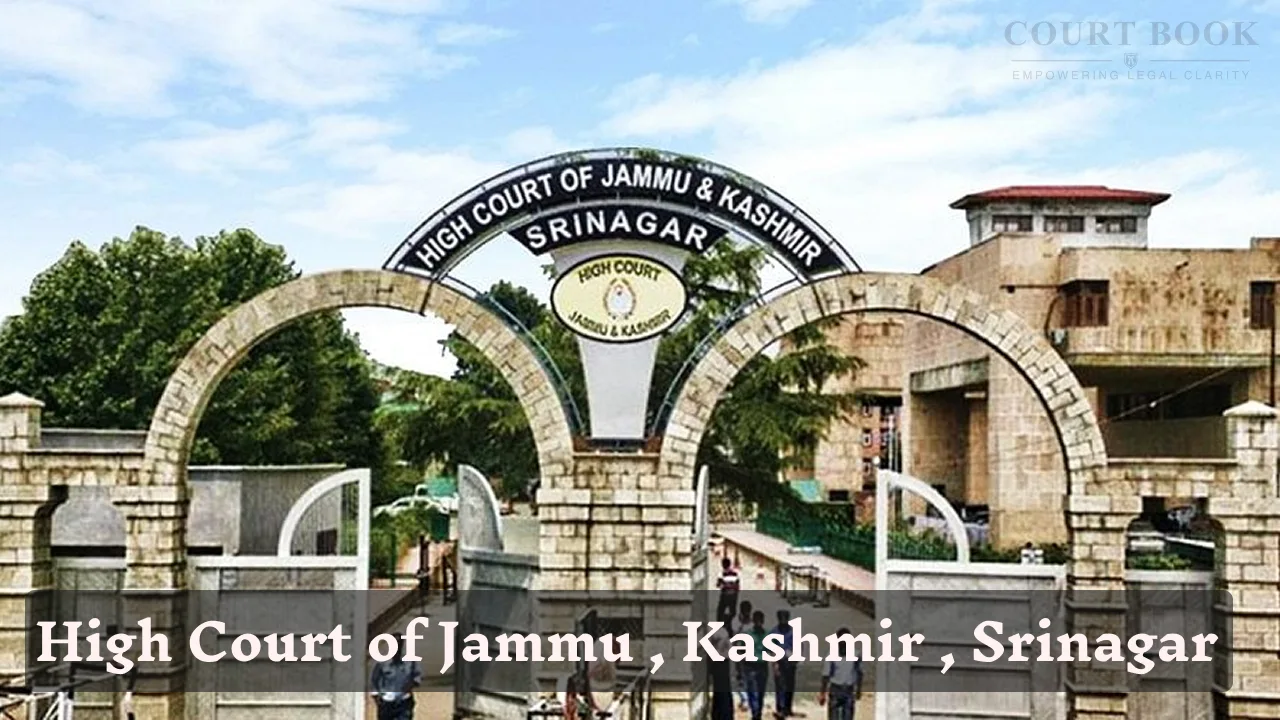
The High Court of Jammu & Kashmir and Ladakh has upheld the legal framework regulating fees charged by private schools in the Union Territory but struck down a provision that allowed a senior government bureaucrat to head the Fee Fixation and Regulation Committee (FFRC).
A Division Bench comprising Justice Sanjeev Kumar and Justice Sanjay Parihar delivered the ruling while hearing a petition filed by several private schools challenging amendments to the Jammu & Kashmir School Education Act, 2002.
Read also:-Chhattisgarh High Court Quashes Criminal Complaint Against Judges, Says Allegations Based
Background of the Case
The petition was filed by seven private educational institutions, including New Convent High School in Srinagar, which challenged amendments introduced by the Central Government through notifications issued in 2020 and 2022.
These amendments inserted Sections 20A to 20J into the J&K School Education Act, creating the Fee Fixation and Regulation Committee (FFRC). The committee was empowered to regulate and determine the fee structure of private unaided schools in the Union Territory.
The petitioners argued that the amendments gave sweeping powers to the committee, allowing it to control tuition fees, transport charges, and other components of school fees. According to them, this interfered with the autonomy of private unaided institutions recognized by the Supreme Court in several judgments, including the landmark T.M.A. Pai Foundation case.
They also challenged orders issued by the committee in 2022 allowing only limited increases in transport fees, claiming the hikes did not reflect rising costs such as fuel prices, insurance, and maintenance.
Read also:-Supreme Court Grants Anticipatory Bail To Folk Singer Neha Singh Rathore In FIR Over Posts On PM
The High Court acknowledged the growing importance of private schools in India’s education system and noted that many families rely on them due to shortcomings in public education.
“The private education system… is not merely supplementing the public education system but is, in fact, on the verge of supplanting it,” the bench observed.
However, the court emphasized that while private institutions enjoy autonomy, they cannot indulge in commercialization or profiteering.
“The establishment of a private educational institution is undoubtedly an occupation pursued by citizens by investing their money, time and labour,” the bench said, adding that reasonable surplus is permissible but excessive profiteering is not.
The court further held that regulatory oversight through a statutory body like the FFRC is permissible so long as the objective is to prevent exploitation of students through excessive fees.
While upholding most provisions of the amended law, the High Court found fault with Section 20A(2) of the Act.
The provision allowed the committee to be headed either by a retired High Court judge or a retired government officer of the rank of Financial Commissioner or above.
The court held that this part of the law violated directions previously issued by the Supreme Court.
Read also:-Kerala High Court Quashes Ombudsman Proceedings Against Village Officer, Says He Is Not
“The Supreme Court… clearly laid down that the FFRC shall be headed by a retired Judge of the High Court,” the bench observed.
Accordingly, the court declared that the provision allowing a retired bureaucrat to serve as chairperson cannot remain on the statute book and directed that the committee must be headed by a retired High Court judge nominated by the Chief Justice.
The petitioners also challenged the committee’s decision to increase transport charges by only 14 percent.
On this issue, the court noted that the matter was already under consideration by the FFRC with the involvement of relevant departments.
The bench observed that transport services are optional and not a mandatory requirement for recognition of schools. Nevertheless, it suggested that the FFRC should consult departments such as Transport and Consumer Affairs to frame guidelines for determining transport fees.
Until such guidelines are framed, the court said the existing order of the committee dated October 6, 2022 would continue to regulate transport charges.
The High Court upheld the constitutional validity of the statutory framework regulating private school fees in Jammu and Kashmir but struck down the provision allowing a retired Financial Commissioner to head the fee regulation committee.
The court directed that the FFRC must be headed by a retired High Court judge nominated by the Chief Justice and asked the authorities to revisit the fee regulation rules to provide clearer guidelines.
The writ petition was disposed of in these terms.
Case Title: New Convent High School & Others v. Union of India & Others
Case No.: WP(C) No. 1070/2022
Decision Date: 28 January 2026


