

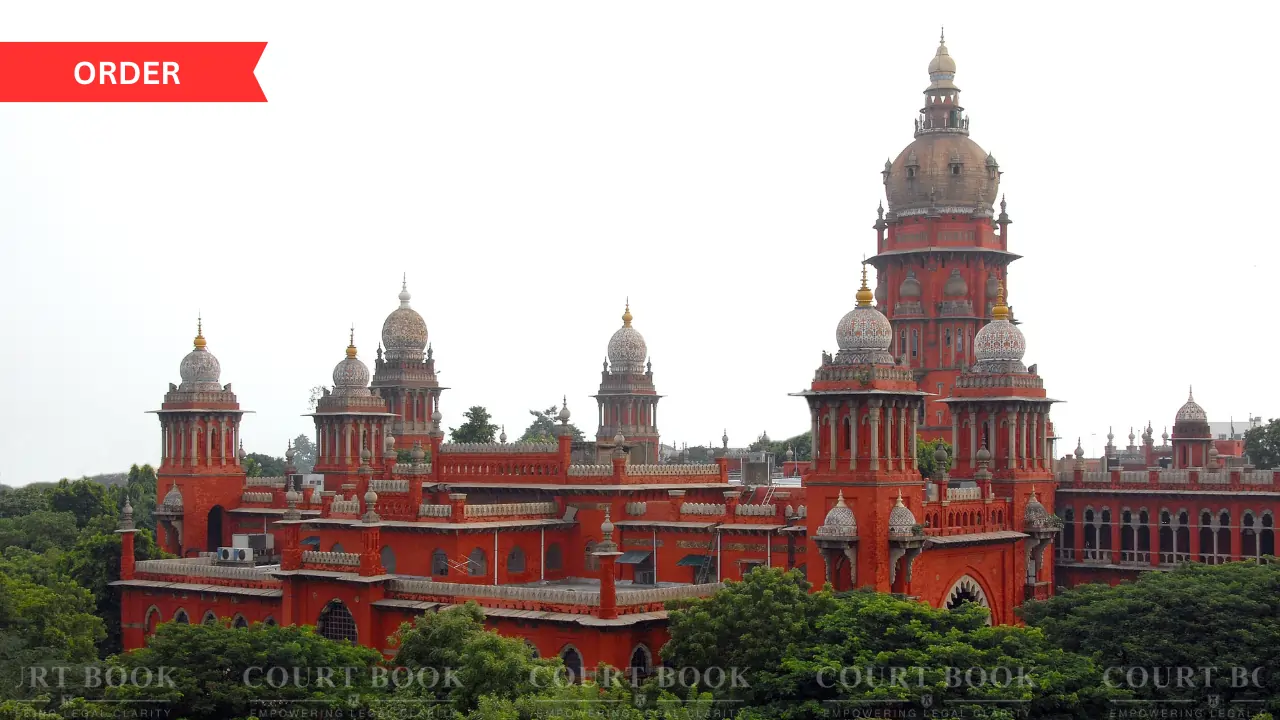
The Madras High Court has set aside the Tamil Nadu Waqf Board’s decision appointing a Mutawalli for a historic dargah in Chennai, holding that the Board could not exercise control over the institution without first establishing that the property was legally a waqf under the procedure prescribed by law.
Justice K. Govindarajan Thilakavadi delivered the judgment while allowing an appeal filed against an order of the Tamil Nadu Waqf Tribunal.
Background of the Case
The dispute concerned the Sarkar Syed Habibullah Sha Khadari Arif Rabbani Hazarath Dargah located on Kamaraj Road in Triplicane, Chennai.
The appellant claimed that his family had been maintaining and serving the dargah for more than four decades and argued that the Tamil Nadu Waqf Board had wrongly appointed another individual as Mutawalli through resolutions passed in August and September 2023.
According to the appellant, the land on which the dargah stands is Government land and had never been lawfully declared waqf property. He challenged both the Board’s resolution and the consequential appointment order.
The Waqf Board and the appointed Mutawalli, however, maintained that the dargah was a waqf institution and that the appointment had been made after an enquiry.
After examining the records, the High Court noted that there was no material showing that the disputed property had been included in the official list of waqf properties.
The Court emphasized that the law requires a statutory survey and notification process before a property can be treated as waqf property.
“The conducting of the surveys before declaring a property a Waqf property is a sine qua non,” the Court observed.
Justice Thilakavadi further stated that the mere existence of a dargah, tomb, or shrine does not automatically make the property a waqf.
The Court observed that there must be evidence of permanent dedication for religious, charitable, or pious purposes as recognized under Muslim law. It also found that the respondents had failed to establish that the property qualified as a “waqf by user” through long and uninterrupted public religious use.
The judgment stressed that the Waqf Board cannot assume jurisdiction over a religious institution simply because it is associated with the Muslim community.
“Appointment of a Mutawalli ordinarily presupposes the existence of a waqf,” the Court noted while examining the Board’s powers.
Allowing the appeal, the Madras High Court held that the Waqf Board had not established the foundational facts necessary to exercise authority over the dargah.
The Court ruled that the Board’s resolution dated August 23, 2023, and the consequential order dated September 14, 2023, appointing the fifth respondent as Mutawalli, were legally unsustainable and liable to be set aside.
Accordingly, the appeal was allowed, the impugned orders were quashed, and the connected miscellaneous petition was closed.
No costs were awarded.
Case Details
Case Title: Sarkar Syed Habibullah Sha Kahdari Arif Rabbani Hazarat Dargha v. Tamil Nadu Waqf Board & Others
Case Number: C.M.A. No. 2062 of 2025
Judge: Justice K. Govindarajan Thilakavadi
Decision Date: June 5, 2026


