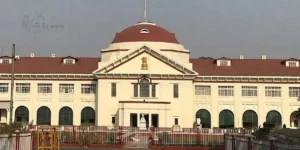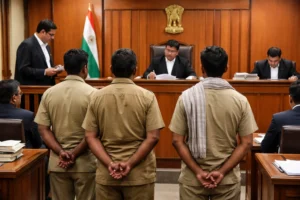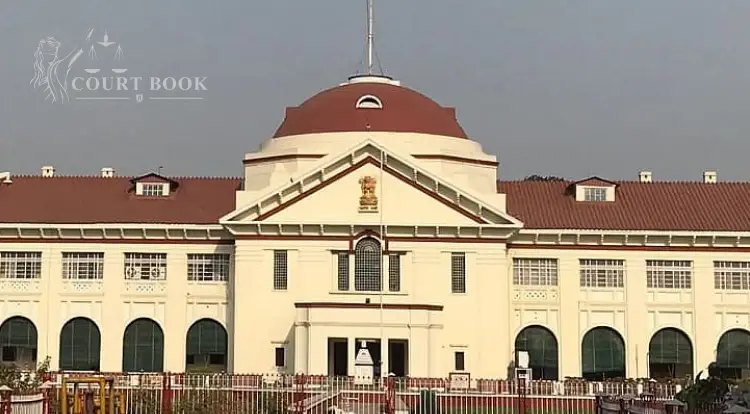
The Patna High Court has directed the Bihar Government to process and sanction family pension in favour of Najma Khatoon, the second wife of a deceased government employee, holding that a valid marriage under Mohammedan Personal Law cannot be ignored while considering pension benefits. Justice Purnendu Singh observed that the State's own 2011 clarification protecting such entitlement continues to remain in force and has not been withdrawn.
Background of the Case
The petition was filed by Najma Khatoon after the death of her husband, Md. Usman, on October 14, 2024. She sought directions for the immediate release of family pension along with arrears from October 15, 2024.
Her counsel argued that the Bihar Finance Department's Resolution dated June 27, 2011 makes it clear that where a deceased Muslim government employee had more than one legally valid wife under Mohammedan Personal Law, the surviving widows are entitled to family pension in equal proportion. The petitioner also relied on records showing that during his lifetime, the deceased had requested authorities to substitute her name in the pension records following the death of his first wife.
The State, however, contended that although Muslim Personal Law permits polygamy, Rule 23 of the Bihar Government Servants Conduct Rules, 1976 requires prior government permission before a serving employee contracts a second marriage. The Accountant General submitted that pension benefits could only be released after sanction by the competent authority.
Court's Observations
Justice Purnendu Singh examined the interaction between constitutional principles, personal law and service rules. The Court noted that Article 44 of the Constitution speaks of a Uniform Civil Code as a Directive Principle, but no legislation currently prohibits polygamy among Muslims across the country.
The Court observed,
"In the absence of any legislation introducing a Uniform Civil Code... Mohammedan Personal Law continues to govern the marital rights and obligations of Muslims."
The judgment further explained that while Rule 23 regulates the conduct of government servants, it contains an exception where a second marriage is permissible under the applicable personal law, subject to government permission. Referring to the Supreme Court's decision in Rameshwari Devi v. State of Bihar, the Court reiterated that personal law remains relevant while examining entitlement to pension-related benefits.
The Court also found that the State had not specifically denied the petitioner's claim under the 2011 Finance Department Resolution. According to the judgment, the resolution is clarificatory in nature, has not been superseded and therefore continues to govern such cases.
Court's Decision
Allowing the writ petition, the High Court directed the Civil Surgeon, Lakhisarai, to complete all necessary formalities for sanctioning family pension in favour of Najma Khatoon. It further ordered the Accountant General, Bihar, to issue the Pension Payment Order immediately after receiving the required documents.
The Court also stated that if the Civil Surgeon delays the sanction beyond two weeks without any lawful reason, the petitioner would be free to take appropriate legal action in accordance with law.
The writ petition was accordingly allowed.
Case Details
Case Title: Najma Khatoon v. The State of Bihar and Others
Case Number: Civil Writ Jurisdiction Case No. 5393 of 2026
Judge: Justice Purnendu Singh
Decision Date: July 21, 2026