

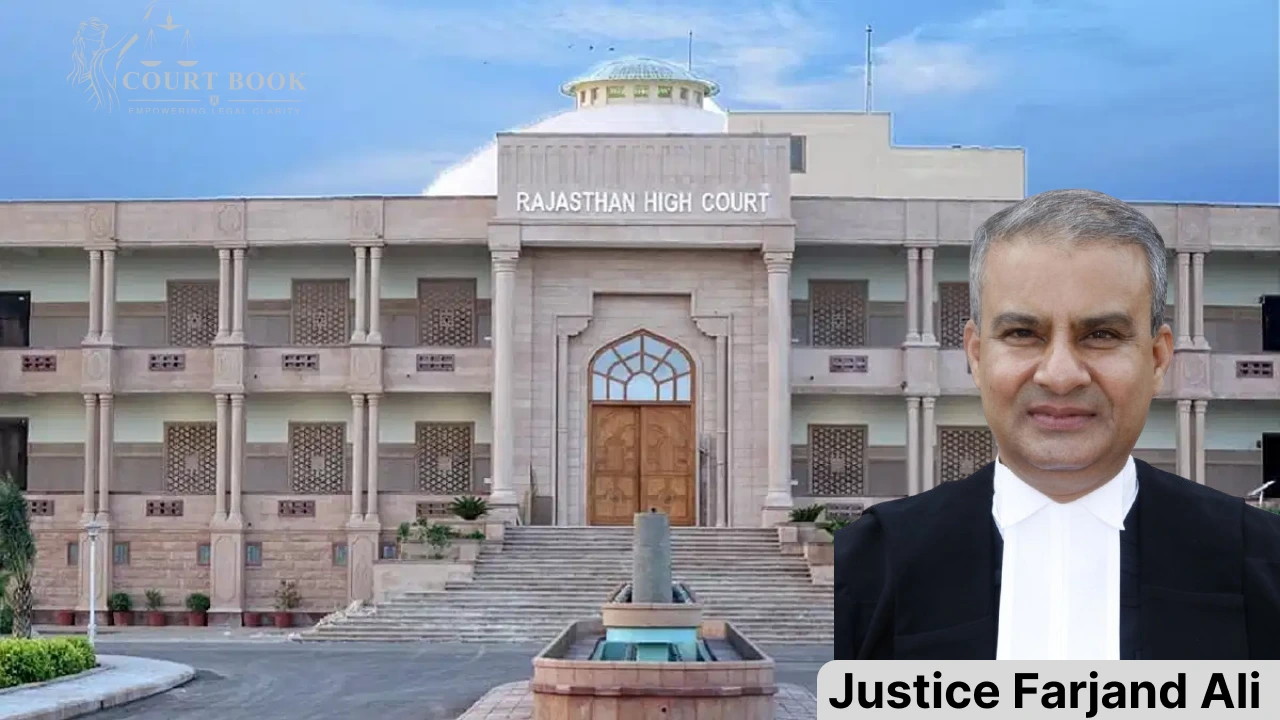
The Rajasthan High Court at Jodhpur has dismissed a second appeal filed in a long-running property dispute, holding that a High Court exercising powers under Section 100 of the Code of Civil Procedure cannot re-evaluate evidence merely because another interpretation is possible.
Justice Farjand Ali said the concurrent findings recorded by the trial court and the first appellate court did not suffer from perversity or any substantial legal error requiring interference.
Background of the Case
The dispute arose from an alleged agreement to sell dated February 5, 1999. The plaintiffs claimed that respondent Narendra Singh had agreed to sell property to them for Rs.50,000 and had already received the agreed consideration.
According to the plaintiffs, despite the alleged agreement, the defendants later dealt with the property in a manner contrary to their claimed rights. They approached the civil court seeking specific performance of the contract, cancellation of a sale deed, and permanent injunction.
However, the trial court dismissed the suit in February 2023. That decision was later affirmed by the Additional District Judge, Parbatsar, in August 2025. The plaintiffs then approached the High Court through a second appeal.
Counsel for the appellants argued that the courts below had wrongly appreciated the evidence and improperly disbelieved the agreements relied upon by the plaintiffs. It was contended that the findings were perverse and based on misreading of evidence.
On the other hand, the respondents argued that both lower courts had carefully examined the oral and documentary evidence and had rightly found the agreements dated February 5, 1999 and May 31, 1999 unreliable and unproved. The respondents also submitted that the property had already been transferred in favour of another person and that no substantial question of law arose in the appeal.
After reviewing the records, Justice Farjand Ali observed that the trial court had conducted a detailed examination of the evidence and framed all necessary issues arising from the pleadings.
The High Court noted that the lower courts found several inconsistencies and contradictions in the plaintiffs’ evidence. The bench observed that the agreements relied upon by the plaintiffs “were not worthy of credence and failed to satisfy the standard of proof required in civil proceedings of such nature.”
The court further recorded that the first appellate court independently reassessed the evidence and concurred with the trial court’s conclusions.
Referring to the scope of second appeals under Section 100 CPC, the bench said,
“The High Court, while exercising second appellate jurisdiction, is not expected to function as a third court of facts.”
Justice Ali also clarified that reappreciation of evidence in a second appeal is permissible only when findings are patently perverse or suffer from manifest illegality.
The High Court held that the appellants had failed to demonstrate the existence of any substantial question of law. It concluded that the appeal merely sought a fresh re-evaluation of facts already examined by two courts.
Finding no perversity, illegality, or jurisdictional error in the impugned judgments, the court dismissed the civil second appeal.
Case Details:
Case Title: LRs of Mahaveer Singh v. Narendra Singh & Ors.
Case Number: S.B. Civil Second Appeal No. 251/2025
Judge: Justice Farjand Ali
Decision Date: May 7, 2026
Download Order

