

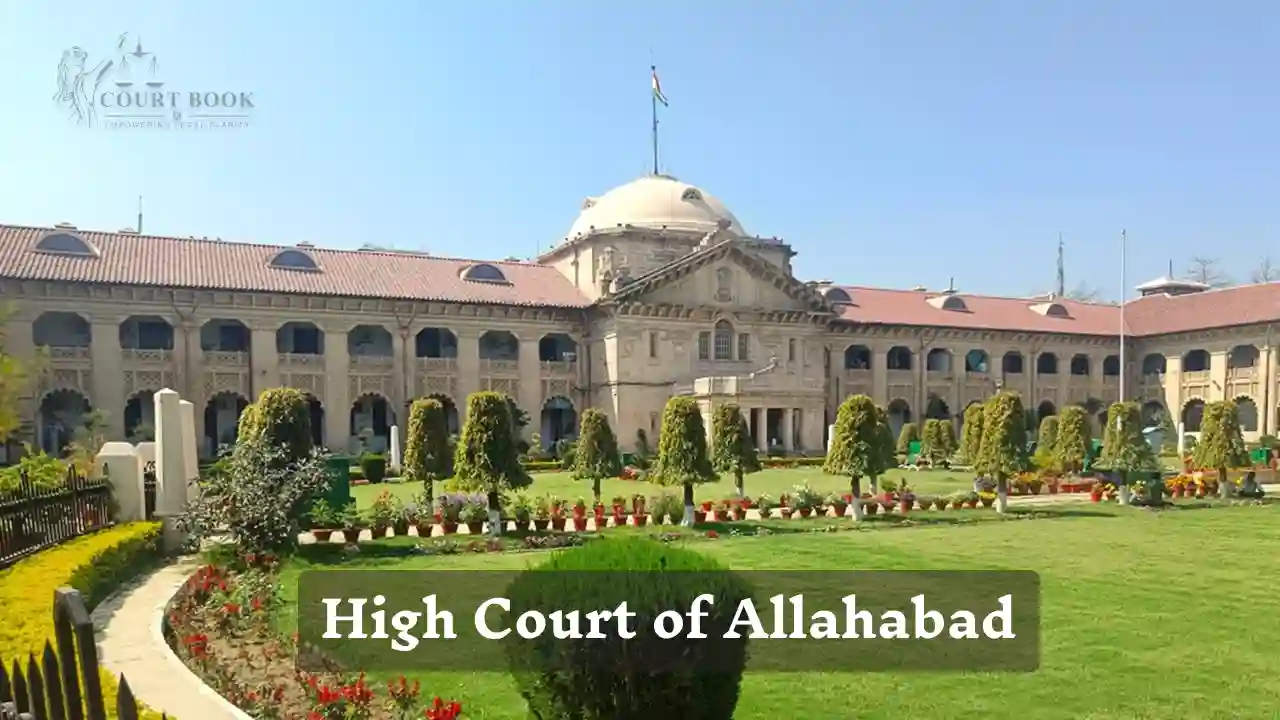
The Allahabad High Court has reaffirmed that the testimony of a rape survivor, if found credible, is sufficient to sustain a conviction and that probation cannot be granted as a matter of right in cases of sexual violence. Deciding a criminal appeal filed in 1983, the Court upheld the conviction of the accused under Section 376 IPC, declined his request for probation, and directed him to pay ₹50,000 as compensation to the victim after finding that the trial court had failed to impose the mandatory fine.
Background of the Case
The case goes back to February 1982. According to the prosecution, the victim, then a teenager, had gone to relieve herself near a nala (canal) in Mohalla Rajapur in Allahabad when two men, Rakesh and Prakash, caught hold of her and raped her one after the other. When she resisted, they allegedly assaulted her.
Her father, Basdeo, lodged a written complaint, and an FIR was registered under Sections 376 and 323 IPC at Police Station Cantt. After investigation, a chargesheet was filed and the matter went to trial before the IV Additional Sessions Judge, Allahabad, registered as Sessions Trial No. 245 of 1982.
On 23 May 1983, the trial court convicted Rakesh under Section 376 IPC and sentenced him to three years of rigorous imprisonment. He challenged this conviction before the High Court, and the matter sat there, reserved and pending, for decades before finally being heard.
Arguments in Court
Appellant's counsel, Imran Syed, didn't really press on the facts of the case. Instead, the focus was almost entirely on sentencing. The submission was simple even if the court found Rakesh guilty, he should be given the benefit of probation. The reasoning offered: the appeal had been pending for around 42 years, and the appellant himself is now over 60 years old.
The state's counsel, representing the prosecution, pushed back, arguing that the trial court's findings were sound and based on credible evidence. It was also pointed out that the state itself never filed any appeal seeking a harsher sentence.
Court's Observations
Justice Santosh Rai went through the medical evidence, the FIR, and the statements of the victim and other witnesses in detail. The medical report had noted six injuries on the victim's body, all within 24 hours of the incident something the court felt corroborated her version of events.
One of the defence arguments was that the medical report mentioned an "old torn hymen," suggesting prior sexual activity. The court was not convinced. It noted that a torn hymen can result from several causes sports, cycling, gymnastics, even an accident and some women are naturally born without an intact hymen. The bench observed that rape is a legal term, not a medical one, and a doctor's opinion about the hymen alone cannot decide whether rape occurred.
On the question of corroboration, the court reiterated a well-established principle in rape cases that the testimony of a victim, if credible and natural, doesn't need independent backing to support a conviction. Citing the Supreme Court's ruling in Ganga Singh vs. State of M.P., the bench noted that a rape victim deserves the same evidentiary weight as an injured witness.
On the probation request, the court was firm. It held that probation isn't something an accused can claim as a right, especially in serious offences involving sexual violence. Granting probation here, the judge said, would send out the wrong signal and weaken the deterrent value of the law particularly since the trial court had already taken a lenient view by awarding only three years instead of the statutory minimum of seven.
The bench also flagged a separate legal lapse the absence of any fine in the original sentence. It referred to earlier Supreme Court rulings, including State of Punjab vs. Gurmit Singh and State of M.P. vs. Ramesh, to stress that imposing a fine in such cases isn't optional; it's meant to compensate the victim and is treated as a mandatory part of the sentence.
The Decision
The High Court dismissed the plea for probation and upheld the conviction under Section 376 IPC along with the three-year rigorous imprisonment term. Going a step further, the court directed the appellant to pay Rs 50,000 as compensation to the victim, to be deposited within one month, with six months of additional imprisonment in case of default.
The appellant's bail bonds were cancelled, and he was directed to surrender before the trial court within ten days to serve out the remaining sentence, failing which coercive steps including a non-bailable warrant would follow.
Case Details:
Case Title: Rakesh vs. State
Case Number: Criminal Appeal No. 1246 of 1983
Judge: Hon'ble Santosh Rai, J.
Decision Date: June 23, 2026


