

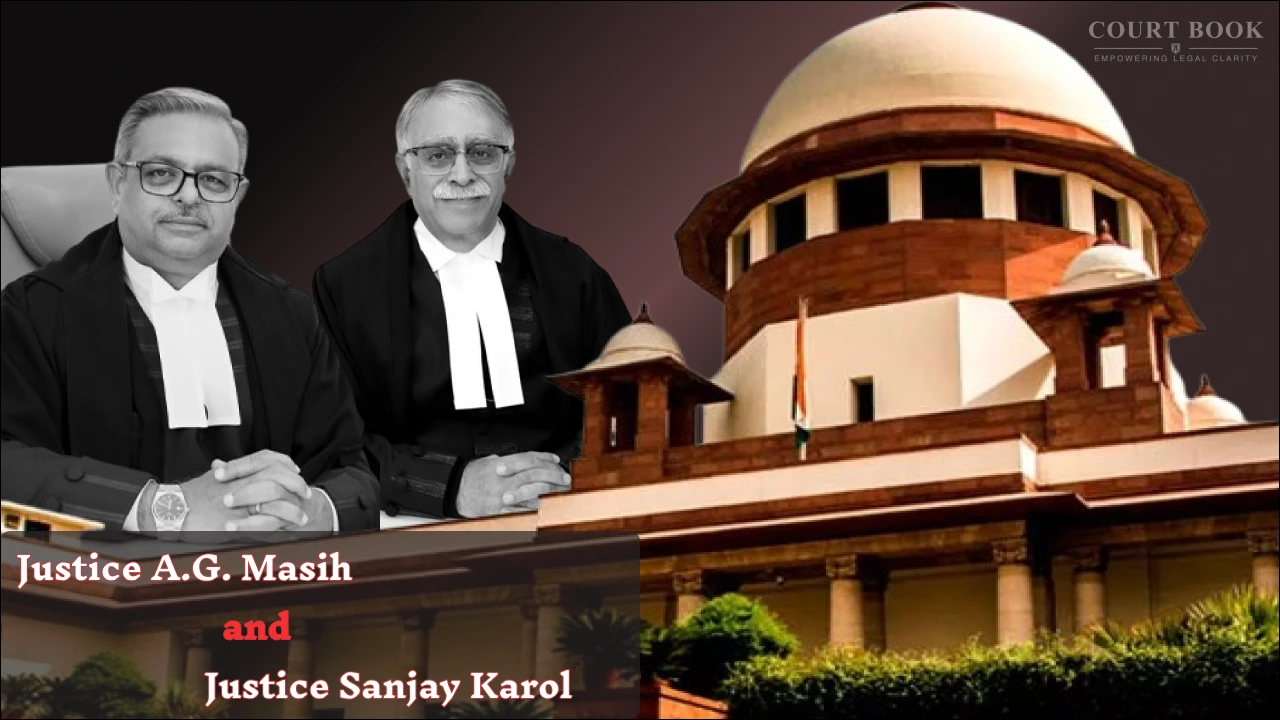
In a significant ruling on personal liberty and the duty of authorities to comply with court orders, the Supreme Court has awarded ₹11 lakh compensation to a Rajasthan prisoner who remained behind bars for 24 days despite a judicial order directing his release on permanent parole.
The Court held that once a competent court orders the release of a person and the required conditions are fulfilled, continued detention without legal authority amounts to illegal detention and violates the constitutional guarantee of personal liberty under Article 21.
Background of the Case
The appellant, Daudayal, was convicted in a criminal case and sentenced to four years of rigorous imprisonment. His conviction and sentence were upheld in appeal, following which he was arrested in December 2021.
After serving a substantial portion of his sentence, he applied for permanent parole in December 2023. The request was rejected in January 2024 because he had not previously availed regular parole.
Daudayal challenged the rejection before the Rajasthan High Court. On November 5, 2024, a Single Judge allowed his petition and directed his release on furnishing a personal bond and sureties. Despite complying with the conditions, he was not released immediately.
He subsequently approached a Division Bench through a habeas corpus petition. On December 6, 2024, the Division Bench ordered his immediate release. The prisoner later approached the Supreme Court seeking compensation, arguing that the 24-day delay between the parole order and his actual release amounted to illegal detention.
State's Defence
The State of Rajasthan argued that the High Court's parole order was contrary to the Rajasthan Prisoners Release on Parole Rules because the prisoner had not undergone the earlier stages of parole before seeking permanent parole.
The State also submitted that it was considering challenging the parole order and therefore the release process could not be completed promptly.
However, the Supreme Court noted that the State had never challenged the Single Judge's order and therefore could not question its legality at this stage.
Court's Observations
A Division bench of Justice Sanjay Karol and Justice Augustine George Masih emphasized that government authorities cannot ignore a judicial order merely because they are contemplating an appeal.
The Court reiterated the principle of "obey first, appeal later" and observed that filing or planning to file an appeal does not automatically suspend the operation of a court order.
“The only scenario in which it would not be so done was if a superior Court has granted stay in the matter,” the Bench observed.
The Court further stated that personal liberty cannot be made dependent on administrative delays or bureaucratic decision-making.
In defining illegal detention, the Bench held:
“The deprivation of liberty by the State without lawful authority or in violation of provisions of the Constitution is illegal detention.”
The judgment also extensively discussed the constitutional importance of the writ of habeas corpus and referred to several landmark decisions where courts granted compensation for unlawful detention and violations of fundamental rights.
Compensation for Violation of Liberty
Rejecting the State's contention that the appellant was not unlawfully detained because he remained a convicted prisoner, the Court held that once parole had been granted and the sureties were verified, continued incarceration lost legal backing.
The Bench observed that the State's internal processes could not justify keeping a person in custody after a valid release order.
“Just because a person had been convicted does not mean that his rights weigh less on the scales of justice,” the Court said.
The judges stressed that constitutional protections extend to every individual, including convicts, and that the State remains accountable when those protections are breached.
Decision
Allowing the appeal, the Supreme Court held that Daudayal had suffered 24 days of illegal detention after the parole order became operative and after the verification process had been completed.
The Court awarded compensation of ₹11 lakh to the appellant, directing the State of Rajasthan to deposit the amount directly into his bank account after receiving the necessary details from his counsel.
The appeal was accordingly allowed and all pending applications were disposed of.
Case Details
Case Title: Daudayal v. State of Rajasthan & Others
Case Number: Criminal Appeal arising out of SLP (Crl.) No. 5036 of 2025
Judges: Justice Sanjay Karol and Justice Augustine George Masih
Decision Date: May 29, 2026


