

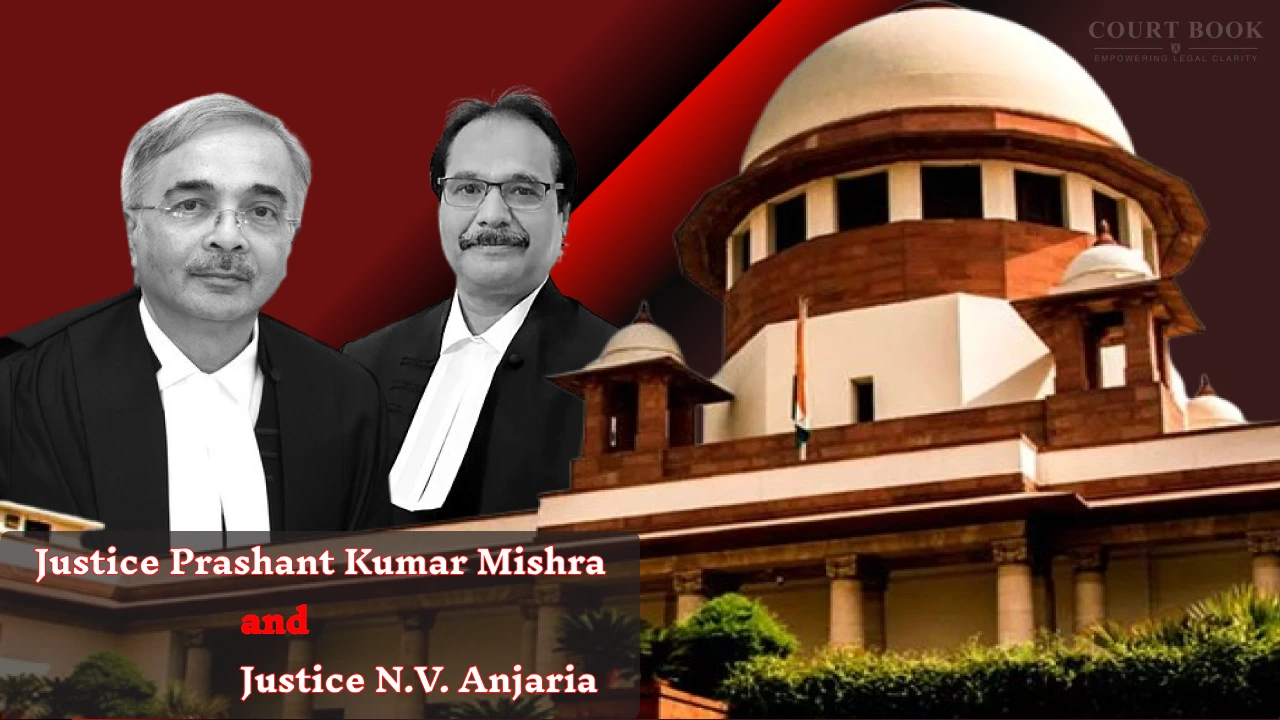
The Supreme Court has quashed criminal proceedings against four members of a Delhi family accused under the Scheduled Castes and Scheduled Tribes (Prevention of Atrocities) Act, ruling that the allegations did not satisfy the legal requirement of occurrence “within public view.”
A Bench of Justice N.V. Anjaria and Justice Prashant Kumar Mishra held that the alleged incident took place inside a residential house during a family property dispute and therefore could not attract offences under the SC/ST Act.
Background of the Case
The case arose from FIR No. 42 of 2021 registered at Kirti Nagar Police Station in Delhi after a complaint by a man against his brothers and sisters-in-law. The parties were close relatives and were already involved in a dispute over ancestral properties in Hari Nagar and Ramesh Nagar.
According to the complaint, one of the accused allegedly used caste-based slurs during an altercation on January 28, 2021, while the others allegedly threatened the complainant. Charges were framed under Sections 3(1)(r) and 3(1)(s) of the SC/ST Act and Section 506 read with Section 34 of the IPC.
The Delhi High Court had earlier refused to interfere with the trial court’s decision to frame charges, observing that the allegations and witness statements were sufficient at the initial stage.
The Supreme Court closely examined whether the allegations fulfilled the mandatory condition under the SC/ST Act that the alleged insult or abuse must occur “in any place within public view.”
The Bench referred to earlier judgments including Swaran Singh v. State, Hitesh Verma v. State of Uttarakhand, and Karuppudayar v. State, which clarified that even a private place may qualify only if members of the public can witness the incident.
“The requirement that the occurrence has to be ‘in a place within public view’ is not satisfied, is missing and absent,” the Court observed.
The Bench noted that the FIR itself showed the incident allegedly occurred inside the residential premises shared by family members. It also found no indication that independent members of the public had witnessed the incident.
The Court further said that general allegations about earlier incidents over the past year were vague and lacked specific details.
The Court also examined the IPC charge of criminal intimidation under Section 506. It held that the complaint did not show any real intention to cause “alarm,” which is a necessary ingredient for the offence.
On the allegation of common intention under Section 34 IPC, the Bench said there was nothing on record to suggest that all accused had acted together with a shared criminal purpose.
“It would be an abuse of the process of law and would amount to harassment,” the Court said while discussing continuation of the proceedings.
Allowing the appeal, the Supreme Court set aside the Delhi High Court’s judgment dated August 22, 2024, along with the trial court orders framing charges against the accused.
The FIR and the entire charge-sheet were also quashed.
Case Details
Case Title: Gunjan @ Girija Kumari & Ors. v. State (NCT of Delhi) & Anr.
Case Number: Criminal Appeal No. 2446 of 2026 (arising out of SLP (Crl.) No. 9198 of 2025)
Judges: Justice Prashant Kumar Mishra and Justice N.V. Anjaria
Decision Date: May 11, 2026
Download Judgment

