

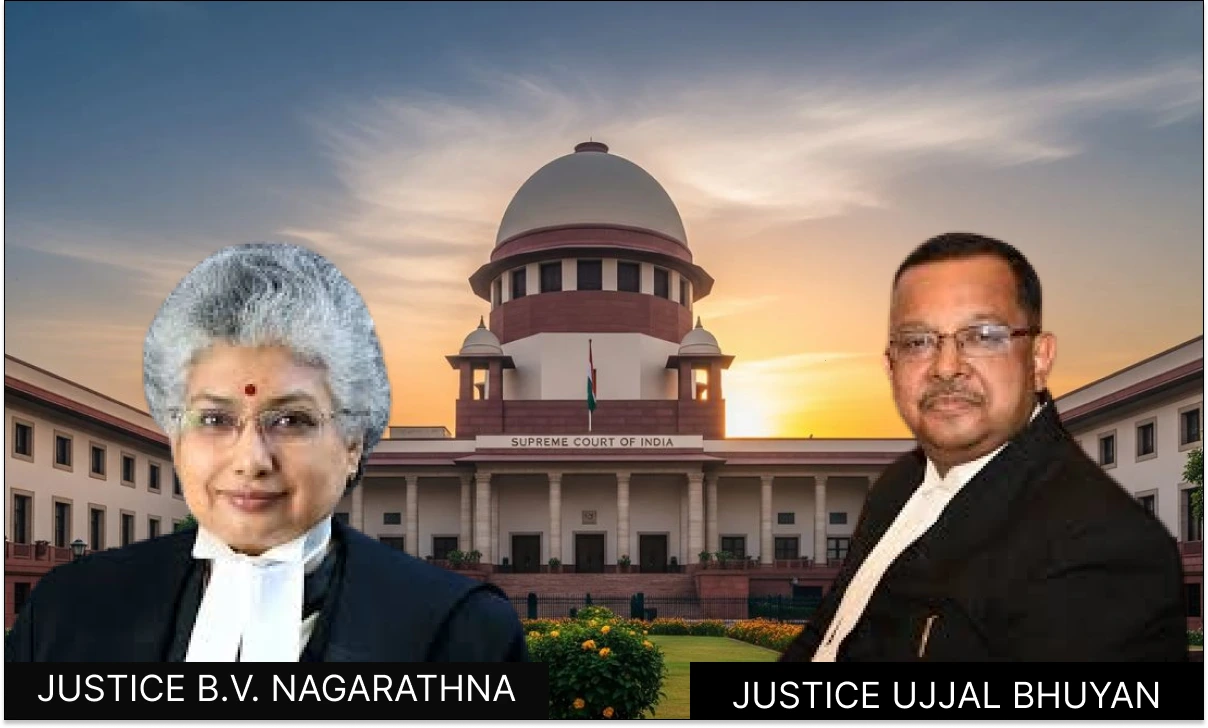
The Supreme Court has set aside a Telangana High Court order that blocked amendments to a land dispute suit, holding that courts should adopt a liberal approach when considering changes to pleadings if such amendments help determine the real issues between the parties.
A Bench of Justice B.V. Nagarathna and Justice Ujjal Bhuyan ruled that correcting property boundary details in the suit was necessary for a proper adjudication of the dispute and did not cause prejudice to the opposing party.
Background of the Case
The dispute arose from agricultural land situated in Nadigudem village of Nalgonda district, Telangana. The appellants had filed a civil suit seeking a permanent injunction against alleged interference with their possession of the land by a neighboring landowner.
During the proceedings, the appellants sought amendment of the plaint schedule, stating that the boundaries relating to one of the survey numbers had been omitted due to an inadvertent error. The trial court allowed the amendment in 2019 and later permitted a corresponding amendment in the temporary injunction application as well.
However, the respondent challenged those orders before the Telangana High Court. The High Court concluded that the proposed amendment would change the nature of the property description and effectively introduce a new cause of action. It therefore set aside the trial court's orders.
Examining the matter, the Supreme Court referred to Order VI Rule 17 of the Code of Civil Procedure, which empowers courts to allow amendments to pleadings when required for determining the real questions in controversy between the parties.
The Bench observed:
“The courts have a discretion to allow all amendments that may be necessary for determining the real question in controversy between the parties, provided it does not cause injustice or prejudice to the other side.”
The Court further noted that while deciding applications for amendment, courts should avoid getting trapped in technicalities and instead adopt a practical and liberal approach aimed at avoiding multiple rounds of litigation.
According to the Bench, the amendment sought in the present case merely sought to correct boundary particulars that had allegedly been omitted by mistake. The correction was relevant to deciding whether the plaintiffs were entitled to the relief claimed in the suit.
The Court also emphasized that the amendment application had been filed before commencement of trial. The respondent would have sufficient opportunity to file additional pleadings and contest the amended case, meaning no prejudice would be caused.
Allowing the appeals, the Supreme Court held that the High Court was not justified in interfering with the trial court's orders permitting amendment of the plaint and injunction application.
The Bench restored the trial court's orders dated March 28, 2019 and December 20, 2022 and formally allowed the amendments sought by the appellants. It further directed that the suit be decided in accordance with law.
The parties were directed to bear their own costs.
Case Details:
Case Title: Akkiraju Panduranga Rao & Anr. v. Gundlapally Ranga Rao
Judges: Justice B.V. Nagarathna and Justice Ujjal Bhuyan
Decision Date: April 16, 2026


