The Supreme Court has dismissed an appeal challenging the acquittal of a man accused in a 1998 murder case from Bihar, holding that it could not interfere merely because another interpretation of the evidence was possible. The Court said that once both the trial court and the High Court have acquitted an accused, interference is justified only when the findings are clearly perverse or legally unsustainable.
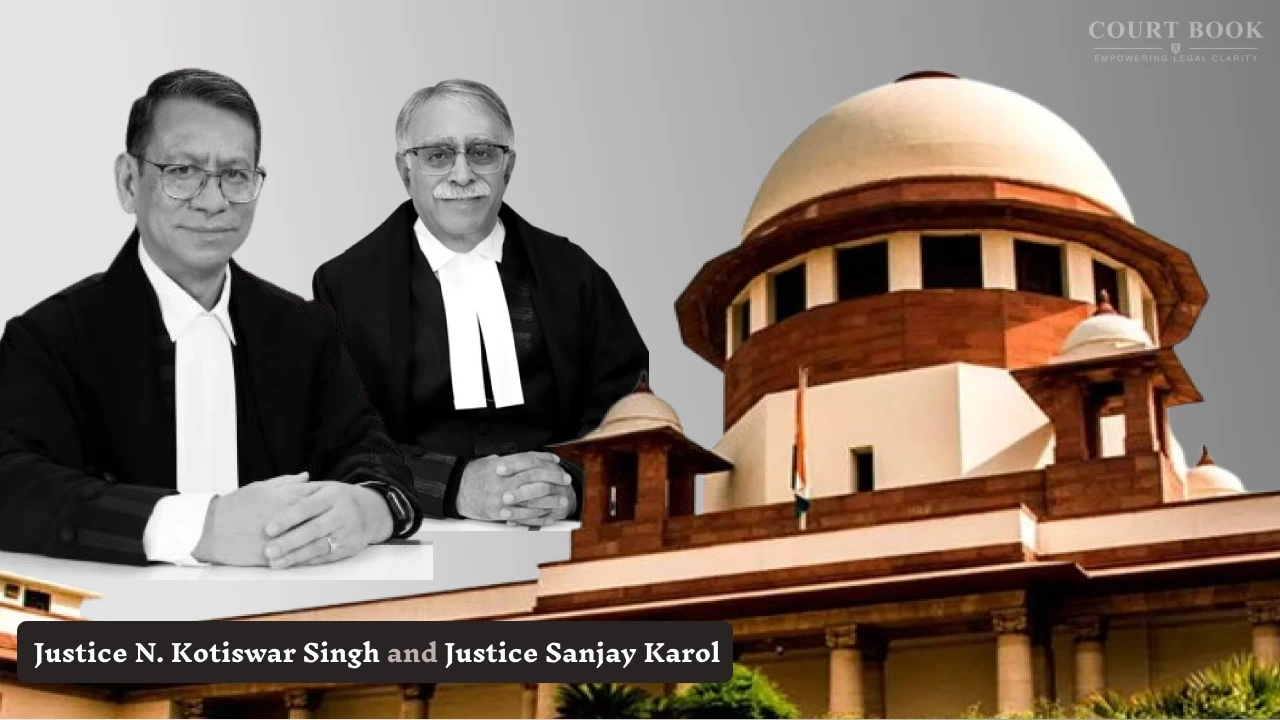
A Bench of Justice Sanjay Karol and Justice Nongmeikapam Kotiswar Singh upheld the Patna High Court's judgment affirming the acquittal of Nakul Prasad @ Nakul Yadav in the murder of Vinod Prasad.
Background of the Case
The case arose from an incident on 11 October 1998, when Vinod Prasad was allegedly shot dead while returning from Yogipur market in Nalanda district, Bihar. According to the prosecution, several accused persons intercepted the deceased and opened fire. Nakul Prasad @ Nakul Yadav was alleged to have fired a shot that struck the deceased on the right side of his chin.
The trial against Nakul Prasad was conducted separately. In December 2024, the Additional Sessions Judge-III, Hilsa acquitted him, holding that the prosecution had failed to establish the charges beyond reasonable doubt. The Patna High Court later affirmed that acquittal. The deceased's son, Sanjay Kumar, then approached the Supreme Court challenging the concurrent findings.
Court's Observations
The Supreme Court reiterated that an accused enjoys a presumption of innocence, which becomes even stronger after acquittal by both the trial court and the High Court.
The Bench observed:
"The question is not whether another view on the evidence is possible. The question is whether the view taken by the Trial Court and affirmed by the High Court is impossible, perverse, wholly unsustainable, or manifestly illegal."
The Court examined the prosecution's argument that eyewitness testimony was supported by the post-mortem report, particularly regarding the injury allegedly caused by Nakul Prasad. However, it noted that the criminal case had been built on a detailed version assigning separate gunshots to different accused, while the medical evidence did not fully correspond with that version.
According to the Bench, although one injury appeared to match the allegation against the respondent, that circumstance could not be viewed in isolation.
The judgment states:
"The criminal court cannot pick one apparently corroborated portion while ignoring other material inconsistencies."
The Court found that the High Court had rightly considered the differences between the eyewitness account, the FIR and the post-mortem findings as relevant factors while assessing whether the prosecution had proved its case beyond reasonable doubt.
Independent Witnesses and Other Evidence
The Bench also attached significance to the fact that the prosecution had cited several independent witnesses, but only two were examined during trial and both turned hostile. The remaining independent witnesses were not produced.
While observing that the non-examination of independent witnesses is not always fatal, the Court said that, in the present case, the circumstance assumed importance because the prosecution case already suffered from other weaknesses.
The Bench observed that the courts below were entitled to treat the absence of independent corroboration as a factor creating reasonable doubt.
The Supreme Court further noted that the lower courts had also considered delays in recording the statement and registering the FIR, along with certain investigative shortcomings. Although each circumstance by itself might not have been decisive, the cumulative effect of these deficiencies could not be ignored.
Decision
After examining the record, the Supreme Court concluded that the findings of the trial court and the Patna High Court did not suffer from perversity or manifest illegality warranting interference under Article 136 of the Constitution.
The Bench observed:
"The benefit of doubt doctrine is not an empty formality. Where the evidence leaves room for reasonable doubt, the court must lean in favour of the accused."
Accordingly, the Court dismissed Sanjay Kumar's appeal and affirmed the acquittal of Nakul Prasad @ Nakul Yadav, while also directing that the respondent be discharged from his bail bonds in accordance with law.
Case Details
Case Title: Sanjay Kumar v. The State of Bihar & Anr.
Case Number: Criminal Appeal No. 3316 of 2026 (Arising out of SLP (Crl.) No. 4268 of 2026)
Judge: Justice Sanjay Karol and Justice Nongmeikapam Kotiswar Singh
Decision Date: 21 July 2026