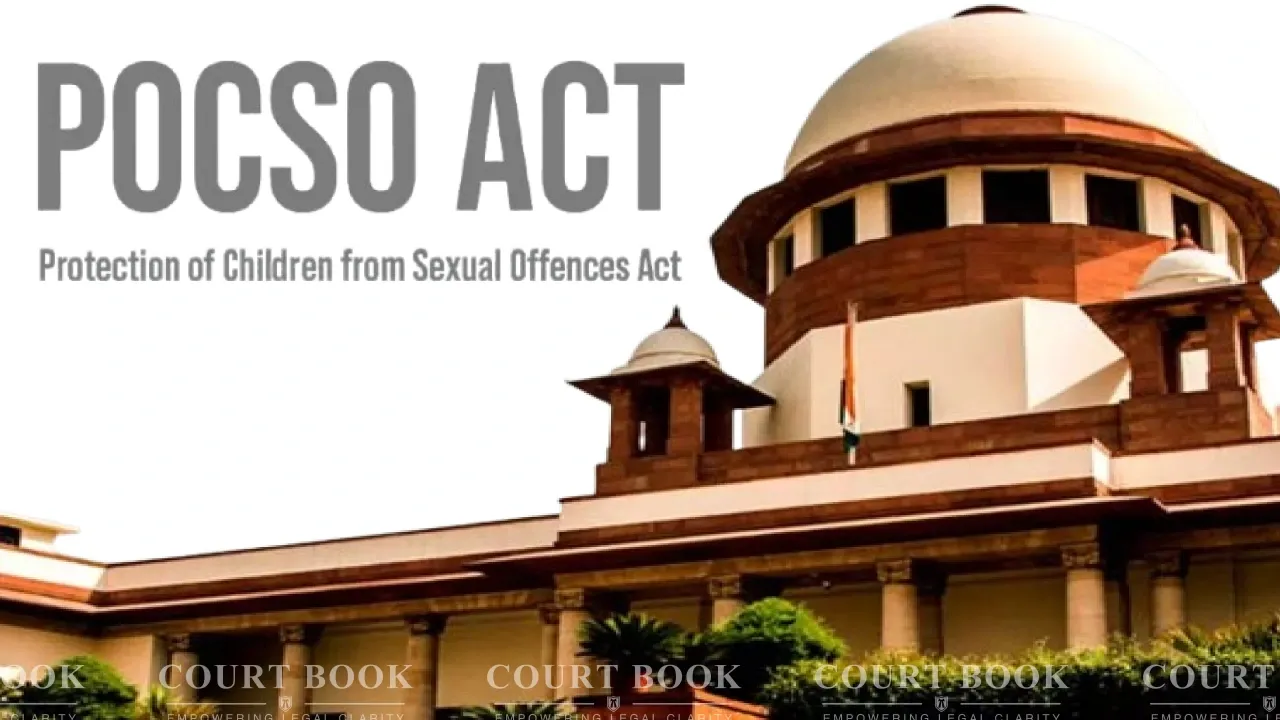
The Supreme Court has laid down detailed safeguards to prevent possible misuse of the Protection of Children from Sexual Offences (POCSO) Act in matrimonial and child-custody disputes, while stressing that the safeguards must not weaken the law’s protection for children.
A Bench of Justices J.B. Pardiwala and K.V. Viswanathan delivered the judgment on September 24, 2026, in a long-running custody dispute involving a minor child identified as ‘M’. The Court also quashed an FIR registered against the child’s father, ‘R’, and three members of his family after considering an extensive investigation conducted by the Central Bureau of Investigation (CBI).
Background Of The Case
‘R’ and ‘E’, who had married in 2011, developed serious differences from 2017. The wife left the matrimonial home with the child in April 2018. A prolonged custody battle followed, eventually resulting in orders directing custody of the child to the father, with visitation rights for the mother.
In March 2024, however, the mother lodged FIR No. 76/2024 alleging offences under Section 10 of the POCSO Act, Section 75 of the Juvenile Justice Act and several provisions of the IPC against the father and his family members. The allegations concerned alleged sexual abuse and physical mistreatment of the child.
The Supreme Court subsequently transferred the investigation to the CBI. A committee comprising CBI officers and experts from NIMHANS examined the allegations, witness statements, medical material, CCTV footage and the child’s psychological and psychiatric evaluation.
The CBI concluded that the allegations were not made out and that the matter was not fit for prosecution. After examining the CBI’s exhaustive report and the material collected during investigation, the Supreme Court held that continuing the proceedings would amount to a gross abuse of the process of law and quashed the FIR.
Supreme Court On POCSO Safeguards
The Court clarified that its safeguards would apply only when two threshold conditions are satisfied: an alleged POCSO offence against a child by a parent or another family member living under the same roof as the child, and a matrimonial dispute of some form between the child’s parents indicating a strained relationship. The police officer receiving the complaint must verify the existence of such a matrimonial dispute.
In such circumstances, the Court directed investigating officers not to act in haste or take immediate coercive action in the form of arrest after registration of an FIR. Arrest must remain governed by the statutory requirements under the Bharatiya Nagarik Suraksha Sanhita, including the requirement of a legally sufficient “reason to believe” and, where applicable, the necessity of arrest.
The Court further directed that, ordinarily, the investigating officer or Special Juvenile Police Unit should engage an expert in child and adolescent psychiatry or clinical psychology, in consultation with the District Child Protection Unit or, where unavailable, the District Legal Services Authority. The evaluation must be conducted independently and without influence from either the disgruntled parent or investigating authorities.
The Bench also made clear that the expert’s report is not binding on the investigating officer. It is only a tool to assist the investigation and the decision on coercive action. The report cannot by itself become the sole basis for filing either a chargesheet or a closure report; the investigation must continue in accordance with law.
For private complaints under Section 33 of the POCSO Act, the Court held that filing a complaint does not automatically require the Special Court to take cognizance or issue process. The Court must apply its judicial mind and determine whether there is a prima facie case and sufficient ground to proceed. In cases meeting the threshold conditions, the Special Court should ordinarily involve an expert in child and adolescent psychiatry or clinical psychology before deciding whether to proceed, subject to an exception where the material is palpable and reasons are recorded in writing.
The Court also directed that courts dealing with remand and bail in cases meeting the threshold conditions should examine whether the investigating officer complied with the statutory requirements governing arrest, including whether the strained relationship between the parents was duly considered.
The Bench further addressed the impact of POCSO allegations on custody and guardianship proceedings. It clarified that the mere registration of a POCSO case should not, by itself, create an inference that the allegation is true or become a means of defeating a parent’s legitimate claim to custody or guardianship. The concerned court must examine the relevant material and form a prima facie view on the allegations on a case-by-case basis.
The Court emphasised that these safeguards cannot dilute the protective purpose of the POCSO Act:
"What is needed is a balancing exercise: precautions that neither dilute the object of the Act nor weaken its provisions, while allowing sufficient leeway to ensure that irreparable harm is not caused to the accused."
FIR Quashed And Custody Directions Issued
After examining the CBI report, the Supreme Court quashed FIR No. 76/2024, re-numbered as CBI Case RC0352026S0003, concerning the POCSO, Juvenile Justice Act and IPC allegations against ‘R’ and his family members.
The Court also directed that legal custody of the child would rest with ‘R’. Since the child had remained in the mother’s physical custody since March 2024, the Court remitted the matter to the Family Court, Bengaluru, for a structured reintegration process with assistance from the expert committee.
The Supreme Court further directed that the safeguards laid down in the judgment be strictly followed in applicable pending investigations and specified private complaints. Copies of the judgment were ordered to be sent to the High Courts, criminal courts, State and Union Territory authorities and police stations for compliance.