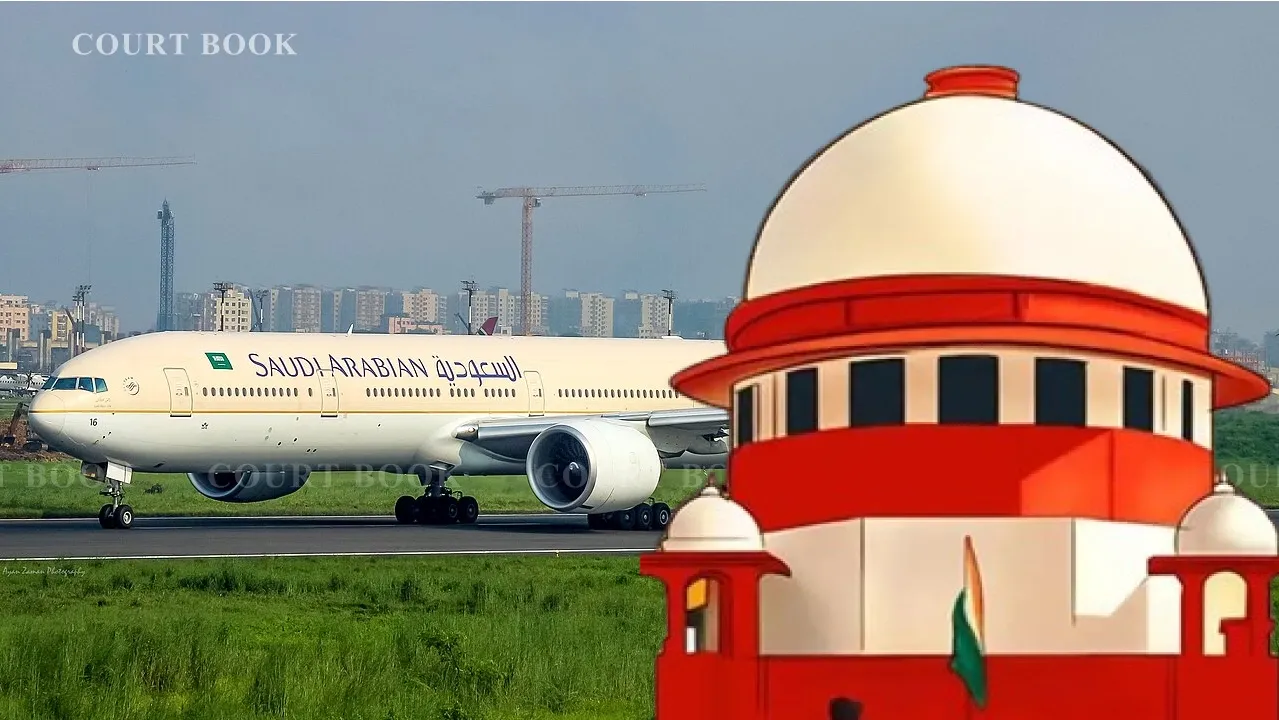
The Supreme Court has ruled that delay in depositing Foreign Travel Tax (FTT) cannot be treated as “failure to pay” the tax for imposing penalty under Section 38(3) of the Finance Act, 1979.
A Bench comprising Justice J.B. Pardiwala and Justice Ujjal Bhuyan held that the statutory scheme distinguishes between non-payment of FTT and delayed payment. The Court consequently set aside the penalty imposed on M/s. Saudi Arabian Airlines for six instances of delayed deposit of FTT.
Background of the Case
The case arose from six instances in which the airline deposited FTT after the prescribed deadline. In five instances, the demand drafts had been purchased before the due dates, but their deposit into the Government treasury was delayed by between one and 11 days. In another instance, the delay was 63 days, which the airline attributed to the concerned employee being on emergency leave.
The authorities initially imposed a penalty of ₹12,000. After the matter was remanded for fresh consideration, however, the penalty for the six delayed payments was enhanced dramatically to ₹71,29,140. The appellate and revisional authorities upheld the enhanced penalty, followed by the Bombay High Court.
Supreme Court’s Observation
The Supreme Court drew a clear distinction between non-payment and delayed payment.
The Court observed:
“Failure to pay” would mean “non-payment”. “Failure to pay” would not mean and cannot be equated with “delay in making payment”.
The Bench held that Section 38(3) applies where FTT collected from passengers is not paid to the credit of the Central Government. A mere delay in depositing the tax falls under Section 38(4), which concerns breaches of the rules made under the Finance Act.
The Court also rejected the view that penalty follows automatically whenever there is a statutory breach. It noted that the adjudicating customs officer has discretion to decide whether a penalty should actually be imposed after considering the explanation given by the affected party.
Importantly, the Court noted that Rule 4 itself allowed the customs authorities, on sufficient cause being shown, to permit a carrier additional time to deposit FTT.
Decision
The Supreme Court held that the penalty imposed on Saudi Arabian Airlines for the six delayed FTT deposits could not be sustained. It set aside the Bombay High Court judgment dated August 9, 2010, the revisional order, appellate order and de novo adjudication order insofar as they imposed the penalty.
The Court directed that any amount already paid towards the penalty be refunded with 9% annual interest within three months, and also discharged the bank guarantee furnished by the airline.
The appeal was accordingly allowed with no order as to costs.
Case Details
Case Title: M/s. Saudi Arabian Airlines v. Union of India & Ors.
Case Number: Civil Appeal No. 1052 of 2013
Judges: Justice J.B. Pardiwala and Justice Ujjal Bhuyan
Decision Date: September 1, 2026








-300x169.webp)