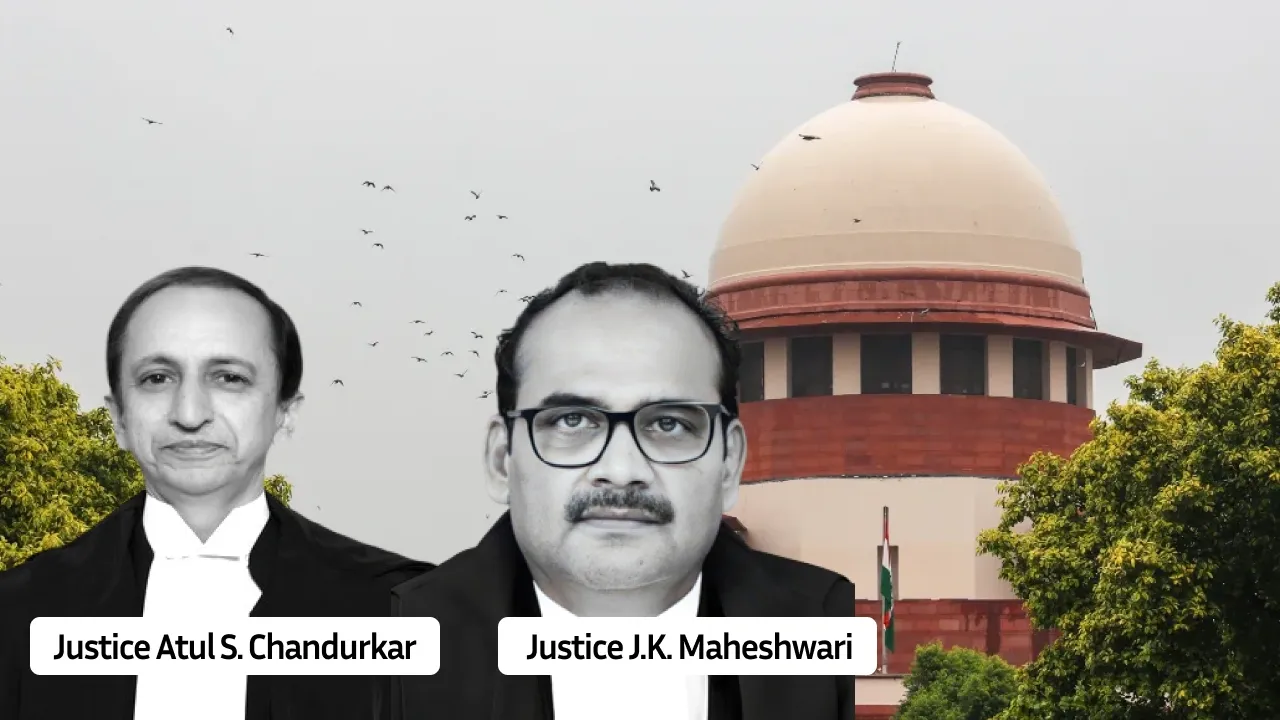
The Supreme Court has dismissed an appeal filed by Bank of Baroda and upheld the Calcutta High Court's decision setting aside the termination of a probationary Assistant General Manager. The Court held that an employer cannot use "unsatisfactory performance" as a cover to remove an employee when the real basis of action is alleged misconduct that was never subjected to a formal disciplinary inquiry.
A bench of Justice J.K. Maheshwari and Justice Atul S. Chandurkar delivered the judgment on May 29, 2026, directing the bank to grant the employee 50% back wages along with consequential benefits.
Background of the Case
The dispute arose from the termination of Ashok Kumar Singh, who joined Vijaya Bank as Assistant General Manager (Networking) on probation in January 2004. His probation was extended twice after the bank stated that his performance was unsatisfactory.
In January 2005, Singh was suspended following allegations that he attempted to remove confidential tender-related documents from the bank premises through his driver. Although the suspension was later revoked, the bank reserved its right to initiate disciplinary proceedings. However, no such inquiry was ever conducted.
In November 2005, the bank terminated his services under Regulation 16(3)(a) of the Vijaya Bank (Officers') Regulations, 1982, citing unsatisfactory performance during probation.
The Calcutta High Court quashed the termination, and the bank subsequently challenged that decision before the Supreme Court.
Bank's Arguments Before the Court
The bank argued that a probationary employee has no vested right to continue in service and that an employer is entitled to terminate such an employee if found unsuitable for confirmation.
It contended that Singh's work and conduct had been reviewed repeatedly and found unsatisfactory. The bank further argued that allegations of misconduct merely formed the motive behind the decision and were not the legal foundation of the termination order.
Court's Observations
The Supreme Court agreed that employers possess the authority to assess probationers and terminate their services if found unsuitable. However, the Court clarified that such discretion cannot be exercised arbitrarily.
"The subjective satisfaction of the Authority must be rooted in objective facts," the bench observed, adding that administrative decisions affecting employees must be supported by relevant material and remain free from arbitrariness.
The Court emphasized that probation is not a mere formality but a period during which an employee's suitability must be fairly assessed. It further noted that adverse remarks, especially those relating to integrity or misconduct, should be communicated to the employee to provide an opportunity for improvement or response.
Examination of Performance Records
The bench closely examined three internal memos relied upon by the bank to justify the employee's alleged poor performance.
Regarding a July 2005 memo concerning implementation of the Online Tax Accounting System (OLTAS), the Court noted that it conflicted with a letter from the Central Board of Direct Taxes praising the bank's performance and specifically recommending that other banks seek guidance from Singh in implementing the system.
The Court found this contradiction significant and observed that the memo could not reasonably be treated as evidence of unsatisfactory work.
Similarly, another memo relating to a delayed transfer of ₹66 crore was found to be unsupported because records showed the delay occurred due to technical issues at another bank, not because of any lapse on Singh's part.
The third memo was never communicated to Singh. The Court held that reliance on an uncommunicated adverse memo violated principles of natural justice and could not be used against him.
Misconduct Was the Real Basis, Court Finds
A key factor that influenced the Court was an internal office note showing that the bank had initially considered disciplinary proceedings based on allegations involving confidential documents and had even sought vigilance advice.
According to the bench, the record indicated that the bank ultimately abandoned the disciplinary route and instead chose to terminate Singh under the probation regulations.
"The law does not permit the use of 'unsatisfactory performance' as a disguise to bypass formal disciplinary proceeding," the Court observed.
The judges concluded that the alleged misconduct was not merely a background factor but effectively formed the foundation of the termination decision. Since no disciplinary inquiry was conducted, the termination could not be sustained in law.
Decision
Dismissing the bank's appeal, the Supreme Court affirmed the orders of the Single Judge and Division Bench of the Calcutta High Court.
The Court held that the termination order was legally unsustainable and directed that the employee be granted 50% back wages from the date of termination until his superannuation, along with all consequential benefits on a notional basis.
The bank has been directed to settle the dues within three months.
Case Details:
Case Title: General Manager, Bank of Baroda & Others v. Ashok Kumar Singh & Others
Case Number: Civil Appeal No. 4814 of 2017
Bench: Justice J.K. Maheshwari and Justice Atul S. Chandurkar
Decision Date: May 29, 2026