

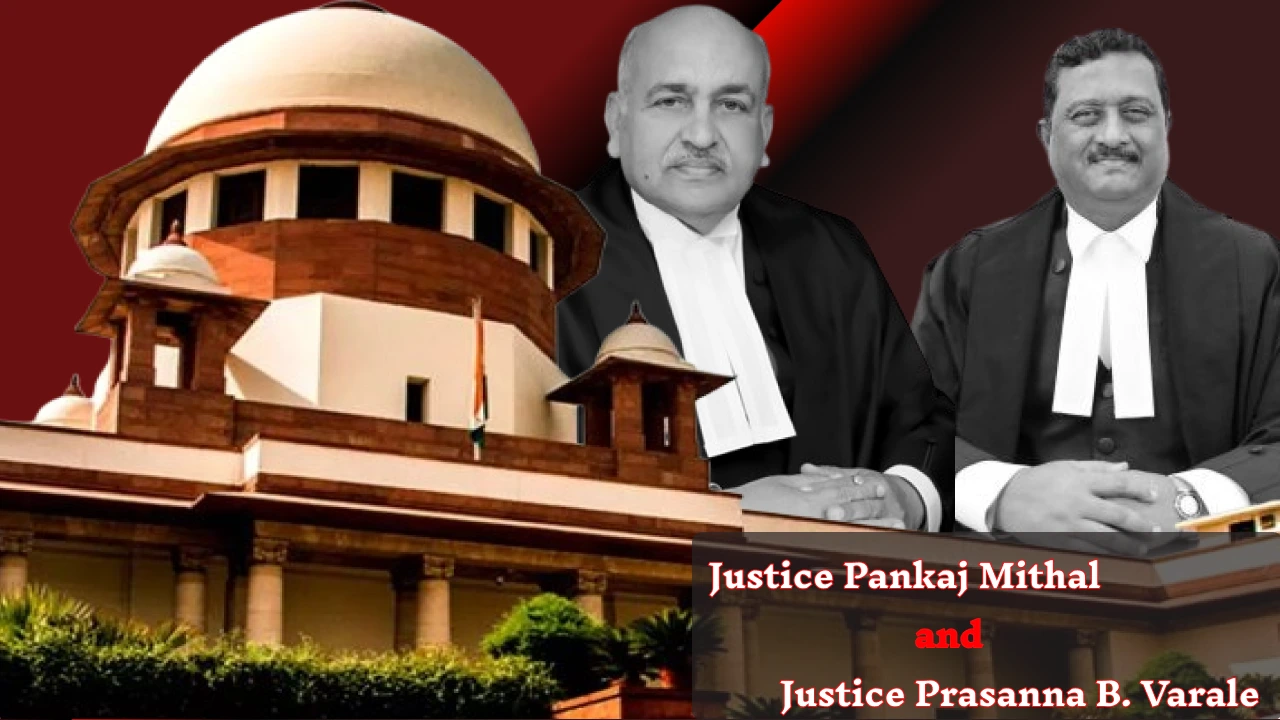
The Supreme Court has upheld the conviction of a Maharashtra man accused of murdering his wife inside their matrimonial home, ruling that the chain of circumstantial evidence clearly pointed toward homicide and not suicide.
A Bench of Justice Pankaj Mithal and Justice Prasanna B. Varale dismissed the criminal appeal filed by Chetan Dashrath Gade and affirmed the findings of the Trial Court and the Bombay High Court.
Background of the Case
According to the prosecution, Rupali Gade married the appellant in April 2012 and was living with her husband and in-laws in Nashik district. In August 2015, she was found dead under suspicious circumstances at her matrimonial home.
Her father later alleged that she had earlier complained of harassment over demands for money and gold. During the trial, the prosecution claimed that certain ornaments worn by the deceased - including an earring, anklet and toe-rings - were missing when the family saw her body at the hospital.
The Sessions Court convicted the husband under Sections 302 and 201 of the Indian Penal Code for murder and destruction of evidence. The Bombay High Court later upheld the conviction while acquitting another co-accused of murder charges.
Senior counsel appearing for the appellant argued that the case rested entirely on circumstantial evidence and there was no eyewitness or proven motive.
The defence also relied on an alleged suicide note said to have been written by the deceased, claiming it showed that nobody was responsible for her death. It was further argued that medical opinions regarding hanging and strangulation were inconsistent, entitling the accused to the benefit of doubt.
The Supreme Court, however, found no reason to interfere with the concurrent findings of the lower courts.
The Bench noted that the medical evidence strongly suggested death by strangulation. The post-mortem report recorded fracture of the hyoid bone and trachea, along with signs of asphyxia. The Court also referred to the injury marks found on the deceased’s cheek and neck.
The Court observed that the missing ornaments became a significant circumstance because “in case of hanging chance of missing these articles is very remote.”
Rejecting the defence built around the alleged suicide note, the Bench noted that the Trial Court had already found evidence suggesting the note may have been obtained forcibly before the incident.
The judges further held that the appellant failed to explain the suspicious circumstances surrounding the death, especially since it occurred inside the matrimonial home. Referring to Section 106 of the Indian Evidence Act, the Court said the burden shifted to the husband to provide a satisfactory explanation.
“The prosecution has successfully established a complete and unbroken chain of circumstances,” the Bench observed while concluding that the evidence was inconsistent with any hypothesis of innocence.
Dismissing the appeal, the Supreme Court upheld the conviction and sentence imposed on the appellant under Sections 302 and 201 IPC. The Court held that there was no perversity or miscarriage of justice in the findings recorded by the Trial Court and affirmed by the High Court.
The Bench, however, clarified that the appellant would be free to apply for premature release in accordance with the applicable state policy.
Case Details
Case Title: Chetan Dashrath Gade v. State of Maharashtra
Case Number: Criminal Appeal No. 1063 of 2021
Judge: Justice Pankaj Mithal and Justice Prasanna B. Varale
Decision Date: May 21, 2026
Download Judgment

