

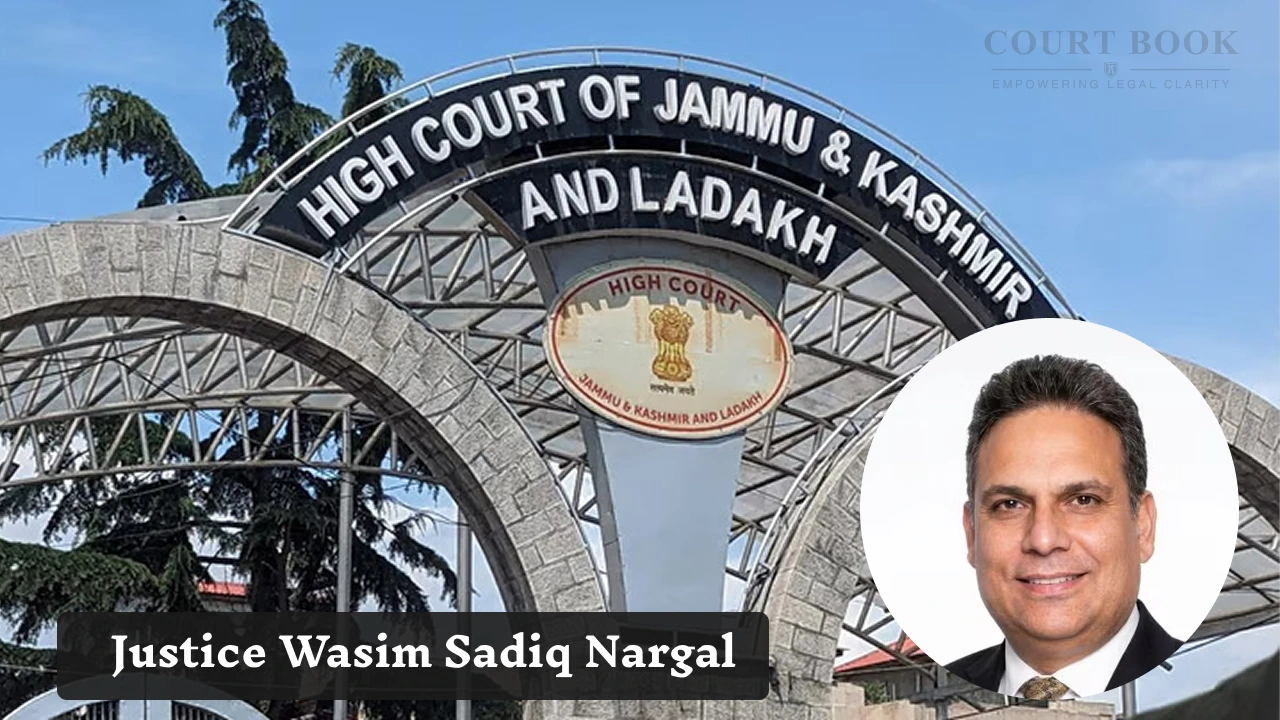
In a significant judgment touching both civil procedure and the growing use of artificial intelligence in legal research, the Jammu & Kashmir and Ladakh High Court has upheld an order directing Woodland House School, Srinagar, to comply with an interim salary payment order issued in favour of a former employee.
Justice Wasim Sadiq Nargal dismissed the school's challenge to execution proceedings initiated by the employee and imposed costs of ₹25,000, observing that judicial orders cannot be frustrated through repeated rounds of litigation.
Background of the Case
The dispute arose after Shakeel Ahmad Malik filed a civil suit claiming that he was entitled to be treated as a Supervisor and challenged the appointment of two other persons to that position. He also sought release of salary benefits.
During the pendency of the suit, Malik's services were terminated. However, on June 14, 2022, the trial court directed the school to pay him 50% of his monthly salary for the period from April 2021 to May 11, 2022. The relief was granted as an interim arrangement, subject to the employee furnishing an undertaking to refund the amount if he ultimately lost the case.
The school challenged that order before the appellate court and later before the High Court, but both challenges failed.
When the order remained unimplemented, the employee moved for its execution before the trial court.
School Challenges Execution Proceedings
The petitioners argued that the interim order was passed under Order XXXIX Rules 1 and 2 of the Civil Procedure Code (CPC) and therefore could not be executed like a decree.
According to the school, the only remedy available in case of non-compliance was proceedings under Order XXXIX Rule 2-A CPC, which deals with disobedience of injunction orders.
The petitioners also contended that a review petition against an earlier High Court order was still pending and that coercive steps such as attachment of accounts or detention of officials were beyond the trial court's authority.
Court Observations
Rejecting these arguments, Justice Nargal held that Section 36 CPC clearly extends execution provisions applicable to decrees to court orders as well.
The Court observed that the law does not limit execution only to final decrees and that interim judicial orders are also capable of enforcement.
“The legislature has used the broader expression ‘orders’, thereby indicating that certain orders of a civil court, though not amounting to decrees, may also be enforced through the process of the Court,” the bench noted.
Relying on Supreme Court precedent, the Court further held that execution proceedings and proceedings for disobedience under Order XXXIX Rule 2-A CPC are not mutually exclusive remedies.
The Court emphasized that an interim order directing payment of a specific amount cannot be reduced to a mere paper direction pending final adjudication.
“The purpose of interim relief is to afford immediate protection pending final adjudication. Such protection would become wholly illusory if the Court were rendered powerless to secure compliance with its own directions,” the judgment said.
Court Criticises Repeated Litigation
The High Court took note of what it described as a consistent pattern of resistance to compliance.
Justice Nargal observed that the interim salary order had already been affirmed by the appellate court and the High Court, yet the petitioners continued to challenge every step taken toward its implementation.
The Court remarked that judicial orders must be obeyed unless they are stayed, modified or set aside by a competent court. It held that repeated challenges to substantially settled issues undermined the principle of finality in judicial proceedings.
Warning on AI-Generated Legal Citations
In an important postscript, the Court separately examined the manner in which certain judicial precedents had been cited in the trial court's order.
The High Court found that some cited authorities contained incorrect citations and that one judgment referred to in the order could not be traced during verification.
Without interfering with the decision on that ground, the Court cautioned judicial officers against relying on unverified legal authorities.
The bench observed that while artificial intelligence tools may assist legal research, they cannot replace judicial verification.
“Any proposition of law, citation, extract, or precedent generated or suggested by an artificial intelligence tool must be independently verified from authentic and authoritative sources before being relied upon in a judicial order,” the Court said.
The Court directed that all judicial officers should ensure citations are accurate, verifiable and faithfully reflect the legal principles being applied.
Decision
Dismissing the petition, the High Court upheld the trial court's order dated October 15, 2025, directing enforcement of the interim salary relief.
The Court imposed costs of ₹25,000 on the petitioners and directed them to comply with the original order dated June 14, 2022. It further held that if compliance is not made, the executing court would be free to adopt all measures permissible under law to enforce the order.
Case Details
Case Title: Principal, Woodland House School & Ors. v. Shakeel Ahmad Malik
Case Number: CM(M) No. 191/2026
Judge: Justice Wasim Sadiq Nargal
Decision Date: June 6, 2026


