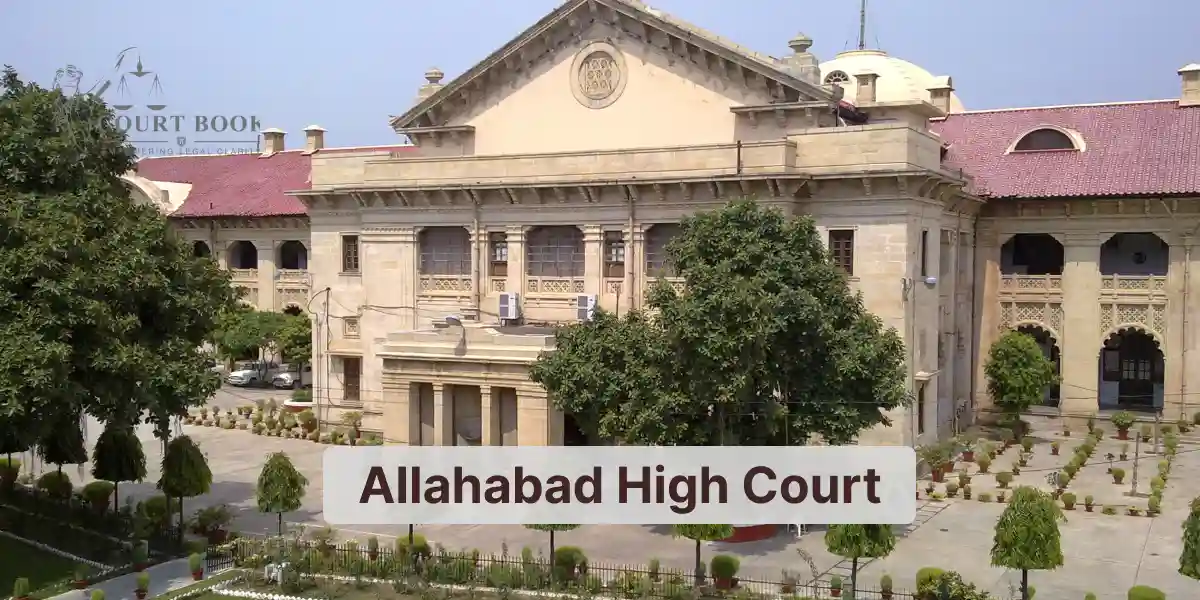
The Allahabad High Court has ruled that an insurance company cannot use a writ petition under Article 226 of the Constitution to challenge an individual compensation order passed under a government welfare scheme merely because it disputes its contractual obligations with the State Government. Dismissing a petition filed by The Oriental Insurance Company Limited, the Court upheld an order directing payment of ₹5 lakh compensation to the widow of a man who died in a road accident under the Mukhyamantri Kisan Evam Sarvhit Bima Yojna.
A Division Bench of Justice Saral Srivastava and Justice Garima Prashad held that such disputes are contractual in nature and cannot be used to delay welfare benefits granted to eligible beneficiaries.
Background of the Case
The dispute arose after the husband of respondent Smt. Rachna Singh died in a road accident on November 29, 2018. She later sought compensation under the Mukhyamantri Kisan Evam Sarvhit Bima Yojna, a welfare scheme intended to provide financial assistance to families that lose their sole earning member in accidental deaths.
The insurance company rejected the claim, contending that it had not been filed within the limitation period prescribed under the scheme. Following earlier directions of the High Court, the District Magistrate reconsidered the matter and concluded that the claimant was entitled to compensation of ₹5 lakh. The insurer then challenged that order before the High Court.
The insurer argued that the scheme operated under a Memorandum of Understanding (MoU) executed with the State Government and that the District Magistrate could not direct payment contrary to the contractual terms agreed between the parties. It also pointed out that issues relating to limitation under the scheme were already pending before the Supreme Court in another matter.
Court's Observation
The High Court drew a clear distinction between rights available to beneficiaries under a government welfare scheme and contractual rights existing between the insurance company and the State Government.
The Bench observed that beneficiaries receive their entitlement directly from the welfare scheme and are not parties to the contractual arrangement between the insurer and the government. Therefore, disputes arising out of that contract cannot be used to deny or delay compensation awarded to eligible beneficiaries.
Rejecting the insurer's reliance on contractual provisions, the Court said:
“The petitioner does not seek enforcement of any statutory or constitutional right in public law. Its grievance is essentially that compensation has been directed contrary to the contractual stipulations governing limitation, claim procedure and liability allocation under the Memorandum of Understanding.”
The Bench further clarified that while beneficiaries may invoke writ jurisdiction to enforce welfare entitlements, an insurance company cannot ordinarily use the same constitutional remedy to contest individual compensation awards based on contractual disagreements with the State.
The Court also held that the pending proceedings before the Supreme Court concerning limitation under the scheme did not affect the present dispute because this case involved the District Magistrate's determination of an individual claim rather than the validity of the scheme itself.
Court Warns Against Delaying Welfare Benefits
Emphasising the purpose of the welfare scheme, the Bench cautioned that allowing insurance companies to routinely challenge compensation orders through writ petitions would frustrate the objective of providing immediate financial assistance to bereaved families.
The Court observed:
“The extraordinary jurisdiction under Article 226 cannot be permitted to become a routine remedy available to Insurance Companies for challenging compensation determinations under welfare schemes.”
It further noted that widows and dependent family members should not be forced into prolonged constitutional litigation merely because the insurer disputes its contractual obligations towards the State Government.
Decision
The High Court held that the writ petition filed by The Oriental Insurance Company Limited was not maintainable under Article 226 of the Constitution. It also found no illegality or jurisdictional error in the District Magistrate's finding that the claim had been submitted within the prescribed period and that the beneficiary was entitled to compensation.
Accordingly, the Court dismissed the petition and directed the insurance company to release the ₹5 lakh compensation to respondent Smt. Rachna Singh within three months.
At the same time, it clarified that the insurer remains free to pursue any contractual remedies available against the State Government before the appropriate civil, commercial or arbitral forum, if advised.
Case Details
Case Title: The Oriental Insurance Company Limited v. Smt. Rachna Singh and 2 Others
Case Number: Writ - C No. 16530 of 2026
Judges: Justice Saral Srivastava and Justice Garima Prashad
Decision Date: July 31, 2026