

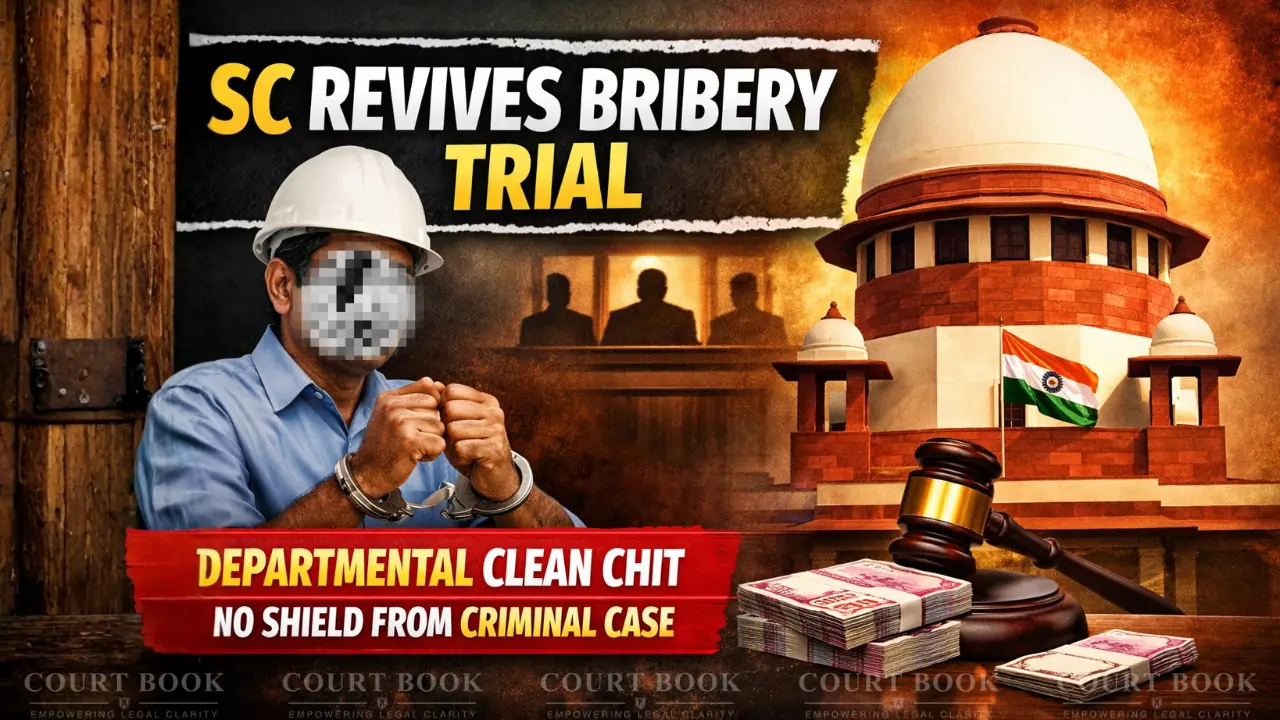
In a significant ruling on corruption law, the Supreme Court of India has held that a government employee’s exoneration in a departmental inquiry does not automatically shield him from criminal prosecution. The judgment restores a bribery trial against a Karnataka electricity department engineer, reversing a High Court order that had quashed the case.
The verdict was delivered by a Bench of Justice K. Vinod Chandran and Justice Ahsanuddin Amanullah on January 6, 2026.
Background of the Case
The case arose from a corruption complaint in Bagalkot district, Karnataka. Chandrashekar, an Executive Engineer (Electrical) with the Works and Maintenance Division of HESCOM, was accused of demanding a bribe from a contractor to clear five pending bills. According to the complaint, the demand was ₹2,000 per bill, amounting to ₹10,000.
Acting on the complaint, the Anti-Corruption Bureau (ACB) laid a trap. Marked currency notes were handed over to the complainant, who was instructed to pass them to the engineer. The trap succeeded. The notes were allegedly recovered from the engineer’s pocket, and a chemical test reportedly confirmed contact with the tainted money.
Parallel proceedings followed. The department initiated a disciplinary inquiry, while the Karnataka Lokayuktha launched criminal prosecution under anti-corruption laws.
During the disciplinary inquiry, the engineer was exonerated. The inquiry officer concluded that the charges were not proved, largely because the ACB inspector who conducted the trap was not examined, and the independent witnesses had not seen the actual exchange of money inside the office room.
Relying on this exoneration, the engineer approached the Karnataka High Court seeking quashing of the criminal case. The High Court accepted the plea, holding that when allegations fail even on the lower standard of proof used in departmental inquiries, a criminal trial demanding proof beyond reasonable doubt should not continue.
Supreme Court’s Observations
The Supreme Court disagreed sharply. The Bench reiterated a settled principle: disciplinary proceedings and criminal trials operate independently.
“The standards of proof are different, the authorities are different, and the evidence is led separately,” the Court observed.
Read also:- Bombay High Court restrains former franchisee from using Jawed Habib trademark after franchise expiry
The judges clarified that departmental inquiries are decided on the “preponderance of probabilities,” while criminal cases require proof “beyond reasonable doubt.” Failure of one does not automatically dictate the fate of the other.
Importantly, the Court distinguished between exoneration on merits and exoneration due to procedural lapses. In this case, the inquiry failed not because the bribery allegation was false, but because of gaps in how evidence was presented.
“The enquiry report does not amount to a clean acquittal on merits,” the Bench noted, pointing out that the complainant and independent witnesses had consistently supported the trap proceedings.
The Court examined the inquiry record and found that there was substantial material indicating demand and acceptance of bribe, including recovery of money and positive chemical test results.
It also underlined that criminal courts have wider powers to compel witness testimony, unlike departmental inquiries. Therefore, the absence of the ACB inspector in the inquiry could not be a ground to shut down a criminal trial even before evidence is tested.
“The criminal court must be allowed to independently assess the evidence,” the judgment said.
Read also:- Supreme Court Reverses Ex-Parte Transfer in Matrimonial Criminal Case, Sends Proceedings
The Final Decision
Allowing the appeal filed by the Karnataka Lokayuktha, the Supreme Court set aside the High Court’s order and permitted the criminal prosecution to continue.
The Bench made it clear that the concluded departmental proceedings would not be reopened. However, it added an important caveat: if the engineer is convicted in the criminal case, service rules would take effect, as already reserved by the disciplinary authority.
With this, the appeal was allowed, reviving the bribery trial against the engineer.
Case Title: The Karnataka Lokayuktha v. Chandrashekar & Anr.
Case No.: Criminal Appeal arising out of SLP (Crl.) No. 13057 of 2025
Decision Date: January 6, 2026
Download Judgment

