

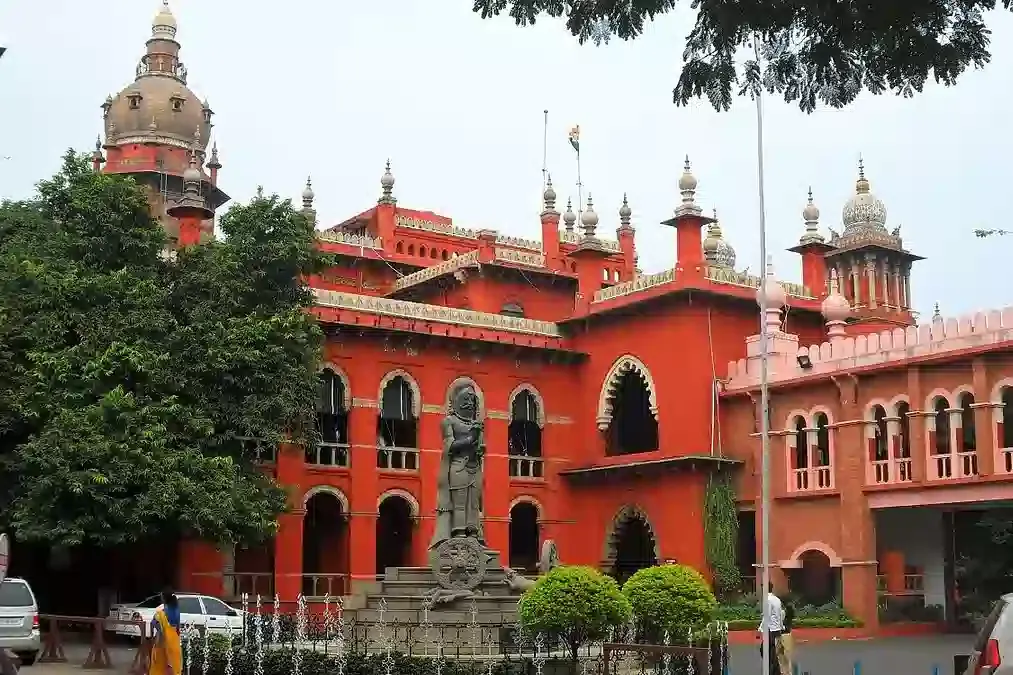
The Madras High Court has refused to interfere with the screening of the Tamil film Karuppu, observing that films, like all forms of art, enjoy constitutional protection under freedom of speech and expression.
A division bench comprising Justice G.R. Swaminathan and Justice V. Lakshminarayanan dismissed a writ petition filed by an advocate who sought a ban on the movie, claiming that it portrayed courts and the judiciary in a damaging manner.
Background of the Case
The petitioner, advocate R.S. Tamilvendan, approached the High Court seeking directions to authorities and the Central Board of Film Certification (CBFC) to prohibit the film’s release in theatres and on OTT platforms. He argued that the movie depicted judges and lawyers in a corrupt and unethical light.
The film, produced by Dream Warrior Pictures and directed by actor R.J. Balaji, revolves around a fictional court in an area called “Seven Wells”, where a corrupt judge and an unethical lawyer are shown influencing the judicial process.
At the very outset, the bench made sharp remarks about the petition itself, noting that the representation submitted by the petitioner contained several spelling and language errors. The court said the plea was “a textbook example” of people pretending to take offence over innocuous issues.
The bench firmly rejected the request to ban the movie and held that the judiciary is not immune from criticism.
“The artist is entitled to present in his own way. This is what is called artistic licence,” the court observed while emphasising that films often rely on exaggeration and dramatization.
The judges acknowledged that corruption within the judiciary cannot be denied altogether and referred to earlier Supreme Court decisions discussing the issue. However, the court clarified that portraying corruption in a fictional setting does not automatically amount to contempt of court.
The bench also relied on several Supreme Court rulings protecting artistic and cinematic expression. It observed that freedom of expression includes speech that may be uncomfortable or unpopular.
Referring to Article 19(1)(a) of the Constitution, the court said films are protected forms of expression and can only be restricted under the limited grounds mentioned in Article 19(2). Since the CBFC had already certified the movie, the High Court said it would not substitute its own opinion for that of the expert body.
The bench further stated that judges should not be treated as “holy cows” and that public debate and criticism of judicial institutions are part of a healthy democracy.
On the allegation of criminal contempt, the court noted that the movie depicted an imaginary court and not any real judicial institution. Therefore, the penal provisions of the Contempt of Courts Act were not attracted.
Concluding that no grounds existed for judicial interference, the Madras High Court dismissed the writ petition and declined to issue any direction against the film’s screening. The connected miscellaneous petition was also closed.
Case Details
Case Title: R.S. Tamilvendan v. Secretary to State of Tamil Nadu & Ors.
Case Number: WP No. 20286 of 2026
Judges: Justice G.R. Swaminathan and Justice V. Lakshminarayanan
Decision Date: 21 May 2026


