

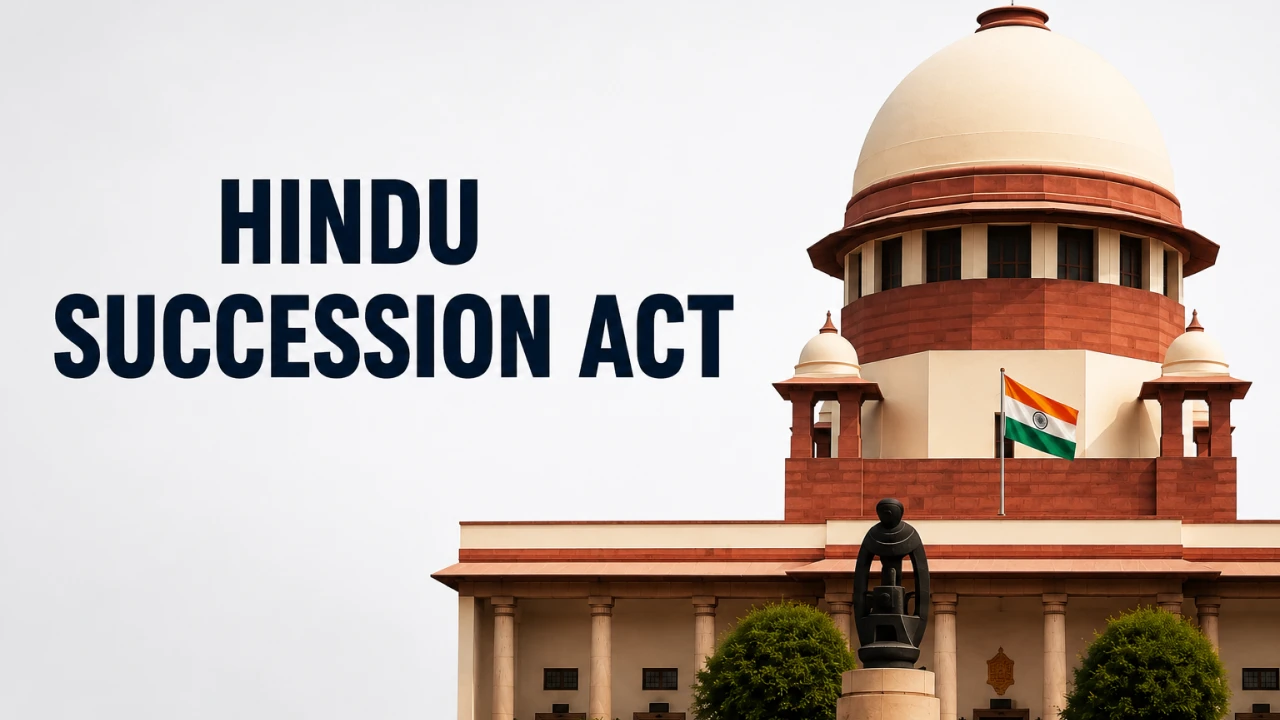
The Supreme Court has set aside a Karnataka High Court order that rejected a partition suit filed by three daughters seeking a share in their late father’s property, ruling that the case deserved a full trial instead of dismissal at the preliminary stage.
A Bench of Justice Sanjay Karol and Justice Augustine George Masih held that Section 6(5) of the Hindu Succession Act, 1956 is merely a saving clause protecting certain past partitions and cannot be treated as a legal bar to instituting a partition suit.
The dispute arose from a family property partition executed in 2000 after the death of the father, B.M. Seenappa, who had died intestate in 1985. The daughters alleged that the partition deed was executed secretly among the mother and sons without granting them any share.
Background of the Case
The daughters filed a partition suit in 2007 claiming 1/8th share each in the family properties as Class I legal heirs under the Hindu Succession Act. The defendants relied on a registered partition deed dated June 16, 2000 and contended that the daughters had no enforceable rights because the partition predated the 2005 amendment to the Hindu Succession Act.
An earlier application seeking rejection of the plaint under Order VII Rule 11 CPC had already been rejected by the Karnataka High Court in 2013. However, a second application was later filed relying on the Supreme Court’s ruling in Vineeta Sharma v. Rakesh Sharma.
What Happened During the Hearing
Before the Supreme Court, the daughters argued that the second rejection plea was barred by the principle of res judicata because the same issue had already been conclusively decided earlier. They also contended that their inheritance rights under Section 8 of the Hindu Succession Act existed independently of the 2005 amendment.
The respondents, meanwhile, argued that the 2000 registered partition deed was protected under Section 6(5) and therefore could not be reopened.
Court’s Key Observation
The Supreme Court held that the Karnataka High Court wrongly treated Section 6(5) as a complete legal prohibition against filing the suit.
The Bench observed:
“Section 6(5) is a saving clause of narrow and strict application. It does not create a jurisdictional bar to the institution of a suit for partition.”
The Court further clarified that daughters acquire rights as Class I heirs under Section 8 when a Hindu male dies intestate, and those rights are independent of the Hindu Succession (Amendment) Act, 2005.
The Bench also ruled that disputed questions regarding oral partition, family settlement, validity of the 2000 deed, and inheritance rights must be decided through evidence during trial and not at the threshold stage under Order VII Rule 11 CPC.
Court’s Decision / Final Order
Allowing the appeal, the Supreme Court restored the daughters’ suit and revived the trial court’s order refusing to reject the plaint. The Court also directed that status quo over the disputed properties will continue until further orders of the trial court.
The trial court has been asked to proceed with the matter expeditiously.
Case Details:
Case Title: B.S. Lalitha and Others v. Bhuvanesh and Others
Case Number: Civil Appeal arising out of SLP (C) No. 23709 of 2024
Court: Supreme Court of India
Bench: Justice Sanjay Karol, Justice Augustine George Masih
Date: May 15, 2026
Download Judgment

